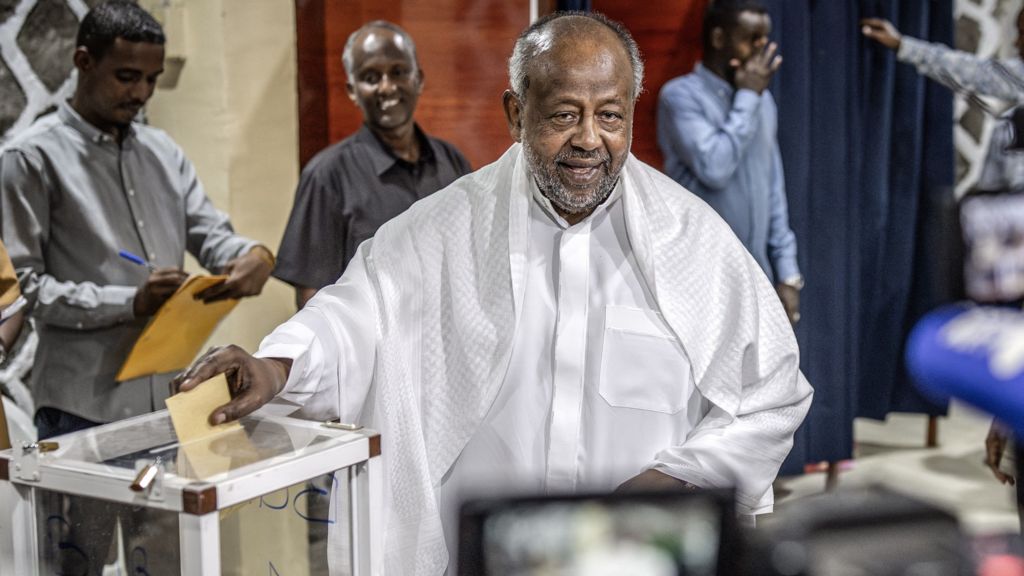
In a decisive landslide victory that cements nearly three decades of rule for the Horn of Africa nation, Djibouti’s incumbent President Ismail Omar Guelleh has won a sixth five-year term in office, preliminary official results from the country’s recent presidential election confirm. The 78-year-old leader secured a staggering 97.8% of the popular vote, with his only opponent, small-party candidate Mohamed Farah Samatar, taking just 2.19% of ballots cast.
The result was widely anticipated after most of Djibouti’s major opposition coalitions announced a boycott of the poll, repeating longstanding claims that the country does not permit free and open political competition. Leading opposition figures including Dahir Ahmed Farah have boycotted every presidential election since 2016, a pattern that held for this 2025 contest.
Samatar, who ran as the candidate of an unrepresented small opposition faction with no seats in Djibouti’s national parliament, has not issued any public response to the preliminary results as of the latest updates.
Guelleh’s ability to run for another term came after a controversial constitutional amendment passed last November. The amendment removed a 75-year age cap for presidential candidates that would have disqualified him from running; the age limit was itself introduced in 2010, when Djibouti’s parliament already scrapped the previous two-term limit for the presidency and shortened presidential terms from six to five years to accommodate Guelleh’s extended tenure. The incumbent had previously publicly pledged to step down ahead of this election cycle, reversing that promise after the constitutional change was approved.
Located on the strategic Bab el-Mandeb Strait, a critical chokepoint connecting the Red Sea to the Gulf of Aden and serving as the primary maritime gateway to the Suez Canal — one of the world’s busiest and most economically vital shipping lanes — Djibouti holds unique geostrategic importance. It hosts military bases for five major global powers: the United States, China, France, Italy, and Japan, making it a key hub for regional security and counter-terrorism operations.
During his election campaign, Guelleh centered his platform on his track record of maintaining political stability in Djibouti, a rare constant in a region marked by ongoing armed conflict and political upheaval across neighboring states and nearby Middle Eastern nations. The 78-year-old leader is only the second president Djibouti has had since it gained full independence from France in 1977, and he has already held the presidency for 27 years. He won the 2021 election by a similarly overwhelming margin.
Election officials reported that more than 80% of registered voters turned out to cast ballots in Friday’s vote. While the interior ministry has released the preliminary results, the outcome still requires formal validation by the Constitutional Council’s judiciary before Guelleh can be sworn in for his new five-year term. Celebrating his projected victory at his private residence, Guelleh framed the win as a success for the entire Djiboutian nation.