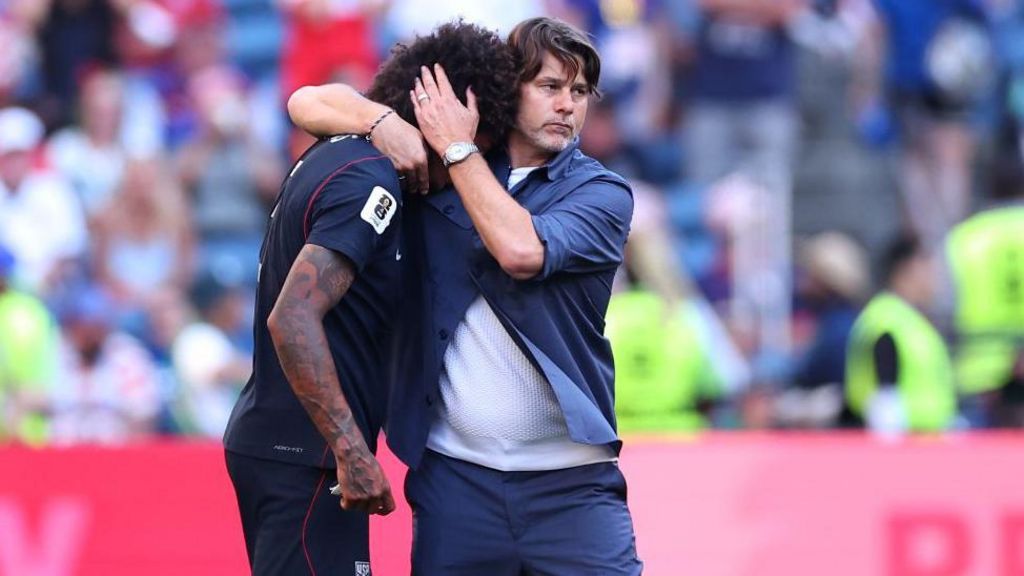
The 2026 FIFA World Cup hosted in part by the United States brought a rollercoaster of emotion for American soccer fans, as the men’s national team’s promising tournament run came to a underwhelming close on Monday with a 4-1 defeat to Belgium in the Round of 16. After a string of electric early victories that captured national attention and lifted soccer’s profile across the country, the USMNT never found its top form against a sharper Belgian side, leaving supporters and analysts reflecting on a missed breakthrough opportunity.
Heading into the knockout stage, expectations ran high for the American squad. The roster was stacked with talent plying their trade in Europe’s most competitive top leagues, and the team was led by Mauricio Pochettino, one of the most respected and high-profile coaches in global soccer. Many fans held out hope the side could match or surpass the US’s modern-era best run to the quarterfinals at the 2002 World Cup. But those hopes fell flat in Seattle, where Belgium dominated play from start to finish.
In his post-match remarks, Pochettino acknowledged his side never managed to compete at the level needed, confirming a full review and learning process would get underway to identify where the campaign went wrong. Star midfielder Tyler Adams echoed that sentiment, saying simply that the team had fallen well short of their own goals for the tournament. “We didn’t go as far as we’d like,” Adams said.
Controversy overshadowed the match even before kickoff, after US President Donald Trump intervened to ask FIFA to review a one-match red card suspension for starting striker Folarin Balogun, the team’s top goalscorer. The suspension was ultimately overturned, and Balogun featured in the match – a move that has drawn widespread criticism from soccer commentators. BBC Sport correspondent Tim Vickery argued Pochettino should have kept Balogun on the bench to defuse the off-field distraction entirely. USA Today sports columnist Nancy Armour noted that while the team’s early thrilling wins, record goal haul and unofficial anthem *Take Me Home, Country Roads* will be the first memories fans hold, Trump’s political interference will also be an inescapable part of the campaign’s legacy. “It’s too bad it ended in this trainwreck,” Armour wrote. “They deserved better.”
Analysts have pointed to a range of missteps that led to the lopsided loss. Andrew Greif of NBC News noted that the US entered the knockout round with unprecedented momentum, with a favorable draw that kept all of their early matches in Pacific time zone venues, giving them a unique home-field advantage. That momentum evaporated against Belgium, Greif observed, with the Belgian side boasting far sharper technical quality while the US undid itself with repeated unforced errors. “What will sting the US is that it may never have a better opportunity for its breakthrough,” Greif added, echoing a widespread sentiment that the 2026 co-hosted tournament represented a once-in-a-generation shot for the US to cement its status among the world’s elite soccer nations. Former USMNT player Herculez Gomez commented on ESPN that key stars turned in “terrible individual performances” at the worst possible moment, with a cascade of errors that sent the team into a psychological spiral they could not reverse. Ben Steiner of Sports Illustrated argued that all the hype and hope built over years ahead of the tournament ultimately felt wasted, as the US floundered in its first match against a top-10 ranked global side. “Instead of a glorious rendition of Country Roads with the Seattle faithful,” Steiner wrote, “the parting message of this World Cup for the USMNT is the controversy surrounding Balogun and an underwhelming performance against what many thought was a beatable Belgian team.”
Even amid the disappointment, not all reaction was negative. Many fans and analysts took a long-term view of US soccer’s growth, pointing to how far the program has come since the US last hosted the World Cup in 1994. California fan Mohammed told BBC Sport that back in 1994, the US only had a 10-team domestic league playing in half-empty rented NFL stadiums, with home national team matches that felt like away games. Today, he noted, the US boasts a thriving professional league, top talent competing in Europe, and world-class host venues like Seattle’s match stadium. “The future is bright,” Mohammed said.
Seattle-based supporters echoed that perspective, acknowledging their disappointment with the loss but emphasizing that the successful co-hosting of the tournament has already cemented the US’s status as a serious global soccer power. “It is an amazing event we have put on,” one fan told BBC reporter Gary Rose. “Everyone has been talking about the World Cup in this country.” Another fan told the New York Times that the high-quality tournament would benefit the USMNT long-term, arguing that American soccer requires patience: “It gains a little bit every year.”
Experts speaking to BBC echoed that long-term optimism, noting that the 2026 World Cup could still prove to be a pivotal moment for American soccer fandom. Record-breaking domestic television ratings and a continuing upward trend in youth soccer participation across the country set a strong foundation for future growth, even after an early exit that left a bitter taste for fans in the short term.