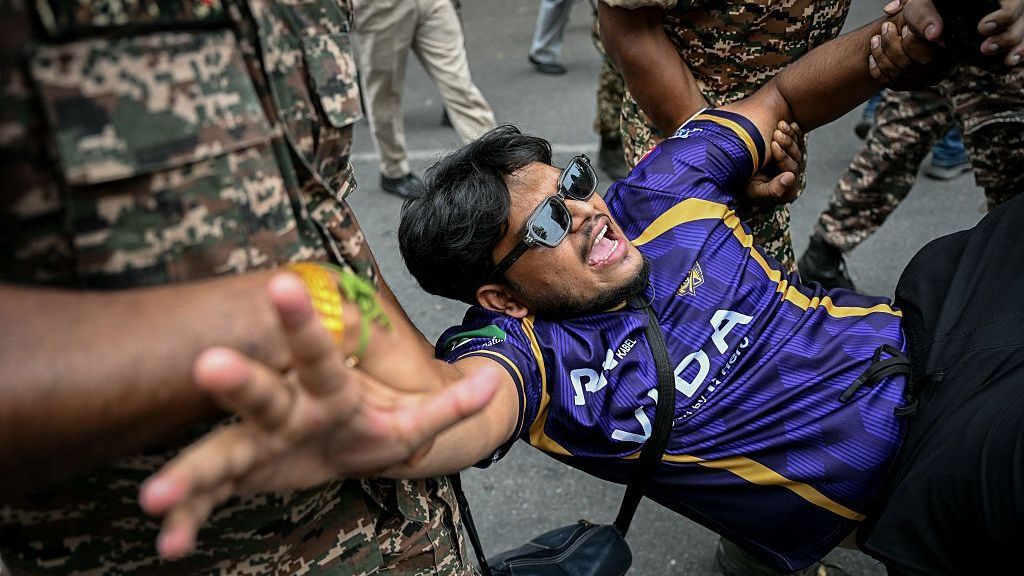
For the second consecutive day, mass detentions of demonstrators have rocked India’s national capital Delhi, as a youth-led grassroots movement continues its high-stakes protest demanding the resignation of the country’s top election official, just months ahead of critical state elections.
The Cockroach Janta Party (CJP), an unregistered Gen Z-driven protest movement that first gained national attention over summer education reform protests, has vowed it will not step back from its demands, even after key leaders were arrested within hours of arriving in Delhi on Saturday. Following their detention, the three top CJP figures – Abhijeet Dipke, Saurav Das, and Ashutosh Ranka – were released by a Delhi magistrate’s court on Sunday, on the condition that they avoid breaching public peace for one year.
In his first public remarks after release, Dipke doubled down on the movement’s commitment to protest, saying “the CJP will neither back down nor be intimidated.” He also confirmed he would travel to his home village to attend his grandmother’s funeral, who passed away around the time of his arrest. CJP leaders argue the court’s order does not restrict their constitutional right to peaceful demonstration at Delhi’s designated Jantar Mantar protest site, shifting blame for potential unrest to Prime Minister Narendra Modi, Home Minister Amit Shah, and Chief Election Commissioner (CEC) Gyanesh Kumar.
Authorities have deployed thousands of police and paramilitary personnel across central Delhi, erecting extensive barricades, closing major public venues, shutting down 45 metro stations, suspending key rail services, and restricting internet access to prevent demonstrators from reaching the planned protest site. Protesters attempting to enter the capital from out of town were removed from trains en route, and major commercial hubs like Connaught Place were forced to close for two days.
BBC reporters on the ground have witnessed widespread detentions: hundreds of protesters were still in custody as of Sunday, following the detention and subsequent release of 7,000 people on Saturday. Footage and on-the-ground accounts show small groups of demonstrators slipping past barricades before being chased, surrounded, and taken into custody by security forces, with detained protesters chanting slogans demanding Kumar’s resignation from police buses. While some rank-and-file protesters told the BBC they felt adrift without their top leadership on the ground, almost all reaffirmed their commitment to continuing the movement.
The controversy at the heart of the protest centers on an ongoing national electoral roll update being overseen by CEC Gyanesh Kumar. The Election Commission of India frames the update as a routine process to remove deceased, duplicate, or ineligible voters from the rolls, and has denied allegations of misconduct. To date, more than 130 million names have been removed from national voter lists, with tens of thousands of voters across multiple states claiming they have been wrongly stripped of their voting rights. The CJP and opposition parties accuse Kumar of manipulating the roll update to favor Prime Minister Modi’s ruling Bharatiya Janata Party (BJP), a claim both the BJP and Election Commission reject.
The Supreme Court of India intervened on Sunday to hold an emergency hearing on complaints of widespread shutdowns and arbitrary detentions. The court ordered authorities to restore cut internet services, reopen public transit including metro and rail services, guarantee free movement of civilians, and end all unlawful detentions, barring actions necessary to prevent public disorder.
The CJP movement traces its origins to a viral social media post from Dipke, a recent Boston University master’s graduate who previously worked with the opposition Aam Aadmi Party. In May, after India’s Chief Justice Surya Kant compared unemployed young people to “cockroaches” (a comment the justice says was misinterpreted), Dipke posted the question, “What if all cockroaches come together?” The post quickly went viral, tapping into widespread youth anger over unemployment, exam paper leaks, and lack of government accountability, and the unregistered movement was born.
Over summer, the CJP led five weeks of large-scale protests in Delhi demanding education reform, a demonstration that ultimately ended successfully when India’s education minister resigned in July. Today, the movement has pivoted to demanding broader electoral reform and the ouster of the CEC, marking a new chapter of youth-led political pushback in India ahead of key statewide polls.