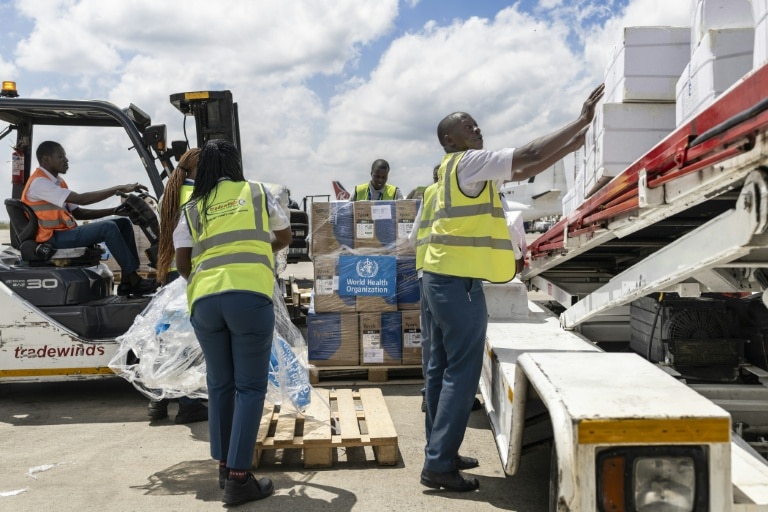
A catastrophic development in the ongoing Ebola crisis in the Democratic Republic of the Congo has seen the deadly virus cross into a new contested region, dealing a major blow to already strained international response efforts. On Thursday, a spokesman for the Rwanda-backed M23 militia confirmed that the first confirmed Ebola case has been recorded in South Kivu, an eastern province largely under the armed group’s control.
The current outbreak, which the World Health Organization (WHO) has already designated as a Public Health Emergency of International Concern, has been consistently undermined by decades of persistent conflict in the DRC’s mineral-rich eastern region, where ongoing military clashes between the Congolese national army and M23 have carved the territory into fragmented, hard-to-access zones. Backed by Rwandan military support, M23 has seized large swathes of eastern DRC since early 2025, establishing a parallel governing administration separate from the national government in Kinshasa — but the group has never before been forced to coordinate a response to a large-scale, high-mortality epidemic like Ebola.
Since the 1970s, Ebola has claimed more than 15,000 lives across the African continent. According to M23’s spokesperson, the confirmed case in South Kivu involves a 28-year-old man who traveled to Bukavu, the province’s capital that fell to M23 control in February 2025, from Kisangani, the major urban hub of neighboring Tshopo province. No cases linked to the current outbreak had previously been recorded in either South Kivu or Tshopo. Tragically, the patient died before official diagnostic testing could be completed, the spokesman added. As of publication, Congolese national health authorities have not released any official comment on the new case.
The WHO reports that this outbreak is the 17th recorded Ebola event in the DRC, a central African nation of more than 100 million people. To date, the outbreak has been linked to nearly 600 probable cases, with more than 139 suspected deaths recorded. The epidemic’s epicenter remains in northeastern Ituri province, where most cases have emerged in remote areas plagued by a tangled network of competing armed groups that restrict aid access. Prior to this confirmation, cases had only been recorded in Ituri, North Kivu, and neighboring Uganda.
Widespread access barriers have complicated the public health response: because most affected areas are cut off by conflict, few patient samples can be transported to certified laboratories for testing, meaning most official counts rely on suspected rather than laboratory-confirmed cases. Both North and South Kivu are now split by active front lines between Congolese government forces and M23 and its Rwandan backers. The critical international airport in Goma, North Kivu’s capital, which previously served as the main hub for airlifting emergency medical aid into eastern DRC, has been closed since M23 seized the city in January 2025.
Complicating the crisis further, no licensed vaccines or specific clinical treatments exist for the Bundibugyo strain of Ebola that is driving the current outbreak. While the WHO assesses the outbreak risk as very high for the DRC and the broader central African region, it classifies the risk of a global pandemic as low. The response effort is also being stretched by deep funding cuts to major humanitarian organizations, driven in large part by sweeping U.S. foreign aid reductions implemented after U.S. President Donald Trump returned to office. One of Trump’s first actions upon resuming the presidency was to withdraw the United States from the WHO, an agency he repeatedly criticized for its handling of the COVID-19 pandemic.