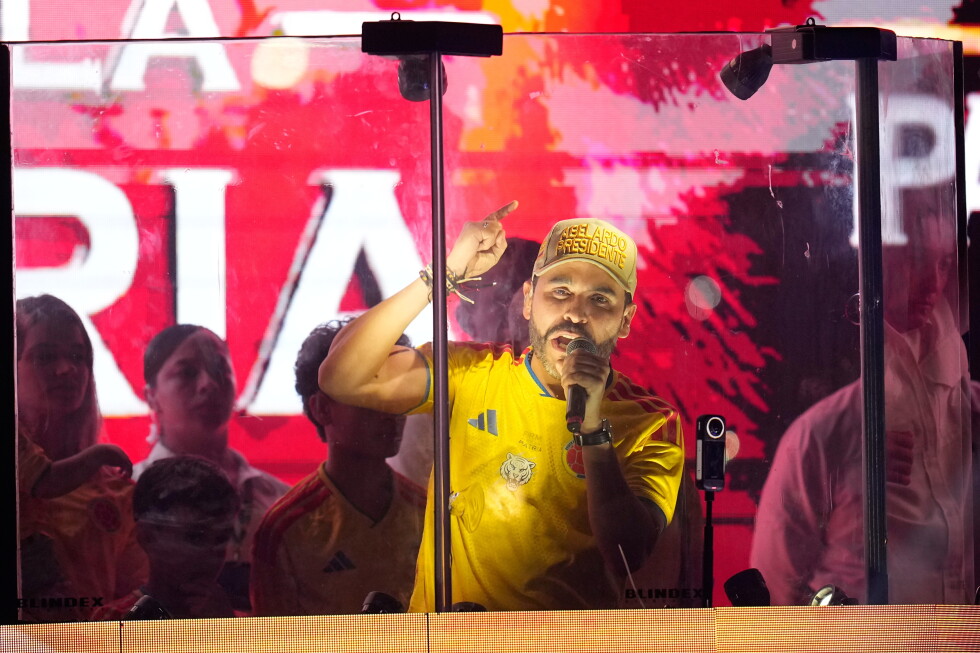
Colombia’s 2026 presidential first-round election has upended pre-vote polling expectations, as bombastic pro-Trump political outsider Abelardo de la Espriella has claimed an unexpected lead over progressive frontrunner Iván Cepeda, riding a regional wave of voter demand for hardline crackdowns on organized crime.
When final ballots were counted Sunday, de la Espriella secured nearly 44% of the vote, edging out Cepeda — the senator from incumbent president Gustavo Petro’s ruling Historic Pact coalition — who finished with less than 41%, according to official results. Cepeda had held a steady lead in public opinion surveys for months throughout the campaign, but de la Espriella surged in popularity in the final weeks of the race. The two top finishers will advance to a decisive runoff election scheduled for June 21.
Political analysts widely view de la Espriella as the early favorite heading into the runoff, noting he is positioned to pick up the bulk of support from voters who backed other conservative candidates in the first round. Sergio Guzmán, a prominent independent political analyst, called the first-round result a major public opinion shift that will be extremely hard for Cepeda to reverse. “Abelardo de la Espriella won the first round. In other words, that’s a shift in public opinion that is very difficult to overcome. So now Abelardo is emerging as the likely favorite to win,” Guzmán explained.
De la Espriella, a 47-year-old lawyer nicknamed “El Tigre” (The Tiger), has never held public office in Colombia. Before launching his presidential bid, he built a high-profile career representing controversial clients including former conservative President Álvaro Uribe and Venezuelan oligarch Alex Saab, an ally of ousted Venezuelan leader Nicolás Maduro who faces U.S. criminal charges. De la Espriella cut ties with Saab roughly seven years ago. Long based in Italy where he lived a luxury lifestyle, he has positioned himself as an anti-establishment outsider aligned with U.S. President Donald Trump, and has openly modeled his security agenda on El Salvador President Nayib Bukele’s controversial gang war.
In a final-week interview with the Associated Press, de la Espriella doubled down on his hardline rhetoric, promising to eliminate what he calls narcoterrorism, comparing targeted criminal leaders to pests, and vowing to build 10 new mega-prisons to house incarcerated gang members. “I will wipe out narcoterrorism and those who I’ve declared a military target like cockroaches, like rats. I will unleash upon them the wrath of God never seen before,” he said.
His rise aligns with a growing conservative shift across Latin America, where a rising number of candidates are embracing the “Bukele model” of aggressive security policy. Voters across the region have increasingly turned away from progressive leaders who focused on addressing the root causes of violence, such as youth economic exclusion and systemic corruption, amid widespread frustration with persistent criminal activity. De la Espriella’s support cuts across a wide swath of Colombian society: from long-time voters like 64-year-old Bogotá coffee server Yolanda Peréz, who said she planned to vote for “El Tigre” ahead of the election, to first-time 20-year-old voter Miguel Maheca, who said after casting his ballot that soft policy would not make Colombians safe. “Love isn’t what’s going to make us safe in Colombia,” Maheca told reporters.
While Bukele’s crackdown has reduced homicide rates in El Salvador, it has also sparked widespread international accusations of systematic human rights abuses. Experts warn the model is almost impossible to replicate in Colombia, a country more than 50 times larger than El Salvador with dozens of competing armed groups fighting for control of drug trafficking territories and local power.
The first-round result delivers a significant blow to Colombia’s sitting progressive government. Petro, a former rebel who won the 2022 presidential election to end decades of right-wing rule led by Uribe’s political faction, has made negotiating a “total peace” agreement with guerrilla groups and criminal gangs the centerpiece of his administration. Cepeda has run on a platform to continue Petro’s peace initiative, which has faced persistent headwinds and ongoing political opposition.
Late Sunday night, Cepeda and Petro both publicly questioned the integrity of the election results without presenting any evidence of widespread irregularities. Cepeda has framed his opponent as a throwback to the darker era of Uribe’s presidency, accusing de la Espriella of representing “a return to the paramilitary politics and drug-trafficking — a mafia-run, plutocratic and corrupt past that the country experienced during Álvaro Uribe’s two administrations.” On Monday, Cepeda issued a formal call for de la Espriella to participate in a series of public debates ahead of the June runoff.
Renata Segura, Latin America and Caribbean Program Director for the International Crisis Group, wrote Monday that the election is currently de la Espriella’s to lose. She argued Cepeda made a critical strategic error by focusing his campaign exclusively on mobilizing left-wing base voters, and that his ability to pivot to win over moderate and undecided voters in the next four weeks will determine whether he can still claim victory. The runoff comes as the Trump administration has ramped up U.S. pressure on Latin American governments including Colombia to escalate anti-crime and anti-drug operations, a shift that has reshaped political incentives across the region.