Pioneering British journalist David Willey, whose more than 50-year career as a BBC foreign correspondent spanned global conflicts, historic diplomatic milestones and five papal reigns, has died of heart failure at his adopted home in Italy at the age of 93.
Willey’s career in international news began shortly after World War II, when he joined Reuters as a trainee. One of his earliest and most consequential assignments came in 1957, when he witnessed the signing of the Treaty of Rome – the foundational agreement that created the European Economic Community, the precursor to the modern European Union. Writing on the 50th anniversary of the historic accord in 2007, Willey recalled the atmosphere inside the frescoed Roman hall where the document was signed, noting the unexpected presence of a single red-hatted Vatican cardinal among crowds of politicians, civic leaders and journalists.
After cutting his teeth at Reuters, Willey launched his freelance career with a posting to Algeria before joining the BBC full-time as East Africa correspondent in 1964. Over the following decades, he filed on-the-ground reports from some of the most high-profile global beats of the 20th century: he covered the height of the Vietnam War from Southeast Asia, and was one of the few Western journalists to report from post-revolution China. But it was his decades-long tenure as the BBC’s Vatican correspondent in Rome that cemented his legacy as one of the most authoritative journalistic voices on the Catholic Church.
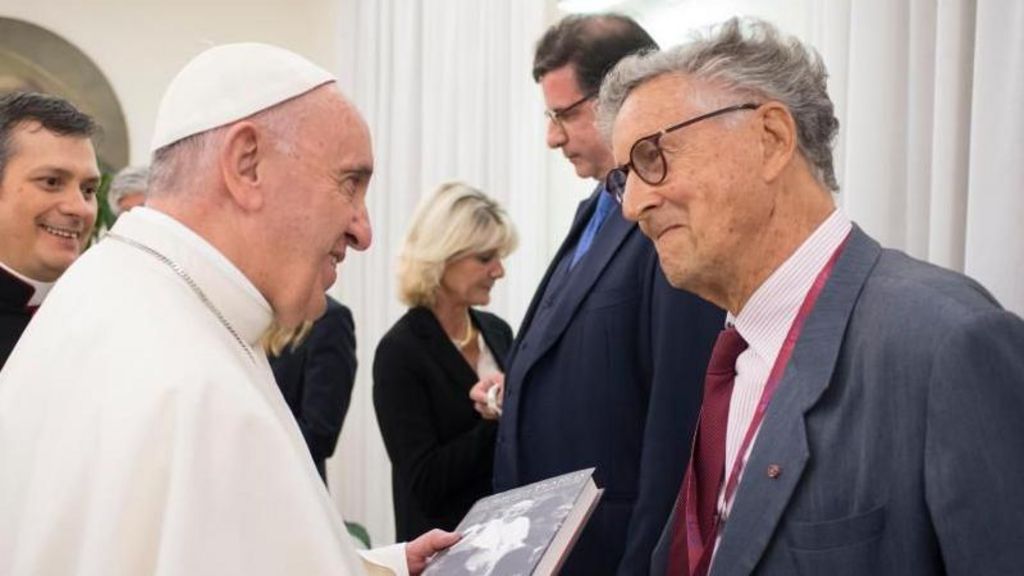
Over his decades in Rome, Willey covered the tenures of five popes, from the mid-20th century through the 2020s. One of his most high-profile assignments was the 1981 assassination attempt on Pope John Paul II, which he covered as it unfolded. He shared a 2002 flight from Bulgaria to Rome with John Paul II, and in 2016, he presented Pope Francis with a copy of his full-length book *The Promise of Francis: The Man, the Pope, and the Challenge of Change* during a private audience. Even after turning 90, Willey continued working: following the death of Pope Francis last year, he published a widely read reflection on the institutional shifts the Vatican underwent during Francis’ papacy, and met newly elected Pope Leo shortly after his appointment.
In that 2025 reflection, Willey marveled at the span of his own life and career, writing: “I have suddenly realised with something of shock that I am already not only four years older than the late Pope Francis, but that my own life now extends through no fewer than eight successive papal reigns.” He also recalled the early days of Vatican reporting in the 1950s, when journalists relied on underground connections to advance access to papal texts. He described one Easter Sunday morning, when he traveled by bus to a café opposite Vatican City’s main workers’ entrance to secretly pick up a smuggled copy of an important papal speech from a corrupt Vatican insider.
Colleagues across the industry have remembered Willey not just for his journalistic rigor and institutional expertise, but for his mentorship of younger reporters. Mark Lowen, a current BBC correspondent and presenter who began his own Rome posting in 2019, wrote that Willey was “an incredible authority on the Vatican, reporting and travelling with five Popes, and was so kind, giving me insight and encouragement when I started.”
For his decades of contributions to international broadcast journalism, Willey was awarded an OBE (Officer of the Order of the British Empire). He remained a sharp incisive analyst and generous mentor to emerging journalists until his death, leaving behind a decades-long legacy of accurate, insightful reporting on some of the most important global and religious events of the modern era.