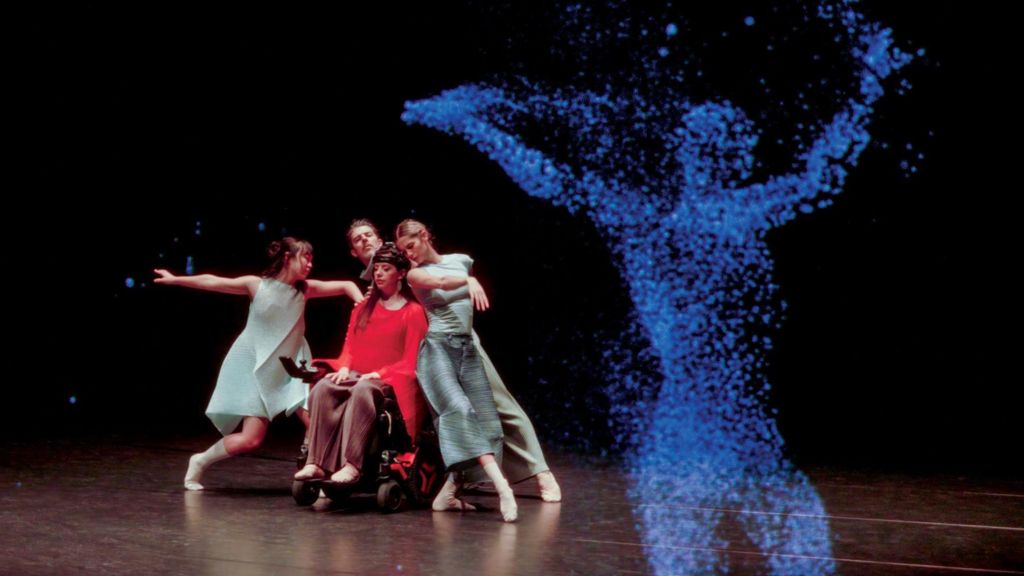
For decades, Breanna Olson, a mother of three from Tacoma, Washington, has dedicated her life to dance, training in ballet, contemporary, and jazz styles since early childhood. That identity was shattered two and a half years ago, when she received a devastating diagnosis: amyotrophic lateral sclerosis (ALS), the most common form of motor neurone disease (MND), a progressive, incurable condition that gradually weakens muscles, erodes control over movement, speech, swallowing, and eventually breathing. For Olson, the diagnosis meant losing the ability to do what she loved most — stepping onto a stage to dance.
That changed last December, when Olson made history at Amsterdam’s OBA Theatre, taking part in what organizers call the first live performance of its kind. Through a breakthrough collaboration between Japanese technology firm Dentsu Lab and data company NTT, Olson used a lightweight electroencephalogram (EEG) headset to translate her brain activity into real-time movement for a mixed-reality avatar, allowing her to return to the stage she thought she’d left forever.
The custom-built brain-computer interface developed for the project, called Waves of Will, works by capturing electrical signals from Olson’s brain as she imagines specific dance movements. The system processes these neural patterns and converts them into digital instructions, which control the avatar’s choreography live in front of an audience. After the performance, which earned a standing ovation from the crowd, Olson described the experience as nothing short of transformative.
“It was exhilarating, magical,” Olson told BBC News in an interview following the performance. “I never dreamed that I would be able to dance on stage again. It was just a beautiful and memorable moment I will remember for the rest of my life.”
Olson acknowledged that mastering the technology came with unique challenges. Users must learn to block out external sensory noise, isolate muscle interference, and focus deeply inward to generate clear neural signals for the system to read. But despite the learning curve, the performance allowed Olson to reconnect with the sense of creative expression that her illness had stolen.
“This is a new way of expression,” she said. “To be able to move in a new way and a different way is just freeing.”
Olson’s groundbreaking performance is part of a rapidly growing field of assistive technology development, where researchers and innovators are exploring how neural interfaces and artificial intelligence can restore autonomy, identity, and creative expression for people living with degenerative conditions. Earlier this year, Noland Arbaugh, the first person to receive a brain chip implant from Elon Musk’s Neuralink, reported that the device had allowed him to play chess again after losing motor control. Most recently, 58-year-old Yvonne Johnson, another person living with MND, shared how AI voice reconstruction tools helped her regain her personal voice after losing the ability to speak.
For the Waves of Will team, the project was born out of a gap in existing neural technology research. “There are many brainwave technologies and research all over the world, but most of them are very expensive and not accessible to everyone,” Naoki Tanaka, chief creative officer of Dentsu Lab, told reporters. “This is exactly why we started Waves of Will — to make a new, more accessible brainwave interface.”
Mariko Nakamura of NTT added that the core technology developed for the dance performance could be adapted for far wider uses beyond creative expression, including controlling assistive devices like powered wheelchairs and home remote controls for people with limited mobility.
For Olson, the performance is about more than just her own personal return to dance. She hopes her story will shift public perceptions of people living with disabilities, pushing back against harmful narratives that frame disabled people only through the lens of illness. “I hope people will view us less as sick people or that something is wrong with us, but more like we have value and talents and wisdom,” she said. Looking forward, she wants to use her experience to give other people diagnosed with ALS hope, demonstrating that the human mind is far more capable than many assume. “We can do more than we think we can,” she noted.
As the field of assistive neural technology continues to advance, projects like Waves of Will highlight how innovation can not only restore function for people living with disability, but also reopen doors to creative expression, connection, and participation in community life that many thought were lost forever.