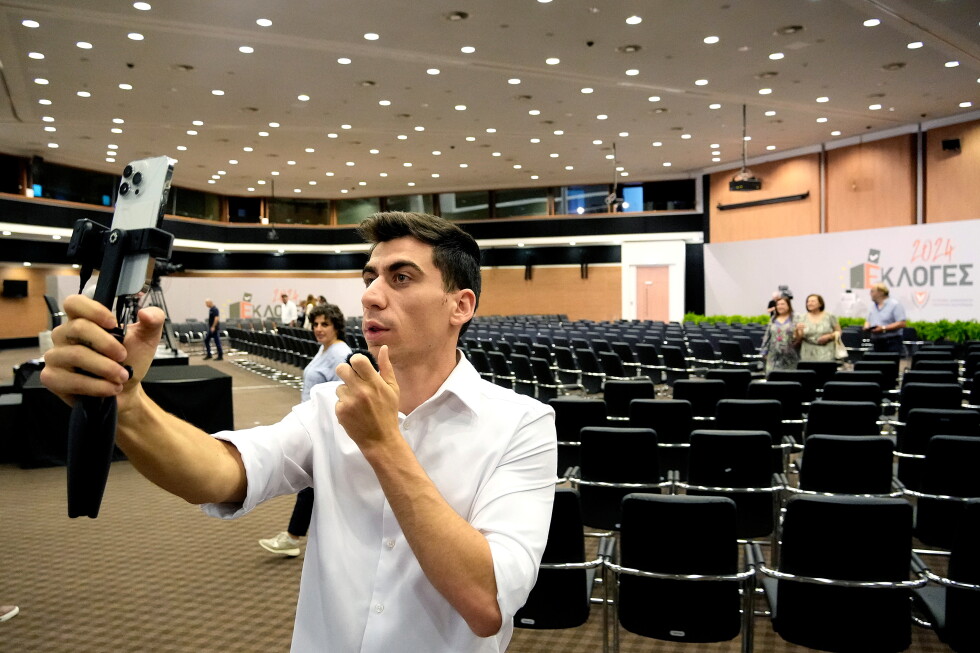
NICOSIA, Cyprus — Six months after launching a new anti-establishment political party built on his massive social media following, 26-year-old Cypriot content creator Fidias Panayiotou has announced he will retain his seat in the European Parliament instead of taking the newly won seat he earned in Cyprus’ national House of Representatives. The announcement came Monday, just one day after his upstart Direct Democracy party defied all political expectations to claim 5.4% of the national vote and four of the 56 seats in the Cypriot parliament.
Fidias, who is universally known to his online audience by just his first name, confirmed his decision to reporters ahead of the official proclamation ceremony for newly elected lawmakers. “I’ll stay in the European Parliament because it would be good for the Direct Democracy party to have a European Parliament member,” he said. “We could’ve done better but we’re happy with what has happened, this is a small victory.”
The result marks a stunning rise for a political outsider who parlayed viral internet fame into electoral success in under a year. For months leading up to Sunday’s vote, Fidias kept the public guessing about his future plans, fueling widespread speculation across Cypriot political circles. What makes the outcome even more notable is that Fidias founded Direct Democracy only half a year ago, building the party around a core promise to upend Cyprus’ decades-old, establishment political order. The party’s unique model lets ordinary citizens shape policy directly and register as candidates through an open online platform, a sharp break from traditional top-down party structures.
In Sunday’s election, Fidias earned more individual votes than any other candidate running for Direct Democracy, but he has already agreed to cede his parliamentary seat to the party’s runner-up in his district, Yiannis Laouris, clearing the way for him to remain in Brussels.
While the four-seat result is already a historic win for a brand-new political movement, it fell short of Fidias’ own high expectations. That high bar was set by his astonishing performance in the June 2024 European Parliament election, where he captured nearly 20% of the national vote — an outcome he achieved without releasing a formal policy platform, making campaign promises, or taking clear stances on key issues. After that election, Fidias argued that his broad support reflected a deep hunger among voters for authenticity over conventional politics. “It seems now that people are hungry not for political positions, but for true people that are not lying, (but) saying the truth,” he told the Associated Press shortly after the June poll.
Fidias first built his global audience of millions on YouTube and TikTok through a series of outrageous, viral stunts: videos of him spending large sums of cash while traveling in Vietnam, living for a full week inside an airport without paying, and even surviving a 10-day burial while buried alive. His big mainstream breakthrough came when he spent months campaigning to meet and get a hug from Tesla and X CEO Elon Musk — a stunt that succeeded, and earned him a new fan in the billionaire entrepreneur.
The influencer-turned-politician has openly acknowledged that his rapid political growth has been fueled by widespread anger among Cypriot voters, who have grown deeply disenchanted with the country’s traditional party system, which is widely perceived as corrupt and built on a decades-old culture of quid pro quo favors for supporters. For Fidias, his candidature and new party have become a vessel for that widespread public frustration.
As an MEP, Fidias has leaned heavily on social media to connect with his base, regularly posting content explaining the inner workings of the European Parliament, breaking down his reasoning on key votes, and responding to his growing cohort of critics. Many of those detractors dismiss Fidias and his trial-by-error approach to policy as politically inexperienced and unfit for office. He has also sparked significant controversy for his foreign policy stances: he has expressed support for opening negotiations with Russia amid its ongoing full-scale invasion of Ukraine, and has questioned the International Criminal Court’s finding that the mass deportation of Ukrainian children to Russia is unlawful.
Sunday’s national election also saw another notable shift in Cypriot politics, with the ultranationalist National Popular Front, commonly known as ELAM, making major gains. The party increased its vote share to nearly 11%, up from just under 7% in the previous election, growing its representation from four seats to eight in the 56-member parliament.