Decades after a fateful mid-1990s incident that left four people dead, the shadow of a Cold War-era tragedy has reemerged to roil already strained relations between the United States and Cuba. On Wednesday, U.S. authorities unsealed a grand jury indictment charging former Cuban president Raúl Castro and five other co-defendants with murder over the 1996 shooting down of two civilian aircraft operated by Brothers to the Rescue, a Cuban-American activist group. All four people killed in the incident, including three U.S. citizens, have remained a flashpoint between the two nations for nearly 30 years, and the charges have etched the event back into the collective consciousness of communities in both Havana and Miami.
The announcement comes amid a sharp escalation of pressure from the Trump administration, which has spent years pushing for a regime change in Cuba. The White House has repeatedly called for broad political and economic overhauls on the island, with publicly stated demands including opening the island’s economy to expanded foreign direct investment and removing Russian and Chinese intelligence assets from Cuban territory. U.S. Secretary of State Marco Rubio has framed Cuba as an ongoing national security threat to the U.S., and recently warned that the odds of reaching a peaceful diplomatic breakthrough between the two nations remain “not high.” Cuban President Miguel Díaz-Canel has already rejected the charges, dismissing them as a baseless political stunt with no legitimate legal standing.
While global headlines focus on the diplomatic firestorm, most ordinary Cubans on the island have been cut off from the full scope of the news, as the country grapples with crippling 20-hour daily blackouts that have paralyzed daily life. The prolonged power outages stem from a near-total U.S. fuel blockade that has disrupted every sector of the Cuban economy, from public services to residential living. For vulnerable residents of Havana, the crisis has upended basic routines and created life-threatening conditions.
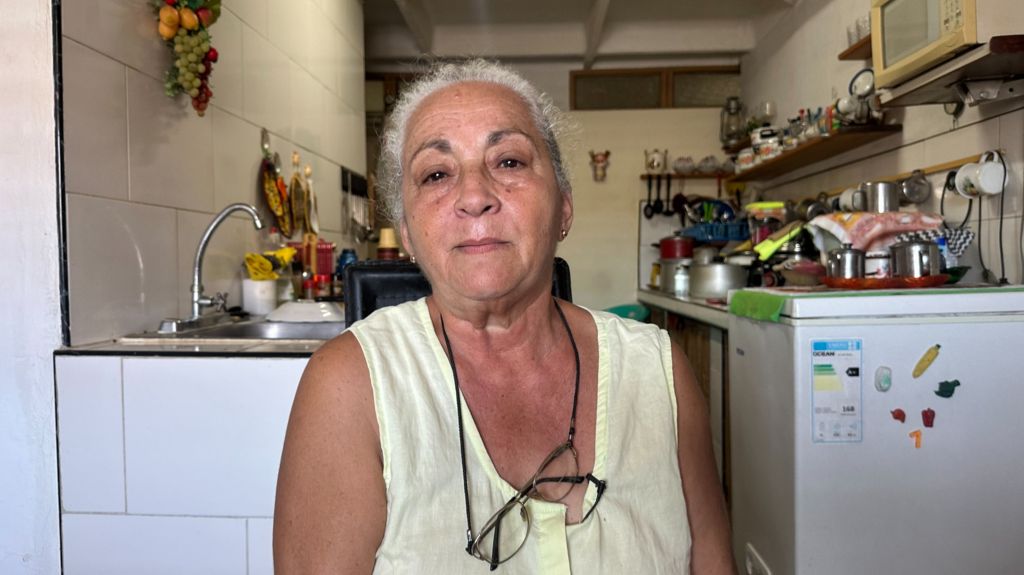
Seventy-something widow Ana Rosa Romero, a retired philosophy teacher who lives in an 11th-floor apartment in Havana’s iconic Granma Dos social housing complex, knows this hardship firsthand. When her husband passed away recently, a neighborhood blackout left her unable to arrange for his body to be moved for hours, forcing her to sit with his remains alone in the dark. These days, with the building’s elevator out of service more often than it runs, Romero says she barely leaves her small apartment. A 70-year-old woman carrying groceries up 11 flights of unlit stairs faces significant fall risks, and uncertainty hangs over every outing: no one knows when the power will cut out, or how long the blackout will last.
“ If you do venture out, it’s with the uncertainty of not knowing what’s coming next. When is the power due to go out? When is it coming back? How many hours are we going to be without electricity?” Romero says. A framed portrait of Fidel Castro hangs on her wall, a quiet reminder of the decades of political upheaval and economic pressure her country has already weathered.
Juana Garcia, the building’s superintendent, says the crisis has hit vulnerable residents the hardest. Nine tenants rely on pacemakers to regulate their heartbeats, and cannot risk being caught in a blackout without power to their devices, or trapped between floors if the elevator cuts out mid-ride. That has forced many to stay confined to their apartments for weeks on end. For six months straight, Garcia has carried or pumped fresh water up multiple flights of dark stairs for more than 100 residents, including bedridden elderly tenants who would go without water entirely without help from neighbors. “It’s dangerous to go up and down these stairs without lights. This is such a difficult situation. We know we’re going through tough times, but it’s sad to see this great building stuck in the darkness,” Garcia said. She holds out hope that the Cuban government will be able to provide solar panels to bring at least small relief to the building’s most vulnerable residents.
Elsewhere in the capital, in the Barrio Toledo neighborhood, Cuban officials are pushing forward with an innovative small-scale project to address the country’s decades-old acute housing crisis, even amid fuel and power shortages. Around 40 decommissioned shipping containers are being repurposed into fully functional two-bedroom homes, each fitted with a kitchen and bathroom. A dozen of the container units are nearly complete, with exterior shipping company logos still visible on the metal walls and new windows cut into the sides. The development will eventually center on a small community playground and a local corner store, but no residents have moved in yet as work proceeds through ongoing supply constraints.
Critics warn that the metal structures will trap unbearable heat during Cuba’s hot, humid summer months. But Orlando Diaz, the site’s foreman and a self-identified committed revolutionary, argues the adaptive reuse project is a practical, well-ventilated solution to a critical housing shortage. “This technique is already being used successfully in other countries,” he notes. “We’re just catching up.” Like many Cubans, Diaz plans to join a government-organized march this Friday to show public support for Raúl Castro and reject the U.S. charges. He describes the indictment as a “vile lie,” and points out that Washington never brought charges against late Cuban-American militant Luis Posada Carriles, who Cuba has long accused of orchestrating the 1973 bombing of a Cuban airliner that killed 73 people.
When asked if he believes the indictment could be a precursor to U.S. military action, similar to the January removal of Venezuelan President Nicolás Maduro by U.S. forces, Diaz is unyielding. “Venezuela is Venezuela, but Cuba is Cuba,” he says defiantly. “And here we don’t lack the necessary courage to face this moment.”
Back on her 11th-floor balcony, Ana Rosa Romero gazes out across Estadio Latinoamericano, the iconic baseball stadium where just over a decade ago she watched then-President Barack Obama and Raúl Castro sit side by side at an exhibition game, a moment that raised hopes of a long-term thaw in U.S.-Cuba relations. Today, she contemplates the prospect of U.S. military intervention on her island, and speaks with the quiet resolve of a person who has lived through generations of crisis. “At my age, I know I’m going to die in Cuba,” she says matter-of-factly. “We’ve faced so many things over the years. And if now we have to face an invasion, then I guess we’ll face that too.”