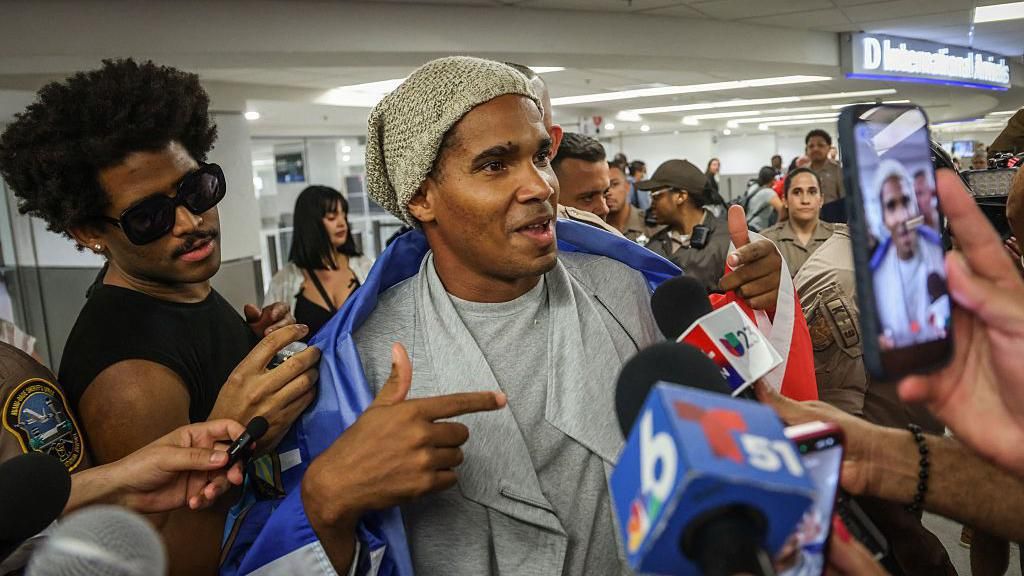
After serving five years behind bars in Cuba, one of the Caribbean nation’s most high-profile government critics has arrived in the United States to begin a life in exile. Thirty-eight-year-old Luis Manuel Otero Alcántara heads the San Isidro Movement (SIM), a collective of artists, independent journalists, and intellectuals that has spent years organizing grassroots campaigns for expanded freedom of expression and democratic governance in Cuba, a one-party communist state.
Otero Alcántara was first taken into custody in 2021, amid the largest anti-government demonstrations Cuba had seen in more than 30 years. For his entire sentence, he was incarcerated at the maximum-security Guanajay prison facility on the outskirts of Havana. In the days leading up to his departure, his location remained undisclosed as Cuban officials processed his release while U.S. authorities reviewed and approved his parole application.
When he stepped out into the public terminal at Miami International Airport, Otero Alcántara was met by a crowd of cheering supporters who sang the Cuban national anthem in welcome. The dissident held up his hand, curving his thumb and forefinger to form the shape of the letter L – a well-known anti-government symbol that stands for “Libertad,” the Spanish word for freedom. Speaking to reporters shortly after his arrival, Otero Alcántara made clear his criticism of the Cuban government would not end with his exile. “I believe the dictatorship has to end, and the Castro dynasty has to end, as well,” he said. “Because as long as there is a Castro in power, there will be corruption.”
Cuban authorities have long alleged that the San Isidro Movement receives direct funding from the U.S. government and operates as a front to destabilize the Cuban state – claims the movement and its members uniformly reject. SIM organizers say their members are routinely targeted by Cuban security forces, with many subjected to arbitrary detainment and harassment for their activism.
The 2021 protests that led to Otero Alcántara’s arrest saw hundreds of demonstrators taken into custody across the island, and the case of the dissident leader and his SIM colleague Maykel Castillo, a musician better known by his stage name Osorbo who is currently serving an eight-year prison sentence, has been a persistent flashpoint in diplomatic relations between Washington and Havana.
Tensions between the two nations have spiked sharply in recent months under the current U.S. administration, which has imposed a full oil blockade on Cuba, expanded sweeping economic sanctions, and issued open threats of potential military intervention. Just last week, CBS News, the U.S. news partner of the BBC, reported that Pentagon officials had held internal briefings reviewing potential military options for action against Cuba, though the report emphasized that the discussions did not indicate a final decision to launch an operation had been made.
The U.S. oil blockade has deepened an already severe national fuel crisis on the island, pushing Cuban communities to face extended daily power blackouts and worsening widespread food shortages. In May, the U.S. further escalated hostilities by issuing an unprecedented murder indictment against former Cuban leader Raúl Castro, connected to the 1996 downing of two private aircraft operated by a Cuban exile group, an incident that killed four people. The indictment drew immediate condemnation from both Russia and China, which reject U.S. interference in Cuban sovereign affairs.
Economic strain from the ongoing sanctions has also hit Cuba’s critical tourism sector hard. Official data from Cuba’s National Office of Statistics and Information (Onei) shows that fewer than 360,000 international tourists visited the island in the first five months of 2026, a nearly 60% drop from the same period in 2025. In comments following Otero Alcántara’s release, U.S. Secretary of State Marco Rubio doubled down on Washington’s stance, calling the Cuban government’s 2021 crackdown on protesters a reminder of “the unique misery and evil that is innate to the communist system.” He added that Otero Alcántara’s only offense was “refusing to stay silent and using his art to demand the basic freedoms everyday Cubans have been denied for almost seven decades.” U.S. officials have repeatedly stated that a peaceful negotiated agreement with Cuba is unlikely under current conditions.