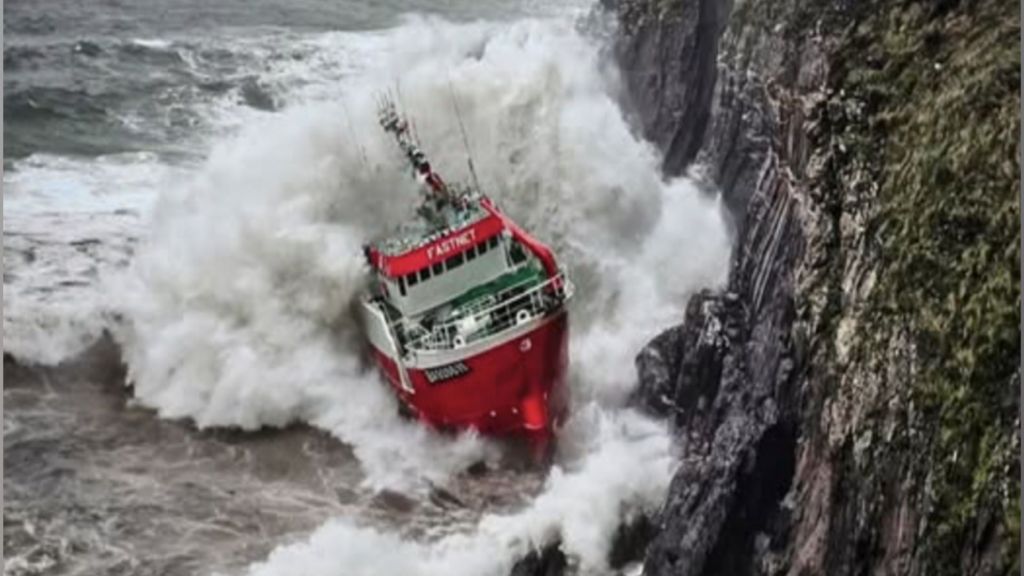
After nearly three decades of plucking stranded people from dangerous waters along Ireland’s rugged coastline via helicopter rescue, Jim O’Neill believed he had encountered nearly every possible crisis a rescuer could face. That perspective shifted dramatically, however, when a desperate emergency call came in just days before Christmas.
The call brought word of a French fishing vessel, the *Fastnet*, carrying a 14-member crew that had run aground on jagged rocks off County Kerry after suffering sudden engine failure while departing Dingle Harbour. Near gale-force Atlantic winds and towering, powerful waves had driven the vessel onto the rocks, leaving the boat at constant risk of capsizing or breaking apart completely, and the crew trapped at the mercy of the churning, unforgiving ocean.
The emergency mobilized a large multi-agency response, with O’Neill and the rest of the crew from Irish Coastguard Rescue Helicopter 115 at the center of the operation to pull the 14 fishermen to safety. For O’Neill, a native of Strabane, County Tyrone, the mission stood out as the most challenging rescue of his entire 30-year career – an incident that could easily have ended in one of Ireland’s worst modern maritime tragedies.
“Going into it, we had no way of knowing how it would turn out. By the nature of the situation, we knew it was extremely high risk,” O’Neill explained in a post-rescue interview. “Success was never guaranteed or certain from the start.”
When Rescue 115 arrived at the incident site, O’Neill quickly confirmed the full scope of the danger facing the stranded fishermen. The *Fastnet* was being pounded by massive waves on one side and bashed repeatedly against the sharp rocks on the other, with visible damage already starting to split the vessel’s hull. Compounding the hazard, leaking diesel from the boat’s damaged engine was already spreading toxic pollution across the surrounding water, adding another layer of risk for rescuers.
Multiple emergency partners joined the response: RNLI lifeboat crews, Irish Coastguard land teams, the Irish Navy, and local commercial fishing vessels all contributed to the operation. Because the *Fastnet* was stuck on rocks in shallow waters, the larger lifeboats and supporting vessels had to hold position in deeper, safer water offsite, leaving the helicopter crew to lead the extraction via winching.
With the helicopter hovering steadily above the battered fishing vessel, O’Neill was lowered down to the deck by his crew. Over the course of 50 grueling minutes, he navigated the slippery, unstable deck to locate all 14 crew members and prepare them for winch extraction, one by one. He deliberately stayed on the damaged vessel until every fisherman had been pulled to safety, leaving himself as the final person to be rescued.
“The biggest challenge for me on deck was making sure I didn’t slip and fall hard, or get swept overboard by the waves,” O’Neill recalled. “I knew if I ended up in that rough sea, I didn’t stand much chance of surviving. Once I got all 14 men up to the helicopter, it hit me that I was the only one left. It was a great feeling to have gotten them all out, but it was also incredibly scary – I knew I still had to get myself recovered.”
Months after the successful rescue, O’Neill was formally recognized for his extraordinary courage at a ceremony held at the UK House of Commons, where he received the prestigious Billy Deacon Memorial Award. The award honors winch operators and winch paramedics who demonstrate exceptional bravery and meritorious service during search and rescue operations, and it carries deep meaning as a tribute to a fallen rescuer.
The award’s namesake, Billy Deacon, was a HM Coastguard winchman who lost his life in November 1997 during a rescue off the Shetland Islands. Deacon had safely extracted all crew members from the stricken cargo vessel *Green Lily*, and was the final person waiting for extraction when he was swept overboard by a large wave. He was posthumously awarded the George Medal for his “outstanding courage and bravery”, and the annual award bearing his name preserves his legacy.
In its citation, the award committee praised O’Neill for completing the extraordinarily demanding rescue “with calm professionalism, despite considerable personal risk.” The committee also extended praise to O’Neill’s fellow Rescue 115 crew members: Captain Robert Goodbody, co-pilot Paraic Slattery, and winch operator Eamon O’Broin, noting their outstanding teamwork, communication, and steady leadership under extreme pressure.
The committee added that O’Neill displayed “magnificent leadership skills” in organizing the 14 fishermen for evacuation, prioritizing their safety above his own even as the risk of the vessel breaking apart grew. “His courage in the face of adversity had a direct bearing on the successful outcome,” the citation read.
Along with the trophy, O’Neill received an inscribed watch from RNLI chief executive Peter Sparkes, with all members of the Rescue 115 crew in attendance at the London ceremony to celebrate the honor. Speaking after the event, O’Neill said he felt deeply honored to receive an award that commemorates Deacon’s sacrifice, and he used the moment to share an important safety message for anyone working or recreating along Ireland’s coastlines.
“It’s important that people are vigilant and prioritize safety,” he said. “They can still go out and enjoy the coastal environment, but they just need to be careful about their choices, think through their actions, and remember what the outcome could be if they take unnecessary, foolish risks.”