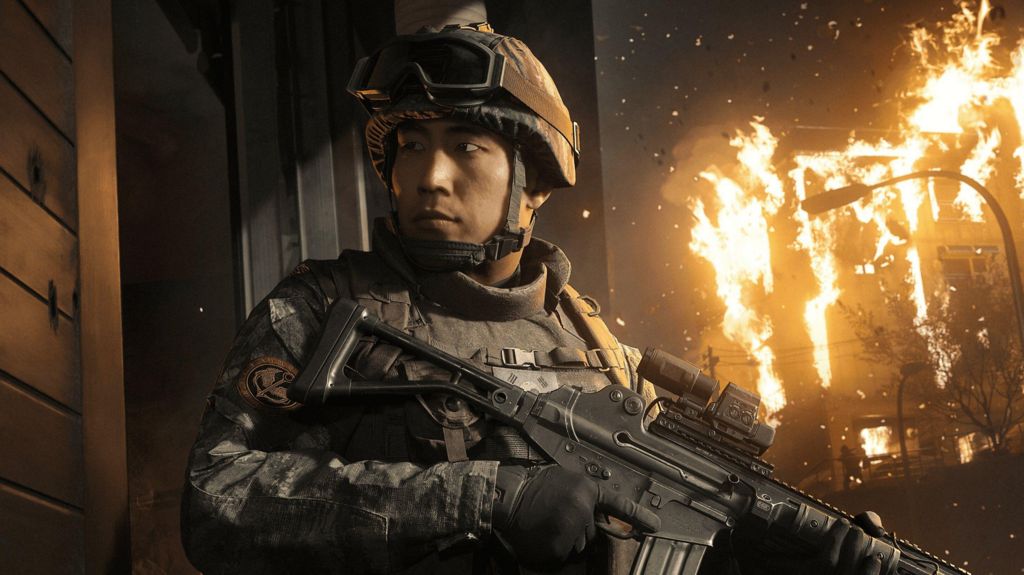
One of the gaming industry’s most anticipated annual releases has officially been unveiled, and the upcoming mainline entry in Activision and Infinity Ward’s blockbuster Call of Duty franchise is already drawing global attention – and heated discussion – over its core narrative premise. Slated for a worldwide launch on October 23, *Modern Warfare 4* centers its single-player campaign around a fictional resumption of full-scale armed conflict on the Korean Peninsula, following South Korean service members as they defend against a large-scale invasion from the North.
The game’s reveal trailer, which racked up nearly 22 million views in just 24 hours after its debut, opens on a group of young South Korean conscripts conducting what looks to be a routine border patrol. The calm is quickly shattered by an incoming missile strike from North Korea, plunging the characters into all-out war. Alongside the Korean Peninsula-focused campaign, the title will also bring back one of the franchise’s most beloved characters, Captain Price, who will appear in multiple missions set across major global cities.
Notably, this release marks a historic milestone for the Call of Duty franchise: it will be the first core mainline entry to skip last-generation consoles, the PlayStation 4 and Xbox One, launching exclusively on current-generation consoles, PC, and the newly released Nintendo Switch 2.
As one would expect for a new Call of Duty drop, the announcement has already become a global viral cultural moment. Posts across major social platforms including Instagram, TikTok, X (formerly Twitter), and Facebook have generated more than 3 million user interactions in the first full day after the reveal. Reaction to the conflict setting has been deeply divided, particularly among Korean audiences.
Many South Korean players have welcomed the choice to center the narrative on ordinary South Korean conscripts rather than framing the conflict through a foreign, Western perspective. Online reactions from Korean fans have leaned enthusiastic in many cases. One commenter noted that the character designs and in-game locations captured an authentic Korean atmosphere, saying “I’m genuinely excited.” Another shared that they initially expected South Korean troops would only be background extras, writing: “Then I heard they’re not just present but one of the playable protagonists? And not even special forces, handled from the perspective of an ordinary conscripted soldier, that’s what gets me.” Some even described the inclusion of Korea as a core setting for one of the world’s biggest gaming franchises as a landmark “symbolic moment.”
However, academic experts and industry analysts warn the narrative choice could spark significant controversy, arguing that the franchise is turning a still-ongoing unresolved conflict into mass-market entertainment. The Korean War ended in 1953 with only an armistice agreement, not a formal peace treaty, meaning North and South Korea remain technically at war.
Dr. Sarah Son, Senior Lecturer in Korean Studies at the University of Sheffield, explained that while fictional renewed inter-Korean conflict is not an unheard-of premise in South Korean popular culture, a global blockbuster franchise will face different standards of scrutiny. “It could be controversial, because it turns still-unresolved war into entertainment,” she said. “A global gaming franchise might be judged differently” than domestic Korean productions that explore similar themes.
George Osborn, author of *Power Play: Video Games, Politics and the Battle for Global Influence*, told media the setting is almost certain to draw close examination in South Korea, pointing to previous video games that faced official pushback for their portrayals of the Korean Peninsula. The 2011 title *Homefront*, which depicted a unified Korea under Northern rule, was banned entirely in South Korea. Osborn warned that the development team will need to demonstrate extreme care in how it handles the conflict to avoid backlash. “The studio will have to show that it has handled possible conflict in the country with great care, or face significant backlash – and possible challenges selling the game – in South Korea specifically,” he noted.
This is not the first time the *Modern Warfare* subseries has courted controversy for its portrayal of real-world inspired conflict. Past entries have sparked widespread public debate over the boundaries of realistic depictions of war in gaming, including the infamous 2009 “No Russian” mission that allowed players to participate in a civilian mass shooting at a Moscow airport, alongside later depictions of war crimes and terrorism.
Beyond the controversial narrative setting, Infinity Ward has also announced a slate of major gameplay updates for the new entry. These include completely revamped movement mechanics, more destructible and interactive in-game environments, an overhaul of the fan-favorite extraction-style multiplayer mode DMZ, and a brand-new “Frontlines” system designed to make large-scale battles feel more dynamic and responsive to player actions than ever before.