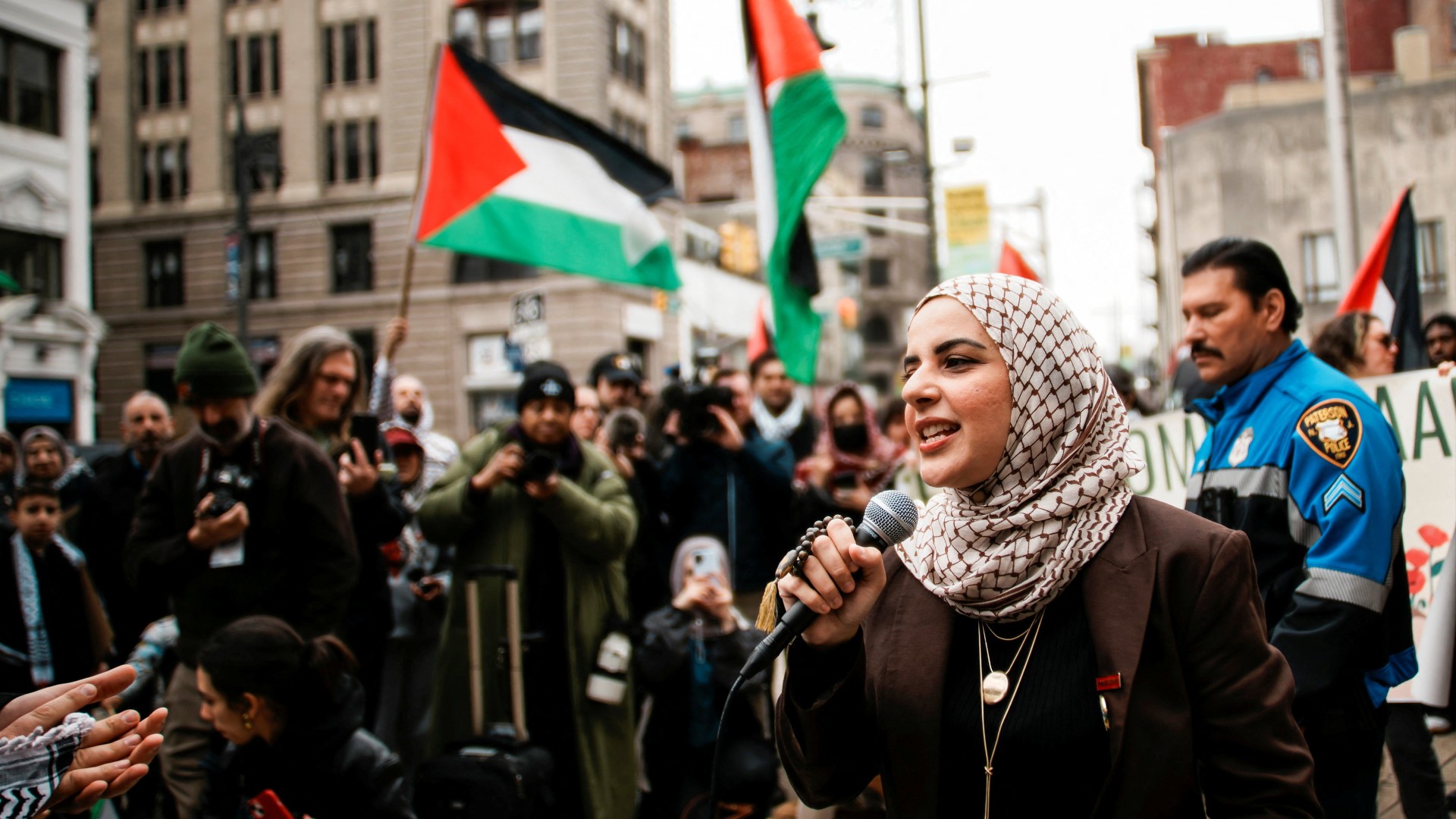
Six months after securing her release from 12 months of U.S. Immigration and Customs Enforcement detention, 33-year-old Palestinian activist Leqaa Kordia is confronting a debilitating new health condition that never existed before her incarceration: repeated, unrelenting seizures. Her most recent episode, the fifth since her March 2026 release, struck Sunday shortly after she returned home from speaking at a panel hosted by New York City’s Riverside Church. Kordia, who was in prayer and still dressed in her prayer garments when the seizure hit, described the harrowing experience in an Instagram statement shared Monday.
“I was scared, exhausted, dizzy, and confused,” Kordia wrote. “I had never had a seizure before ICE jailed me for exercising my freedom of speech and my right to protest.”
Kordia first entered the United States in 2016 from the Israeli-occupied West Bank on a Palestinian Authority passport, initially as a visitor before transitioning to student status to study English. Her detention saga began in March 2025, when she voluntarily attended a scheduled meeting with immigration agents after learning authorities had questioned her acquaintances and visited her home to inquire about her. During that March 13 meeting in Newark, New Jersey, Kordia was served a notice to appear for immigration court and was immediately transferred overnight to a detention facility in Texas.
She spent 368 days in ICE custody before an immigration judge ordered her release on March 13, 2026. Her first seizure, which was documented publicly, occurred one month earlier in February while she was still detained at the Prairieland Detention Center in Alvarado, Texas, and required emergency hospitalization. Recounting the incident to Middle East Eye in April, Kordia said she had developed a high fever the night before the seizure, and fellow detained women begged guards to provide her with basic over-the-counter pain relievers like Ibuprofen or Tylenol. Their pleas were ignored, Kordia said, and the seizure followed shortly after. “I swear, that night I thought I was going to die,” she told MEE at the time. Supporters had repeatedly raised alarms about the lack of medical access for Kordia during her detention, and she was only hospitalized days after the fever had already spiked.
Kordia’s ongoing health struggle is far from an isolated incident. It has drawn renewed attention to longstanding, widespread allegations of systemic medical neglect across ICE detention facilities, a crisis that advocacy and medical rights groups have warned about for years. Middle East Eye has previously documented multiple other cases of inadequate medical care for detainees held by ICE.
One such case involves 65-year-old Syrian detainee Iemad Saifo, who was taken into ICE custody in Mount Laurel, New Jersey, in July 2025. Saifo’s family told MEE in August that facility staff failed to properly log his regular prescription medications when he was admitted. Over his two-week detention, Saifo’s health deteriorated drastically because he could not access his required treatment, a common outcome that disrupts routine, life-sustaining care for detainees entering the system. Kordia herself recounted a similar experience from inside the facility: a woman detained in the same housing unit as her had brought her own medication with her when she was taken into custody, but officers never cataloged the drugs and kept them locked in the woman’s seized purse, despite repeated urgent requests to release the medication.
Inadequate medical access is not the only pervasive complaint about conditions in ICE detention. Earlier this year, detainees at Delaney Hall, a privately run ICE facility in Newark, launched a hunger strike to protest abysmal living conditions that included insufficient food and substandard medical care. During a May visit to the facility, members of Congress documented these claims, with Representative Jerry Nadler telling reporters that some detainees reported meals containing maggots. The U.S. Department of Homeland Security has repeatedly denied all allegations of poor conditions in its detention facilities.
A March 2026 report from the Florence Project, an Arizona-based nonprofit providing legal services to immigrants, further corroborates claims of widespread medical neglect. The organization documented a sharp, alarming rise in the number of its clients facing severe, chronic health conditions that have been exacerbated by life-threatening denial of care in ICE custody. Case studies included in the report mirror Kordia’s experience: a woman who developed recurring seizure-like convulsions only after entering detention, multiple pregnant women denied appropriate prenatal care, and a woman who was scheduled for surgery to repair a broken ankle just before her detention, who remains in severe chronic pain with an unhealed broken bone months later.
For Kordia, the crisis is deeply personal. “I can’t take back the 368 days that were stolen from me,” she wrote in her Instagram post. “I can’t fully live a normal existence. I don’t know whether I will ever heal from this trauma and sickness.”
Sally Pillay, executive director of the Mami Chelo Foundation, told MEE that Kordia’s account is deeply troubling and aligns with what the organization hears consistently from people held in ICE detention: requests for medical care are routinely delayed or ignored until a condition becomes a life-threatening emergency.
“No one should leave civil immigration detention with their health permanently damaged because they could not access timely, adequate medical care,” Pillay said.
Six months after her release, Kordia says the seizures that started only after her detention continue to upend her life. “Now I carry the pain of my people and my family in my chest, and the consequences of raising my voice live in my brain and body,” she wrote. “I will pay the price of speaking up for the rest of my life.”