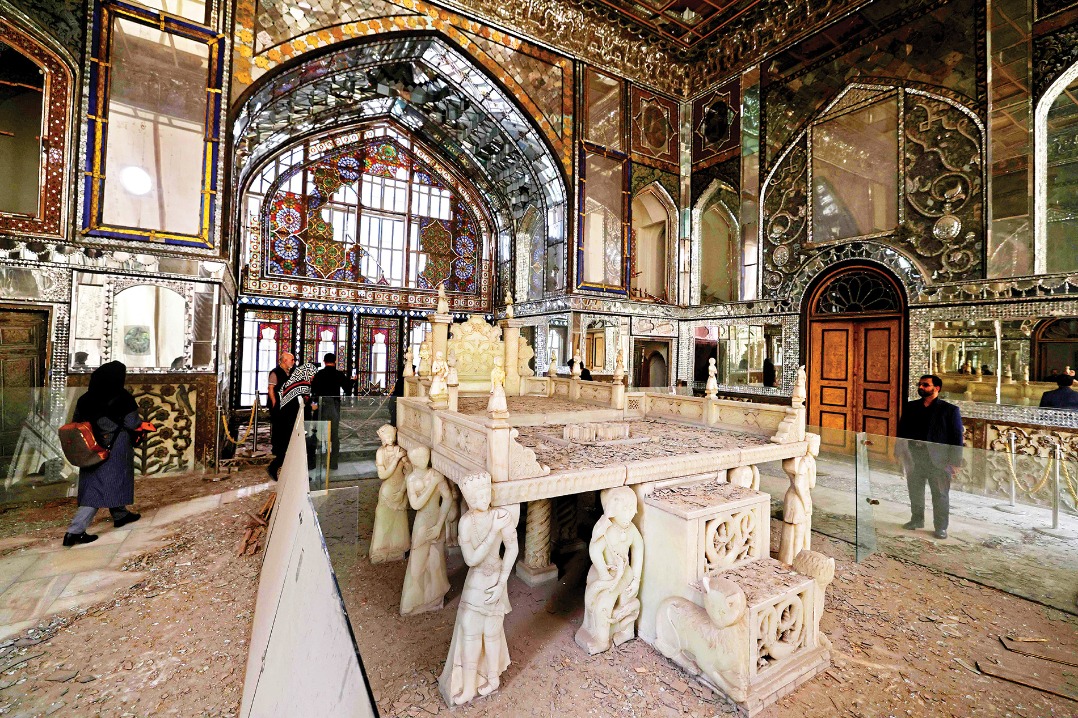
As armed clashes between US-Israeli forces and regional opponents intensify across the Middle East, a growing global outcry has emerged over the widespread destruction of irreplaceable historic and cultural sites that form part of humanity’s collective shared memory. Leading cultural experts warn that the scale of damage goes far beyond what can be dismissed as unavoidable collateral damage of war, marking a deliberate, systematic erasure of centuries of civilizational history.
According to Iran’s Minister of Cultural Heritage, Tourism, and Handicrafts Seyed Reza Salehi-Amiri, at least 131 historical and cultural monuments spanning 20 of Iran’s provinces have sustained damage from US-Israeli airstrikes. The capital Tehran has borne the brunt of the destruction: 63 sites in the city have been impacted, including the Golestan Palace, a world-renowned architectural masterpiece combining Safavid and Qajar era design, and the 100-hectare Sa’dabad Palace complex, which houses 20 separate museums. In central Isfahan province, 23 sites have been damaged, among them Chehel Sotoun Palace, a UNESCO World Heritage Site. Western Kurdistan province has recorded 12 damaged historical monuments.
Neda Zoghi, an Iranian artist and civilization scholar with a doctorate in Islamic art based at Kuala Lumpur’s Asia West East Centre, emphasized that the destruction is not merely damage to empty structures. “Every tile-work panel, every inscribed archway, every manuscript cabinet represents a node in a living network of human knowledge that took centuries to construct and cannot be reconstructed in any lifetime,” she explained. Zoghi added that the layered artistic traditions of Iranian heritage mean that a single damaged site can erase multiple irreplaceable strands of human history at once, noting that these sites predate modern political conflicts by centuries and millennia. The targeting of these spaces, she argued, violates explicit international prohibitions on cultural violence during armed conflict.
UNESCO has repeatedly called for the protection of cultural heritage across the region, reminding all parties that cultural property is protected under the 1954 Hague Convention for the Protection of Cultural Property in the Event of Armed Conflict and the 1972 World Heritage Convention. As of late March, the organization confirmed that multiple UNESCO-listed sites across Iran, Israel, and Lebanon have already sustained damage, and it has warned of growing risks to cultural sites in more than a dozen neighboring countries across the Middle East and West Asia.
The threat extends far beyond Iran, most acutely to Gaza and Lebanon. In Gaza, which has faced three years of intense Israeli bombardment, remote satellite monitoring led by UNESCO has confirmed verified damage to 164 cultural sites between October 2023 and March 2026. This toll includes 14 religious sites, 128 buildings of historic or artistic importance, two museums, and eight archaeological sites. In Lebanon, where Israeli bombardment has escalated in recent months, growing fears center on damage to iconic sites including the Roman temple ruins of Baalbek and the ancient coastal city of Tyre, both UNESCO World Heritage Sites. Even when sites are not directly hit, experts note that shockwaves from nearby airstrikes can destabilize ancient foundations and stone structures, causing irreversible long-term damage.
Following a formal request from the Beirut government, UNESCO held an extraordinary meeting in early April to coordinate emergency protection for Lebanese cultural heritage. The body approved provisional enhanced protection for 39 key cultural properties and allocated more than $100,000 in emergency funding for on-the-ground protection efforts. Nabil Najjar, a member of the executive committee for the world-famous Baalbeck International Festival, held annually at the archaeological site, said that while the festival has not yet been canceled, a postponement or full cancellation for 2026 looks increasingly likely. He noted that in 2024, a strike on the site’s perimeter wall prompted immediate protective measures from UNESCO, which has since rolled out similar protective marking for other at-risk sites across the country.
Legal experts note that while UNESCO’s enhanced protection framework carries important legal weight, its on-the-ground impact is limited. Arie Afriansyah, a law professor at the University of Indonesia, explained that the 1999 Second Protocol to the Hague Convention grants the highest level of international legal protection to listed sites, banning attacks and military use of these properties and requiring criminalization of violations. “Its real value is deterrence, clearer no-strike identification, documentation, and stronger accountability later. But it is not a physical shield,” Afriansyah said, adding that protection is weakened in Lebanon because Israel is not a party to the 1999 Second Protocol, even though the broader 1954 Hague Convention remains binding.
Zoghi highlighted a deeper systemic flaw in global enforcement of cultural heritage protection: selective application of international law. She noted that when Iran retaliates militarily, the international community moves quickly to condemn the action, but the initial US-Israeli strikes that damaged sites ranging from mosques and synagogues to ancient Zoroastrian landmarks have not faced equivalent international censure. “This asymmetry is not merely politically inconvenient. It is legally corrosive. It teaches every future aggressor that the Convention is a shield available only to the powerful,” she said. Zoghi stressed that this critique is not a justification for any particular military action, but a defense of the principle that international humanitarian law only works if it applies universally. “The moment it becomes a tool selectively deployed against one party, it ceases to function as law and becomes instead a form of geopolitical rhetoric dressed in legal language. That is dangerous for every civilization on Earth, not only for Iran.
She also pushed back against widespread framing of the current conflict as a religious war, noting that Iranian and broader Persianate civilization has always been a pluralistic space shared by Muslim, Christian, Jewish, Zoroastrian, and secular communities. “To reduce this heritage and this conflict to a simple religious binary is to commit violence against history itself,” Zoghi said. “You may wage war against a government, but history will never forgive you for waging war against civilization.”