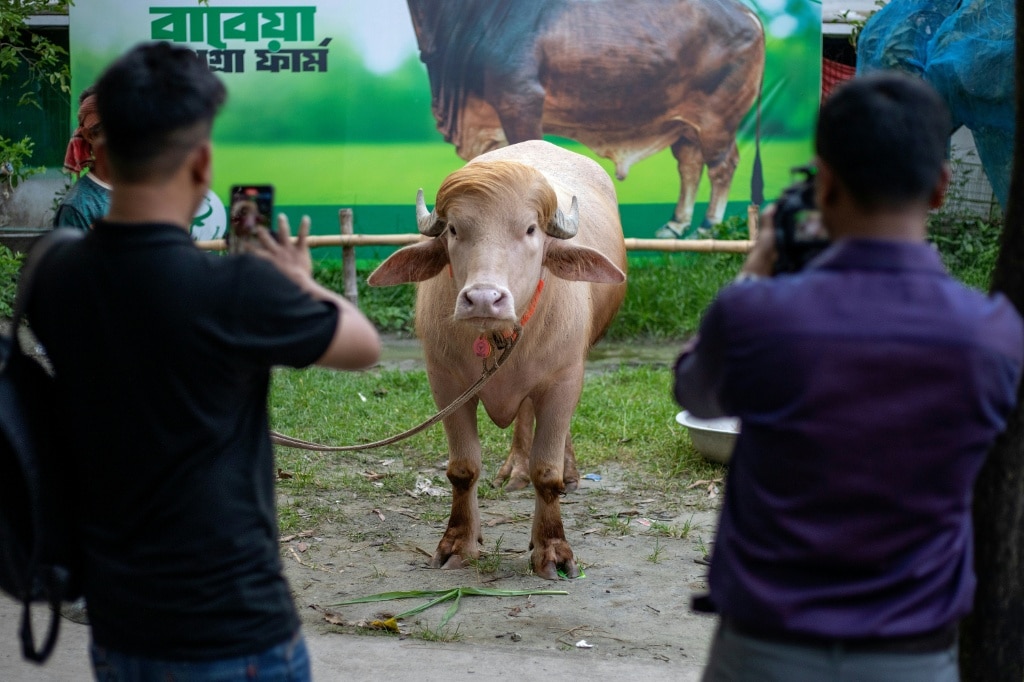
An unusual new internet sensation has captured the attention of millions in Bangladesh: a 700-kilogram albino buffalo, nicknamed “Donald Trump” for his striking golden-blond mane that echoes the former U.S. president’s iconic hairstyle, has become an overnight social media star — even as he is scheduled to be sacrificed for the upcoming Eid al-Adha holiday.
The rare buffalo lives on a family farm owned by 38-year-old Zia Uddin Mridha in Narayanganj, a small district just outside Bangladesh’s capital Dhaka. Mridha told reporters it was his younger brother who gave the buffalo its distinctive name, pointing to the animal’s thick, flowing blond coat that sits neatly between his large curved horns, bearing an uncanny resemblance to Trump’s signature hairstyle.
Since going viral on social media at the start of May, the four-year-old buffalo has drawn a nonstop stream of curious visitors, from local onlookers and social media fans to groups of excited children, all eager to catch a glimpse and snap a photo with the rare animal. Mridha said the constant attention has been overwhelming: the stress of large daily crowds has caused the buffalo to lose weight, forcing the farm to impose limited visiting hours. Still, the starstruck public continues to gather outside the farm gates, many traveling hours by boat or road to see the viral celebrity. One visitor, 30-year-old businessman Faisal Ahmed, traveled with five relatives to see the buffalo, noting his 10-year-old nephew took an hour-long boat trip just to get a look. “Truly, the features are similar between the buffalo and President Donald Trump,” Ahmed told Agence France-Presse.
To keep the buffalo comfortable amid the warm South Asian spring weather, farm workers bathe him up to four times a day, brushing his blond mane with a pink brush to keep his signature combover neat. Mridha emphasizes that any similarities between the buffalo and the former American president end at the hair.
Livestock department officials confirm pure albino buffalo are extremely rare: their distinctive pale white-pink coat and light hair come from a genetic condition that prevents the production of melanin, the pigment that gives animals their typical dark skin and fur coloring.
Bangladesh, a Muslim-majority South Asian nation of 170 million people, is gearing up for Eid al-Adha, the Islamic Feast of the Sacrifice, which is celebrated later this month. The holiday commemorates the Prophet Ibrahim’s willingness to sacrifice his son to obey God, and tradition calls for religious Muslim families to sacrifice a livestock animal, sharing a portion of the meat with poor communities. This year, an estimated 12 million livestock including goats, sheep, cows and buffalo are expected to be slaughtered across the country, providing one of the few annual opportunities for low-income Bangladeshi families to eat meat.
“Donald Trump” is not the only named buffalo on Mridha’s farm: other bulls have playful nicknames matching their personalities or looks, from Tufan (meaning “storm” in Bengali) for an aggressive bull, to Fat Boy for the largest animal and Sweet Boy for the gentle member of the herd. Another golden-haired bull was named after Brazilian football star Neymar, thanks to his dyed-style bleached blond cut.
Mridha, who has cared for the viral albino buffalo for more than a year, says he has grown attached to the animal, who currently munches fodder calmly in his pen. Despite the animal’s newfound national fame, Mridha says he will honor the tradition of Eid al-Adha. “I am going to miss Donald Trump, but that is the core spirit of Eid al-Adha — making a sacrifice,” he said.