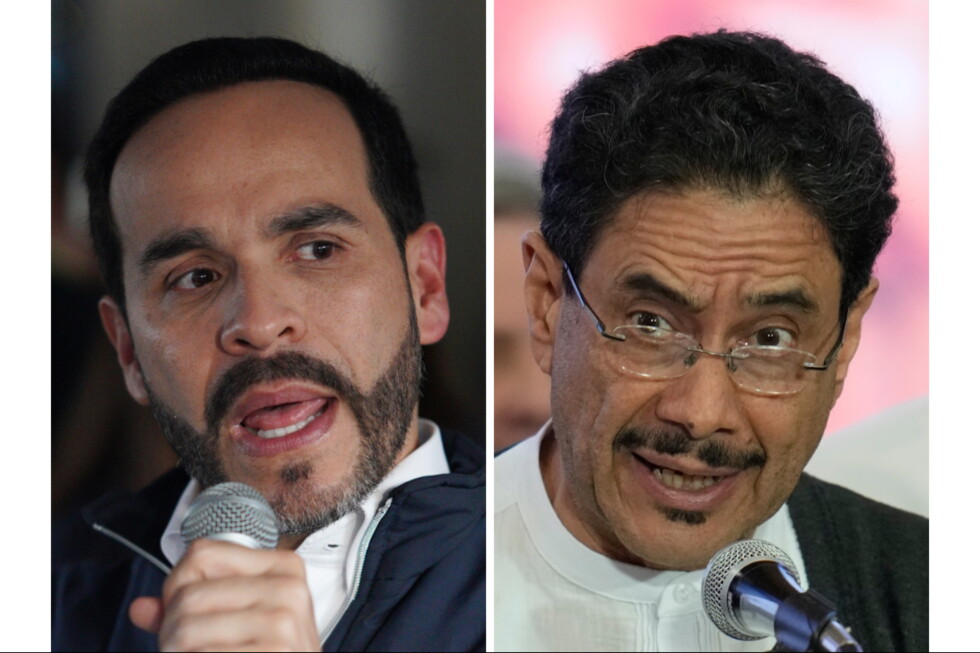
BOGOTA, Colombia – As Colombia prepares to select its next head of state in this Sunday’s presidential runoff, a deeply fractured electorate stands at a crossroads, with the nation’s decades-long struggle with violence shaping every thread of the high-stakes race. Two candidates from opposite ends of the ideological spectrum – conservative political outsider Abelardo de la Espriella and progressive lawmaker Iván Cepeda, the standard-bearer of outgoing President Gustavo Petro’s leftist movement – are vying for the nation’s top office, both leaning into widespread public anxiety over a potential resurgence of internal armed conflict to win over voters. The pair secured their spots in the runoff after outperforming nine other challengers in the May 31 first round of voting.
The defining issue of this election has been how to address the resurgence of widespread violence that has gripped Colombia a decade after the nation signed a landmark peace deal with the Revolutionary Armed Forces of Colombia (FARC), an agreement that was once hailed as a permanent end to the vicious cycle of government-rebel fighting that stretched back generations. After the 2015 peace pact, hope for long-term stability quickly faded: most former rebel groups abandoned ideological warfare to pursue the massive profits of the drug trade, sparking deadly turf wars that have sent homicide rates soaring to their highest point in a decade. In 2024, official data recorded 14,780 homicides, a surge driven by clashes between competing illegal armed groups that even claimed the life of conservative presidential candidate Miguel Uribe during the campaign. Extortion rates have also exploded, hitting 13,417 reported cases in 2025 – more than double the number recorded just 10 years earlier. The violence that once defined Colombian life, including car bombings, mass kidnappings, forced disappearances, and widespread displacement, has reemerged as a top voter concern, and both candidates have positioned their policy platforms as the only path back to security.
De la Espriella, a wealthy businessman and lawyer nicknamed “The Tiger” who is making his first run for elected office, has adopted a harsh, hardline security strategy modeled directly on the controversial policies of El Salvador’s President Nayib Bukele. His plan includes cracking down on all illegal armed groups and constructing 10 new mega-prisons to incarcerate thousands of suspected criminals. The approach has earned him high-profile support from former U.S. President Donald Trump, though it has drawn criticism over potential human rights violations, mirroring the accusations leveled at Bukele’s policies in El Salvador, which have reduced homicide rates but sparked widespread outcry over mass detentions and due process violations.
On the other side, Cepeda – a long-serving lawmaker and political heir to Petro, Colombia’s first leftist head of state – is running to continue Petro’s flagship “total peace” initiative, which prioritizes opening dialogue and negotiating peace agreements with all active illegal armed groups. Petro’s 2022 initiative has been widely panned for its lack of progress over three years: only this Thursday did the first small faction, comprising roughly 100 dissident guerrilla fighters, formally disarm and enter a civilian resettlement program, while Colombia is still home to more than 27,000 active members of illegal armed groups. Still, supporters of the strategy argue the decades-long conflict cannot be resolved in a single presidential term, and that the plan deserves more time to deliver results.
Beyond security, the two candidates have also put forward starkly different solutions for Colombia’s other pressing crises: a collapsing public health system, rapidly growing national public debt, and deeply rooted systemic corruption that has plagued Colombian politics for generations.
Official first-round results show a remarkably tight race: de la Espriella earned 44% of the first-round vote, while Cepeda finished just behind with 41%, a surprise finish that saw Cepeda slip from his consistent lead in pre-election polling. After the results were announced, Petro raised unsubstantiated questions about election fraud, deepening the already severe political polarization that has split the nation in the lead-up to the runoff.
The campaign has been marked by escalating personal attacks and widespread accusations of misconduct, ranging from fraud and vote-buying to voter intimidation. Cepeda has even filed formal complaints against de la Espriella with both Colombia’s Attorney General’s Office and the International Criminal Court, alleging de la Espriella has longstanding ties to illegal paramilitary groups – allegations that de la Espriella has forcefully denied.
For ordinary Colombians, the anxiety over the election’s outcome and the threat of renewed conflict runs deep. “Right now, what worries me is the polarization that exists between us: there are two very extreme sides, and the violence is concerning,” said John Manrique, a Bogota-based lawyer, as he walked through the capital. “What I hope is that people accept who won. Let’s accept it, regardless of the side, and try to reach a social consensus. … Let’s not go out and fight.”
Yamile Guevara, a retired Bogota teacher and committed Cepeda supporter, argued that Petro’s peace initiative has been unfairly judged, given the 60-year history of conflict that cannot be undone in four years. She also pushed back against long-standing stigma against Colombia’s left, which has for decades been unfairly associated with rebel violence. “The left has always been viewed negatively; it has been harsh, and many people have died,” Guevara said. “So, one wonders what’s wrong with people who have forgotten history … how can they not think carefully about which candidate they are going to elect?”
More than 41 million eligible Colombian voters are registered to cast their ballots this Sunday, as the nation waits to see whether voters will embrace a hardline security crackdown or give the progressive peace process a second chance.