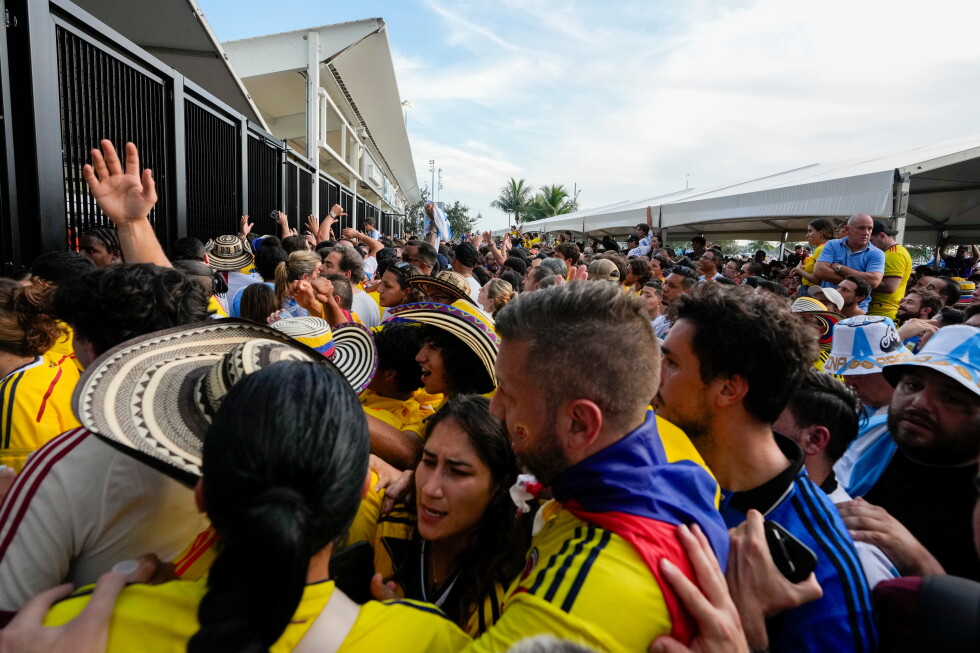
MIAMI GARDENS, Fla. – Two years after a chaotic crowd disturbance marred the Copa America final at Hard Rock Stadium, the South Florida venue is preparing to host its first World Cup match featuring Colombia this Saturday against Portugal, with sweeping new security measures and heightened vigilance in place.
The 2024 incident saw thousands of ticketless supporters, many waving Colombia’s national colors, breach the stadium’s outer security gates hours before the highly anticipated final between Colombia and Argentina. Videos shared widely on social media captured screaming fans scrambling for safety, with footage showing desperate attempted entries through stadium air vents. Multiple fans were injured in the human rush, as overwhelmed security personnel struggled to regain control of the scene, leaving legitimate ticket holders terrified.
In the wake of that disaster, public scrutiny intensified over security planning for major soccer tournaments hosted across the U.S. – including last year’s Club World Cup and this year’s 2026 World Cup. Officials used the Miami-hosted Club World Cup matches held last summer as a real-world test for new, layered screening protocols that are now fully implemented for this weekend’s high-stakes group stage fixture.
Unlike the loose entry protocols in place in 2024, anyone approaching the stadium now must clear three separate checkpoints that cover the entire stadium campus, with parking credentials verified miles before fans reach entry points. Permanent steel fencing lines the entire perimeter of the venue, which is being referred to as Miami Stadium for the World Cup under FIFA’s sponsorship conflict rules. Andrew Giuliani, executive director of the White House World Cup task force overseeing the multiagency security operation, said the stepped-up measures are designed to eliminate any repeat of the 2024 chaos.
“We’ve built a layered system that every person must pass through step by step,” Giuliani explained. “We’re going to make sure every member of the security team is on high alert specifically for match day. Our goal is simple: we want post-match conversation to be all about what happens on the pitch, not security issues.”
Giuliani confirmed there will be a substantial federal law enforcement presence across both the stadium and surrounding Miami-area neighborhoods on Saturday, declining to specify whether personnel numbers exceed the heavy deployment already used for the three previous World Cup group matches held in Miami to date. All three prior matches have seen consistent, large police presence with no major incidents.
For Colombian soccer supporters, both local residents and transplants from the South American nation, Saturday’s match is as much about changing global perceptions as it is about the result on the field. Juan Nicolas, a Bogotá native who was not present for the 2024 disturbance, said the Colombian community is eager to showcase a new image to the world.
“Now that we’re back here, I do feel a little pressure to show the best version of ourselves, and to show our country in a better light,” Nicolas said. “Colombia is different now. We have so much new to offer the world, and we have to prove that this week.”
Lucas Gaviria, a Colombian native who studies at Florida Atlantic University, acknowledged that while passionate support is a core part of Colombian soccer culture, a small minority of fans crossed lines in 2024. “We love showing up for our team, but some people take that passion too far,” Gaviria said. “There’s a mindset for some that they have to see the game no matter what, even if they can’t afford a ticket. That’s not who we are as a community.”
Demand for Saturday’s match has been unprecedented, driven by two major draws: South Florida’s large, tight-knit Colombian community, and the global star power of Portugal’s Cristiano Ronaldo. On resale platform StubHub, available ticket prices currently range from roughly $3,000 to more than $5,000, far above face value. Giuliani emphasized that non-ticket holders will not be allowed to gather near the venue, unlike U.S. college or professional football events where pre-game tailgating is standard.
“If you don’t have a ticket, you shouldn’t be on site here,” Giuliani said during a January inspection of the stadium during the College Football Playoff national championship. “This is a very different event than a football game. We need all our security resources focused on protecting fans who have legitimate tickets. Non-ticket holders can enjoy the match at official fan festivals or other safe venues across Miami.”
Hard Rock Stadium officials have declined to comment on the lead-up to Saturday’s match, as the venue remains involved in multiple ongoing lawsuits stemming from the 2024 Copa America incident. The legal claims, which name multiple defendants including stadium management and soccer governing bodies, allege that organizers failed to deploy enough security to handle the anticipated crowd, lacked sufficient Spanish-speaking staff to manage crowd control, and did not protect paying ticket holders from what the suits call “foreseeable criminal activity.”
For Colombian fans living in the area, the hope is that the 2024 chaos will not be the defining moment for their nation’s global reputation. Nadia Rodriguez, a Bogotá native who now resides in Miami, said the bad incident belongs in the past.
“There are so many wonderful things Colombia stands for: incredible coffee, stunning landscapes, amazing music, a world-class soccer team,” Rodriguez said. “That darkness from two years ago is in the past, and we’re ready to show the world who we really are on Saturday.”