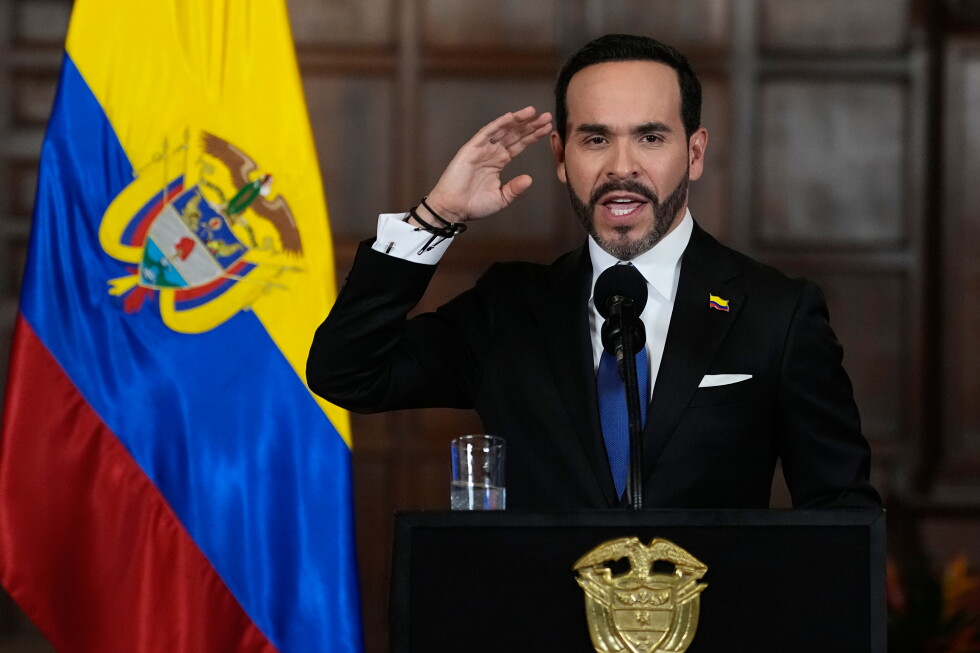
In a high-profile joint operation marking a new era of regional security cooperation, Colombian security forces have captured Luis Saúl Pérez Nieto, a suspected top-ranking leader of the transnational Venezuelan criminal gang Tren de Aragua, U.S. Southern Command announced Friday. The arrest, carried out Thursday with participation from the U.S. Drug Enforcement Administration, stands as the first major milestone in deepened counter-organized crime collaboration between the two neighboring countries following the inauguration of Colombia’s new conservative president Abelardo de la Espriella.
Pérez Nieto, who operates under the aliases “Páez” and “Nairobi”, is accused by Colombian law enforcement of overseeing the gang’s cross-continental drug and weapons trafficking networks, and leading Tren de Aragua’s expansion into Peru. Originally founded as a prison gang based out of Venezuela’s Tocorón penitentiary, the organization has evolved into a powerful transnational syndicate under the coordination of leaders like Pérez Nieto. In 2023, he escaped from Tocorón prison alongside the gang’s top leader Héctor “Niño Guerrero” Guerrero Flores, who was killed earlier this year in a U.S. military strike conducted under a rare collaborative agreement with the Venezuelan government.
A self-described admirer of U.S. President Donald Trump, de la Espriella took office earlier this month on a promise to dismantle Colombia’s powerful drug trafficking networks with direct support from Washington. In a sharp policy reversal from his progressive predecessor, his administration has designated Colombia’s second-largest city Medellín as the operational hub for Trump’s new regional anti-cartel alliance, and formally approved joint U.S. military counter-crime operations on Colombian soil.
“Narco-terrorists have no safe haven in our hemisphere,” U.S. Southern Command stated in its official announcement Friday. “We stand united with our partners to dismantle these criminal networks and protect our homeland.” DEA Administrator Terry Cole extended congratulations to the Colombian government and national police for the successful capture, noting the operation as a major win for regional counter-terror and anti-crime efforts.
U.S. authorities have formally requested Pérez Nieto’s extradition to face charges of terrorism, money laundering, drug trafficking, and criminal conspiracy, per confirmation from Colombian and Peruvian officials. As of Friday, the Trump administration had not released public details of the U.S. case against the suspect, and the DEA declined to comment further on the specific charges or its operational role.
The capture comes amid a broader push by the Trump administration to expand coordinated counter-cartel action across South America, aligned with a growing regional shift toward conservative, Trump-aligned leaders who have campaigned on aggressive security crackdowns. Earlier this week, U.S. Southern Command chief General Francis Donovan met with Colombian defense and military leaders in the Pacific port city of Tumaco, before traveling to neighboring Ecuador for security talks centered on the volatile Colombia-Ecuador border, a key transit route long exploited by cartels for drug smuggling, illegal mining, and human trafficking.
During the visit, Donovan announced that U.S., Colombian, and Ecuadorian officials had agreed to a new coordinated strategy to “hunt cartel leadership, shatter their logistics and permanently deny them safe haven.” “The border between Colombia and Ecuador is a geographic chokepoint that violent cartels have long exploited,” Donovan said. “Today, we are changing the game.” Colombia and Ecuador are among the handful of South American governments that have approved joint U.S. military counter-crime operations on their territory, a core part of the Trump administration’s plan to expand its lethal campaign against drug smuggling from maritime routes to inland criminal networks.
On the same day Pérez Nieto’s capture was announced, Chilean officials celebrated their own major security victory against Tren de Aragua, with the extradition of two suspected gang leaders from the U.S. and Colombia to face charges connected to the 2024 abduction and murder of former Venezuelan army Lieutenant Ronald Ojeda, a dissident who had been granted political asylum in Chile. Ojeda’s body was discovered buried in a cement-lined pit inside a suitcase in the Chilean capital Santiago.
Chilean President José Antonio Kast, another Trump-aligned conservative leader who took office on promises of sweeping crime reduction and mass deportations, has faced widespread criticism for failing to deliver on his security pledges. The extraditions mark a high-profile win for his administration. Chilean authorities have charged Rafael Enrique Gámez Salas, alleged head of Tren de Aragua’s primary Chilean branch Los Piratas, with kidnapping, extortion, and criminal association. The second suspect, Alfredo Camilo Carrillo Ortiz, alias “El Gocho”, was extradited from Colombia, with prosecutors accusing him of helping plan and execute Ojeda’s killing and managing the informal settlement where the dissident was buried.
Chile’s Undersecretary for Public Security María del Pilar Giannini called the extraditions “a concrete demonstration” of the Kast government’s commitment to rooting out transnational organized crime, adding “We are going to pursue them to the very end.” U.S. officials also praised the extradition of Gámez, who was transferred from a U.S. federal prison in California where he was serving a sentence for illegal reentry. U.S. Attorney General Todd Blanche called the transfer “evidence of the strong cooperation with our Chilean partners to combat transnational crime, dismantle foreign terrorist organizations like Tren de Aragua and hold members accountable for their heinous criminal acts.”
The Trump administration designated Tren de Aragua as a formal foreign terrorist organization last year, part of a policy shift to treat Latin American cartels as U.S. national security threats rather than ordinary criminal groups. However, independent reporting from The Associated Press has previously documented that Trump has at times overstated the gang’s transnational connections to justify expanded deportation policies targeting Venezuelan migrants.