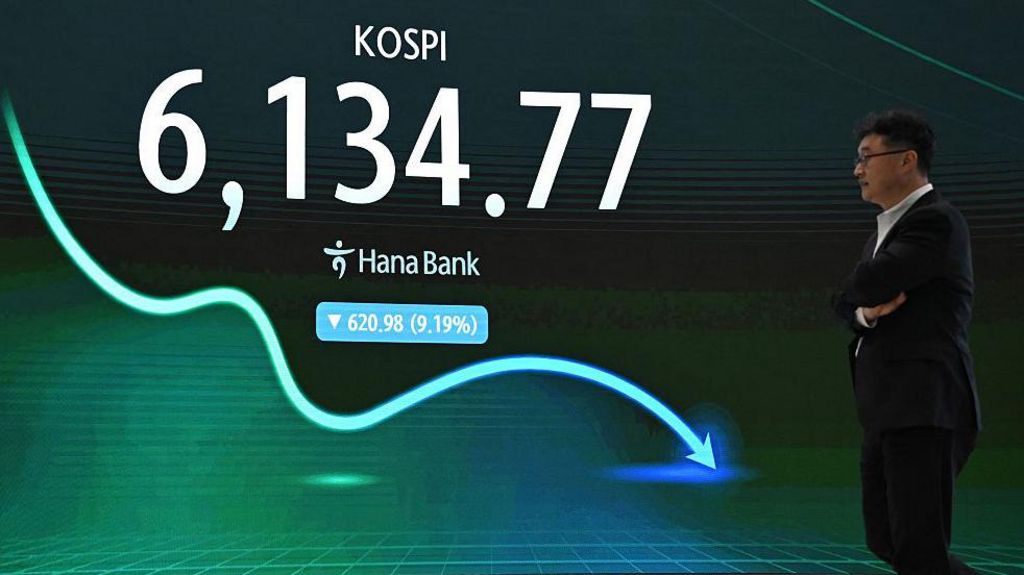
A deepening sell-off in artificial intelligence-linked equities has triggered sharp share drops for leading semiconductor manufacturers across U.S. and Asian markets this week, sending benchmark indexes into steep declines and activating market safety mechanisms.
On Tuesday morning, South Korea’s primary Kospi Index saw trading temporarily suspended after plummeting 8% early in the session. The 20-minute circuit breaker halt failed to stem the downward momentum, with the index closing down a dramatic 10.8% for the day. The collapse was led by the country’s giant technology and chip sectors: Samsung Electronics and SK Hynix, two of the world’s largest memory chip producers, both recorded declines of more than 13% by market close. This is not the first time the tech-heavy Kospi has triggered a circuit breaker this year; the mechanism is explicitly designed to slow panic-driven selling during periods of extreme market volatility. Year-to-date, the index had surged more than 100% from January to mid-June, but has now surrendered roughly a third of that peak value. South Korean stock markets have seen unusually high volatility in recent months, driven by a flood of new retail investors entering the market.
The global AI stock downturn was sparked by Monday’s trading on Wall Street, where leading AI chip designer Nvidia dropped 5%, erasing its title as the world’s most valuable publicly traded company and handing the top position back to Apple. The decline came following a Wall Street Journal report that Nvidia is in advanced discussions to contribute up to $250 billion to a massive data center infrastructure project developed in partnership with OpenAI, the creator of ChatGPT. The BBC has reached out to both Nvidia and OpenAI to request comment on the reported deal.
SK Hynix, which held a record-breaking initial public offering on the Nasdaq just three weeks ago, saw its U.S.-listed shares drop 7.5% on Monday, falling well below its $149 per share offer price. Across the East China Sea, Japan’s tech-heavy Nikkei 225 index followed the regional downward trend, closing nearly 4% lower on Tuesday. Apple, which has seen its shares climb roughly 25% so far this year, benefited from Nvidia’s decline to retake the top valuation spot.
Jun Bei Liu, founder of investment advisory firm Ten Cap, told the BBC that two key factors are driving the pullback: growing investor anxiety over the massive volumes of capital flowing into AI development, and rising competition from Chinese chip manufacturers. Against this uncertain backdrop, Liu noted that institutional investors are currently “taking some profit off the table” after the months-long AI stock rally, but many plan to reinvest in AI-related equities following the upcoming U.S. holiday season.
In a striking contrast to the broader global sell-off, China’s largest domestic memory chip manufacturer ChangXin Memory Technologies (CXMT) saw its shares skyrocket nearly 470% during its trading debut on the Shanghai Stock Exchange on Monday. The firm produces dynamic random-access memory (DRAM) chips, a critical component for AI data centers, smartphones, personal computers, tablets and a wide range of other consumer electronics. CXMT announced it plans to allocate the majority of proceeds from its IPO to expanding production capacity and accelerating research and development into next-generation memory chip technologies.