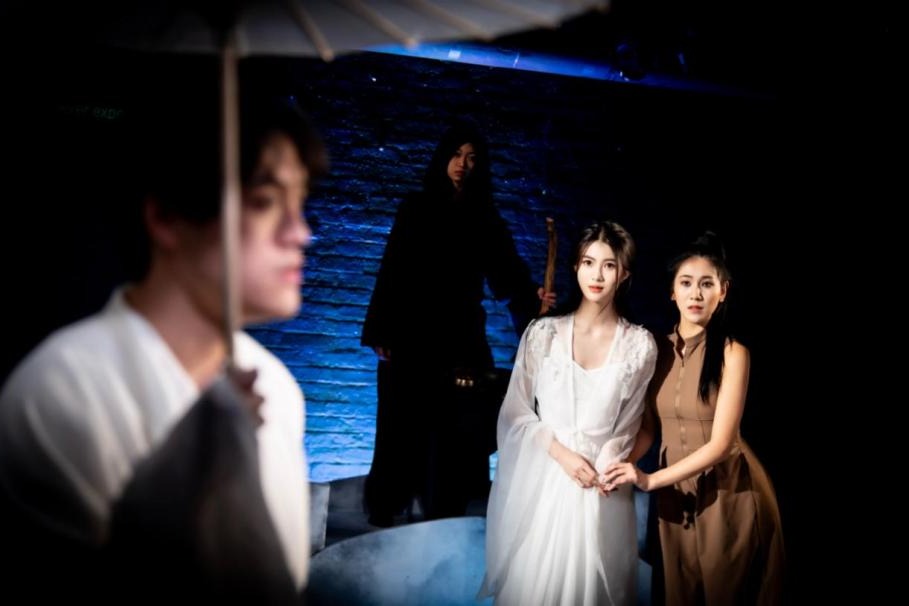
NEW YORK—The ancient Chinese folktale of The Legend of the White Snake has undergone a transformative reinterpretation through experimental theater, captivating audiences at New York’s HERE Arts Center from December 14-16, 2025. The production titled ‘Qing Bai: Innocence’ represents a groundbreaking fusion of Eastern mythology and Western avant-garde performance techniques, created by a collaborative team of emerging Chinese theater artists.
This innovative staging employed movement, sound, and physical gesture within an experimental framework to explore universal emotional themes transcending cultural boundaries. The creative team deliberately moved beyond conventional narrative structures, implementing an ‘ensemble approach’ that granted four central characters equal narrative weight and complete story arcs.
Lead performer and co-playwright Ophelia He, who portrays the serpent spirit Bai Suzhen while simultaneously playing traditional pipa instrumentation, described the New York presentation as profoundly significant. ‘I feel honored to bring this beautiful piece of traditional Chinese culture to New York theaters,’ He stated, emphasizing the production’s accessibility despite cultural differences. ‘Even without prior knowledge of Chinese tradition or language, audiences can feel the emotional struggles and identities through performance and physical expression.’
Director and co-playwright Tara Nyingje explained the production’s experimental nature: ‘I’m especially drawn to exploring how familiar stories can be reimagined through different forms of expression. This tale can be interpreted in numerous ways and understood from multiple perspectives.’
The production faced unique linguistic challenges, performing primarily in Mandarin while projecting English surtitles rendered in deliberately archaic language to match the historical tone of the original dialogue. This approach, while potentially ‘awkward’ to modern ears, intentionally blended contemporary and ancient storytelling elements.
The creative process, which began in September, formed part of a broader East Coast tour including performances at Brown and Yale Universities. For the artists involved, the project represents both cultural exploration and personal discovery, with He noting that her Western academic experience intensified her desire to investigate her Chinese cultural heritage. ‘This makes me look back and explore the underlying core of my own culture,’ she reflected.
The team views their work as continuing the folktale’s evolutionary tradition—a story that has transformed across Chinese dynasties through retellings and adaptations. As Nyingje concluded, ‘Performance methods are primarily tools. The ongoing interest always lies in integrating Chinese cultural elements into experimental theater and testing how they could be combined.’