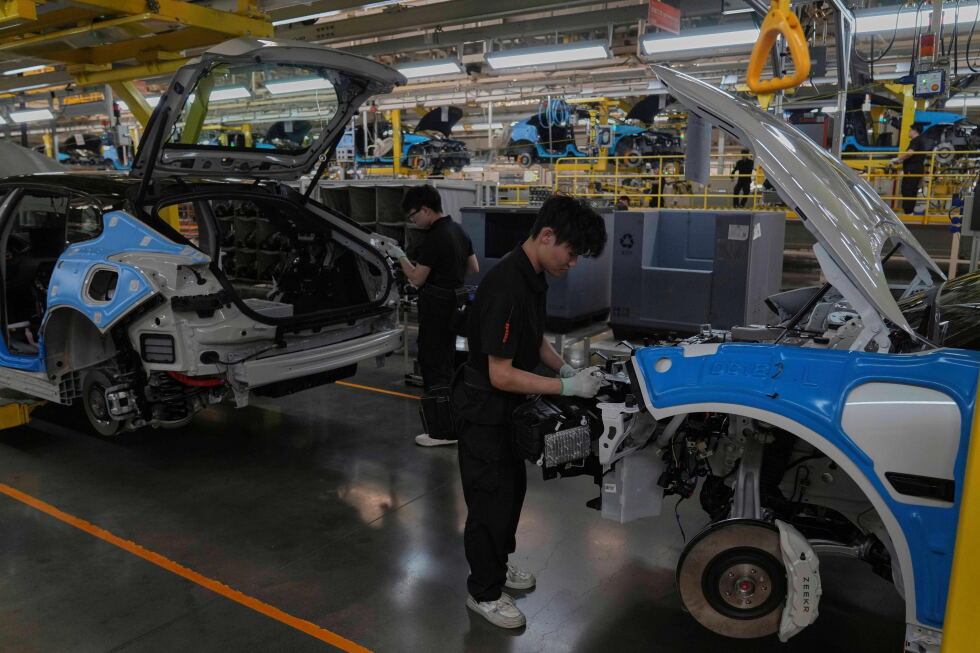
Against a backdrop of slowing domestic demand and escalating trade barriers in Western markets, a growing number of Chinese automakers are stepping away from a reliance on vehicle exports to Africa and embracing local production on the continent. Industry players and analysts are betting that Africa’s rapid urbanization, expanding middle class, and policy incentives will cement its status as one of the global auto sector’s last major untapped growth frontiers. For many, the shift is not just a market opportunity, but a strategic response to shifting global economic pressures that is already reshaping the future of Africa’s automotive industry.
This trend, while still in its early stages, is gaining momentum across the continent. In July 2024, Chery – China’s top auto exporter – completed its acquisition of Nissan’s former Rosslyn production plant outside Pretoria, South Africa. The facility is set to be retooled to produce plug-in hybrid vehicles, fully electric models, and cars under Chery’s Jetour brand. Chery’s move is not an isolated one: Beijing Automotive Group (BAIC) already operates a full manufacturing and assembly plant in Gqeberha, South Africa, while Great Wall Motor has established localized assembly operations and component distribution networks on the continent.
Industry analysts identify South Africa, Morocco, Kenya, Ethiopia, and Ghana as the most attractive markets for Chinese electric vehicle investment, thanks to their existing industrial capacity, pro-investment policies, and expanding energy infrastructure. Morocco holds an added advantage from its proximity to European export markets, while Zimbabwe’s massive lithium reserves position it to become a key player in regional EV battery supply chains. Already, Africa’s first large-scale EV battery gigafactory is in the planning stages in Morocco, signaling how local auto manufacturing is set to unlock broader industrial development across the continent.
Proponents of the shift note that local production will eventually bring down vehicle costs for African consumers by eliminating steep import duties, while also spurring critical investment in charging networks, local component manufacturing, and domestic battery production. For decades, Africa’s new vehicle market was dominated by European, Japanese, and American legacy brands, with most consumers relying on cheap used imported cars due to cost barriers. Today, the relative affordability of Chinese auto brands is opening up access to new vehicles for millions of middle-class African consumers, allowing Chinese manufacturers to capture significant market share from long-established incumbents.
“Whilst African consumers have been thriving on used cars, the affordability of Asian brands is providing a wider accessibility reach for new vehicles,” said Hiten Parmar, executive director of The Electric Mission, a South African nonprofit focused on advancing sustainable mobility.
Nick Hedley, an energy transition research analyst at Zero Carbon Analytics, added that Africa’s fast-growing population and expanding middle class create built-in demand for affordable electric vehicles, while EV adoption aligns with key national economic priorities for most African countries. Most African nations are net importers of refined petroleum, a reality that drains foreign currency reserves, weakens local currencies, and puts significant pressure on government budgets.
“Switching to local electric cars for transportation is in African countries’ national interest,” Hedley explained. “As electric vehicles become more cost-competitive, their uptake will accelerate across Africa, and Chinese automakers will benefit.”
The push for local African manufacturing is also driven by shifting economic dynamics within China. Domestic vehicle production has outpaced slowing domestic demand in recent years, while Chinese auto exports face growing tariffs and trade barriers in European and North American markets. Locating production inside Africa allows automakers to bypass these trade restrictions while placing manufacturing facilities closer to their fastest-growing consumer base.
“Onshoring production on the continent is a sound long-term investment,” said Tombo Banda, managing director of CrossBoundary Energy. Banda noted that local manufacturing helps companies navigate tariff regimes while positioning them to capitalize on rapidly rising consumer demand across the region.
Many African governments have already adjusted their transportation and industrial policies to support this transition, aligned with broader goals of boosting energy security and local industrial development. The African Union’s Green Minerals Strategy prioritizes expanding domestic processing of critical auto and battery minerals, which will increase the supply of usable raw materials for local manufacturers. Ethiopia has gone a step further, banning imports of new fossil fuel-powered vehicles and cutting import duties for domestically assembled EVs to encourage local production. South Africa, by contrast, has adopted a incentive-based approach, offering customs duty rebates, production-linked tax credits, direct investment support, and tax breaks to attract investment in EV and hydrogen-powered vehicle manufacturing.
Parmar emphasized that the shift from pure import models to local assembly and full manufacturing represents a notable, fundamental change in how Asian auto brands approach the African market. What was once purely a sales destination for imported vehicles is increasingly on track to become a full-fledged global auto manufacturing hub.
“If Chinese manufacturers want access to these markets, they need to add value locally rather than simply sell into them,” Banda said. “That is what will move Africa from a sales market to a genuine manufacturing base.”
South Africa, in particular, has emerged as an early leader in this transition, thanks to its existing auto manufacturing capacity, skilled local workforce, and established access to regional and global export markets. Acquiring pre-existing facilities like Chery’s Rosslyn plant also allows companies to retool existing infrastructure rather than investing billions to build new factories from the ground up, cutting down on timelines and risk. “Companies can pivot, or enter partnerships, far faster than anyone starting from scratch,” Banda noted.
Even with these advantages, significant challenges remain. Banda cautioned that converting factories originally designed for internal combustion engine vehicles to produce EVs is a complex, capital-intensive process that requires long-term policy certainty. Sudden shifts in tax rates, tariff rules, or industrial regulations can quickly erode investor confidence, while inadequate energy and transportation infrastructure remains a major barrier to widespread EV adoption across much of the continent. “Without clean, reliable, affordable electricity, forget about operating EVs. Without sufficient, well-located charging, forget about functional EVs,” Banda said.
Still, analysts agree that the long-term trajectory of the sector is clear: as Chinese automakers deepen their investment in local African production, the shift will create new jobs, build local supply chains, and accelerate the continent’s transition to sustainable electric mobility, reshaping the future of both the African and global auto industries in the process.