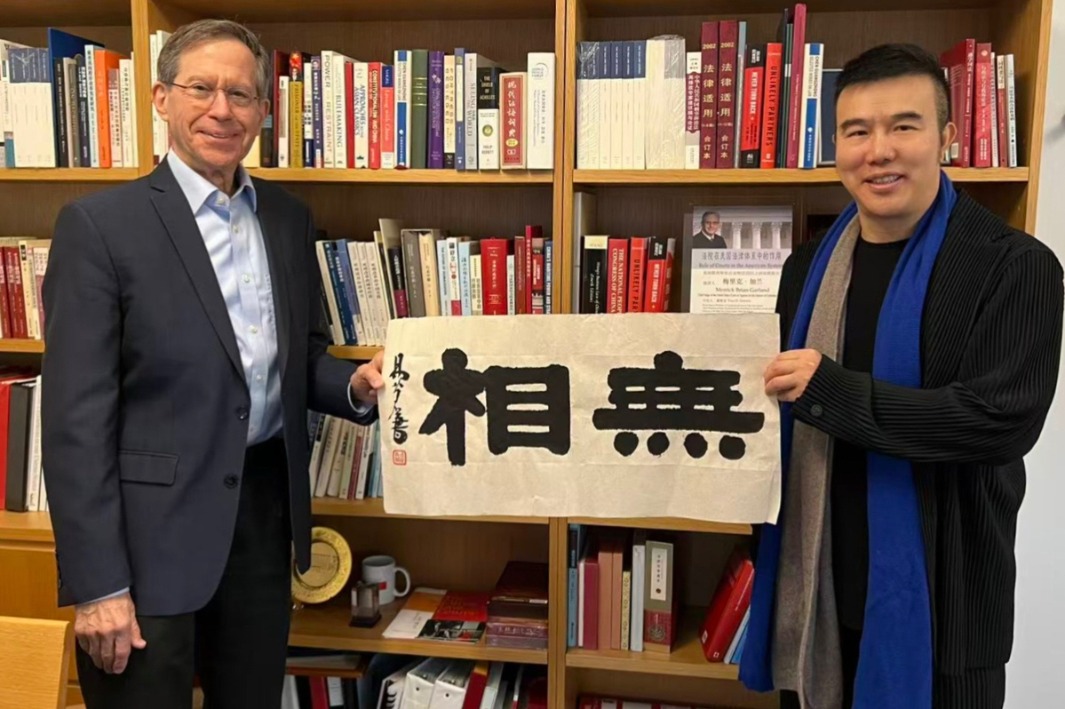
NEW YORK – Renowned Chinese artist Yi Ming, whose creative vision has shaped some of China’s most prominent international events, recently articulated his philosophy on cross-cultural artistic expression during an engagement at Harvard University. The multidisciplinary creator—accomplished in painting, calligraphy, and design—emphasized the critical importance of ‘leaving space’ as a universal principle in artistic communication across cultural boundaries.
Yi brings unique credibility to this perspective, having served as a key visual designer for both the 2008 Beijing Summer Olympics and the 2022 Beijing Winter Olympics. This rare dual experience has provided him with a distinctive vantage point to observe the evolution of China’s cultural presentation on the global stage. He characterized the 2008 Games as an endeavor centered on ‘Harmony,’ with artistic efforts focused on demonstrating the depth and strength of Chinese civilization to international audiences.
‘The fundamental objective in 2008 revolved around facilitating global understanding of China,’ Yi explained. ‘By contrast, the 2022 Winter Olympics represented a significant thematic shift toward romanticism and technological artistry. Our approach reflected greater national confidence—we sought to present China not merely as historically significant, but as contemporary, engaging, and emotionally resonant.’
Beyond his Olympic contributions, Yi’s portfolio includes serving as chief stylist for the 2016 G20 Summit in Hangzhou, the 2018 Qingdao SCO Summit, and the acclaimed ‘Beijing 8 Minutes’ segment at the 2018 PyeongChang Winter Olympics. Despite this impressive institutional work, the artist self-identifies primarily as a ‘storyteller’ who communicates China’s cultural heritage through visual language.
Yi maintains that while large-scale events have brought him recognition, artistic authenticity stems from personal style. His work integrates modern aesthetics while consistently emphasizing the Chinese artistic principle of ‘liubai’—intentionally leaving space for imagination. This concept takes on enhanced relevance in today’s technology-driven environment, particularly with the emergence of artificial intelligence.
‘In our rapidly accelerating, technology-saturated world, such creative space provides essential room for human breath and reflection,’ Yi noted. ‘While AI demonstrates remarkable efficiency and learning capacity, artists must focus on what machines cannot replicate: genuine emotion, vitality, and creativity.’
The artist also commented on the global circulation of Chinese cultural content through digital platforms, citing the international popularity of vertical short dramas as evidence of how quickly cultural elements can now travel. He observed growing international interest in both traditional Chinese mythology and the country’s modern technological engagement.
Addressing Harvard students, Yi encouraged artistic exploration and self-discovery, emphasizing that across diverse cultures and backgrounds, creative space remains essential for imagination, kindness, and love to flourish amidst relentless technological advancement.