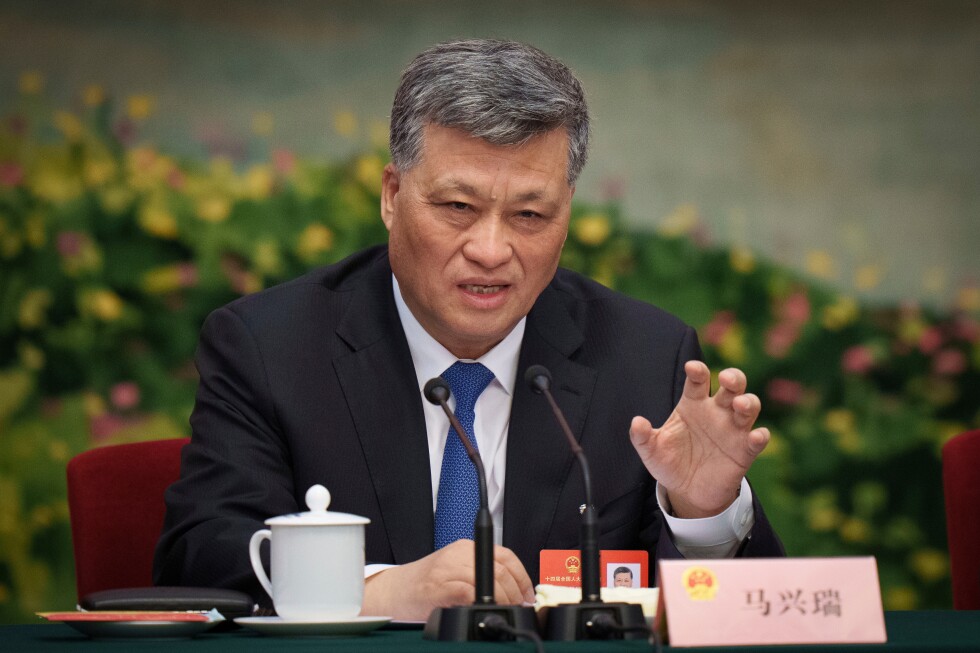
BANGKOK (AP) — In an announcement made Friday, the Central Commission for Discipline Inspection, the top anti-graft watchdog of the Communist Party of China, confirmed that it has launched a formal investigation into Ma Xingrui, a former top regional party official and sitting member of the party’s Central Committee, over suspected violations of disciplinary rules and national law.
Ma, who has held a series of high-level leadership positions across China, served as the Communist Party Secretary of the northwestern Xinjiang Uyghur Autonomous Region between 2021 and early 2025. Prior to taking on the top role in Xinjiang, he held posts including director of the National Ethnic Affairs Commission and deputy Communist Party Secretary of southern China’s Guangdong Province. As of the announcement, no specific details have been released regarding the nature of the alleged violations linked to Ma.
The investigation of Ma marks the latest high-profile leadership shakeup within China’s senior ranks this year. Back in January, Chinese leader Xi Jinping oversaw the removal of the country’s top military general from his post, in a move that drew widespread international attention.
Ma was actually replaced as Xinjiang’s top party official by Chen Xiaojiang back in July 2024, months before the formal investigation was announced. Xinjiang has long been a region at the center of global controversy, due to a years-long Chinese government campaign that has been widely criticized by international observers and human rights groups.
For years, international reporting and investigations have documented that Chinese authorities detained over 1 million ethnic minority groups, predominantly Uyghur Muslims, in a network of extrajudicial detention camps across the region. Beijing has repeatedly defended the policy, framing it as a necessary counterterrorism measure aimed at addressing violent attacks carried out by a small faction of Uyghur extremist groups.
By the time Ma took up his post as Xinjiang’s party secretary in 2021, Beijing announced that it had closed the vast majority of the original detention centers. But reporting from the Associated Press, based on leaked internal information, has confirmed that many former camp facilities were converted into formal, prison-like facilities. Documentation shows that thousands of Uyghur detainees have been transferred to these facilities to serve long criminal sentences, which independent legal and policy experts have widely described as baseless, politically motivated charges.
Earlier this year in March, China’s national legislature passed a new national-level ethnic affairs law. Independent analysts who study the region say this new law formalizes and codifies the government’s long-running assimilationist policies targeting ethnic minority communities across the country, building on incremental policy changes that have been rolled out at the provincial level in Xinjiang and other regions with large ethnic minority populations over the past decade.