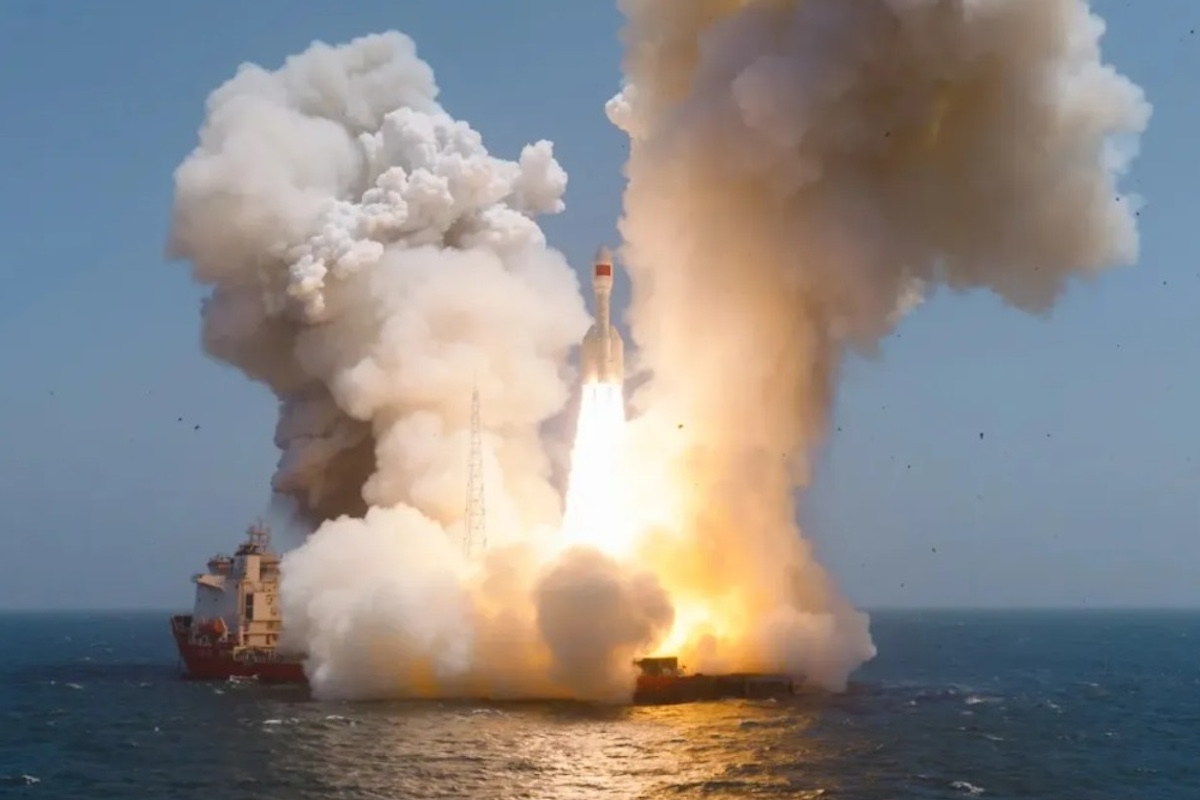
In a landmark demonstration of advancing commercial and military space capabilities, Chinese commercial launch firm Orienspace has successfully completed the third flight of its Gravity-1 solid-propellant rocket, lifting nine satellites into pre-planned low Earth orbits from a mobile maritime launch platform off the coast of Shanghai in the East China Sea. Standing 30 meters tall with a total liftoff mass of 405 tons and generating 600 tons of liftoff thrust, Gravity-1 holds the title of the most powerful solid-fuel rocket currently operational worldwide, marking a major milestone for China’s expanding offshore space launch infrastructure.
The January mission deployed a diverse array of payloads, including six Dongpo-series satellites combining optical imaging and synthetic aperture radar (SAR) technologies built for regional geographic mapping and emergency disaster response. It also carried two Earth observation satellites, Xiguang-2 01 and Tianyi-49, plus the Lilac-3 technology demonstration satellite. Of particular note is Xiguang-2 01, China’s first satellite to integrate on-board artificial intelligence capable of processing spatial imagery directly in orbit, a breakthrough that could enable near-real-time analysis and distribution of collected data to end users.
Coordinated jointly between the Oriental Aerospace Port and the Taiyuan Satellite Launch Center, the long-distance open-ocean launch validated a key operational capability: solid-fuel rockets can be safely stored aboard maritime launch vessels for extended periods even in harsh open-sea conditions. This success establishes agile, high-volume offshore launch operations as a viable alternative to traditional fixed land-based spaceports, bringing a host of strategic and practical advantages.
Mobile sea-based platforms resolve growing congestion at crowded land launch sites, while also allowing rockets to follow fuel-optimal launch trajectories that maximize the payload mass delivered to orbit per mission. Offshore launch infrastructure also opens new opportunities for first-stage booster recovery via specialized net-based capture systems, eliminating the need for heavy landing legs that add dead weight to rockets. This weight reduction improves fuel efficiency and enables reusable launch vehicles to carry larger payloads than their land-recovery counterparts.
Analysts have increasingly focused on the dual military and commercial implications of China’s advances in mobile sea launch, solid-fuel rockets, and on-orbit AI processing. In a 2023 report for the Center for Security and Emerging Technology (CSET), researchers Corey Crowell and Sam Bresnick argue that China’s investment in small, mobile solid-fuel launch systems is designed to reduce dependence on vulnerable fixed land-based spaceports, while building a tactically responsive rapid launch capability.
These improvements, they note, drastically boost China’s operational resilience in space by enabling the rapid replenishment of damaged or degraded satellite constellations — a capability that would be critical for maintaining command-and-control and precision targeting systems during high-intensity conflict. The researchers go so far as to conclude that China has now surpassed the United States in the ability to rapidly deploy or replace critical mission-supporting satellites during emergencies or wartime operations.
The integration of on-orbit AI processing for imagery addresses a longstanding limitation of traditional space-based intelligence, surveillance, and reconnaissance (ISR) systems. Traditional satellites must transmit raw unprocessed imagery back to ground stations for analysis, creating delays that can make hours-old data obsolete when tracking time-sensitive moving targets such as warships, combat aircraft, and mobile missile launchers. By conducting preliminary detection and analysis directly in orbit, AI-equipped satellites can cut these delays dramatically, though analysts note findings still require cross-validation with other sensor platforms including unmanned aerial vehicles and over-the-horizon radar to generate reliable targeting data.
Analysts point out that this faster targeting cycle could give China a strategic edge in countering the U.S. military’s Agile Combat Employment (ACE) strategy in the Indo-Pacific, which disperses U.S. aircraft across small, dispersed island airfields and regional bases to reduce vulnerability and improve survivability. With dispersed U.S. fighters capable of repositioning for new missions within three hours, AI-powered rapid surveillance can cut China’s targeting cycle to under 24 hours, potentially allowing forces to locate and threaten scattered aircraft before they can relocate again.
Despite these technological advances, independent analysts emphasize that the United States retains a massive overall lead in orbital infrastructure. Writing for Think China in June 2026, Simon Gwozdz notes that the U.S. operates 78% of all active satellites in orbit globally, while China accounts for just 8%. The imbalance is even starker in low Earth orbit, where the U.S. operates 86% of satellites and China only 4%.
Gwozdz attributes much of this gap to structural differences: the U.S. has leveraged a large, mature commercial launch sector to rapidly expand orbital deployment, while China’s launch industry still remains dominated by state-run space agencies. He also notes that even with recent technological breakthroughs by Chinese private firms, expanding overall launch capacity is far more challenging than increasing satellite production, due to geographic constraints, airspace management requirements, and limited availability of suitable launch sites.
Even as the U.S. holds a clear numerical lead, analysts warn that its own launch ecosystem carries strategic vulnerabilities. In an April 2026 article for the Center for Strategic and International Studies (CSIS), Andy Yang observes that U.S. launch capacity is overwhelmingly concentrated in a single commercial provider: SpaceX. This heavy reliance on one company, Yang argues, creates a long-term strategic risk, as a critical national capability is tied to the capacity, business decisions, and institutional stability of a single entity.
In contrast, China is pursuing a diversified approach: it is advancing multiple state-backed low Earth orbit constellation projects including Xingwang, Qianfan and Honghu, while also providing support for private domestic firms such as Orienspace and LandSpace to develop reusable launch vehicle technologies. Yang cautions that while China still lags behind the U.S. in total orbital scale, Chinese public and private actors could rapidly deploy large low Earth orbit constellations once they master mass production of reusable rockets.
He warns that the combination of U.S. over-reliance on a single launch provider and China’s investment across the entire space ecosystem could allow China to expand its orbital footprint rapidly and pose a serious challenge to the current market dominance of SpaceX’s Starlink network.
Beyond military competition, the long-term global space race is increasingly centered on control of the fast-emerging orbital economy. Writing for Think China this month, Akhmad Hanan argues that future leadership in space will not be decided by prestige-driven flagship exploration missions such as crewed Mars landings, but by the ability to operate large satellite constellations at the lowest sustainable cost and build a more comprehensive commercial space ecosystem than rival powers.
Hanan notes that future space competition will be defined less by national pride or exploration milestones, and more by which countries and companies control the digital services, data infrastructure, and communications networks that underpin global economic activity, military operations, and everyday global connectivity. For China, the core challenge ahead is to convert its recent technological breakthroughs into an integrated launch system that can operate frequently, cheaply, and reliably — capable of both rapid wartime satellite replenishment and large-scale commercial constellation deployment and maintenance in peacetime.
If China succeeds in this goal, the future of U.S. orbital advantage will depend not on the size of its current numerical lead, but on how quickly the U.S. can diversify its domestic launch provider base, reduce its dependence on a single company, and adapt its military and commercial space architecture to compete with a more distributed, responsive, and resilient Chinese space sector.