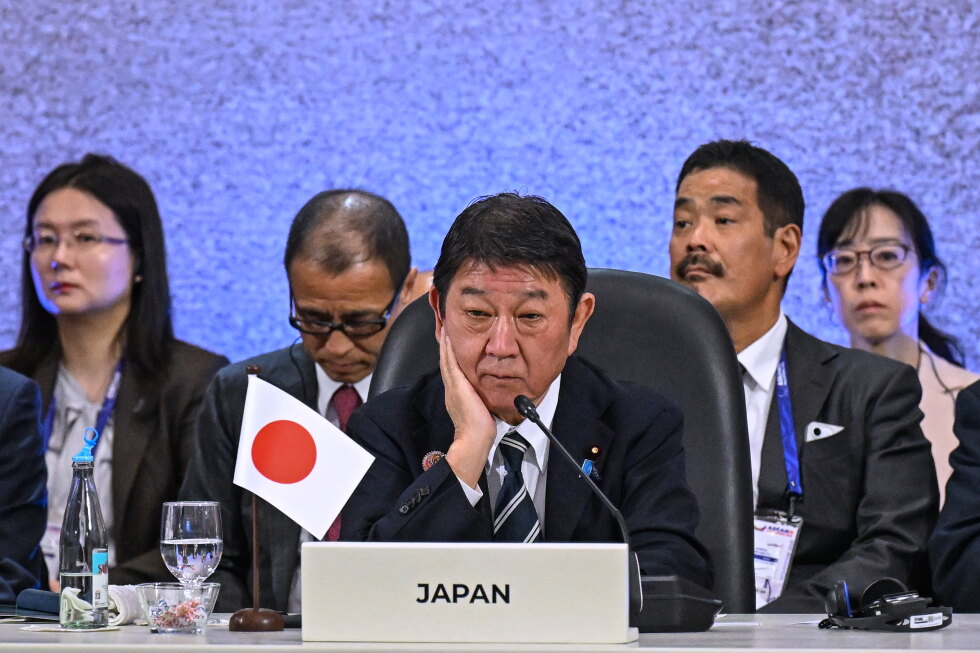
Diplomatic friction between China and Japan has erupted into public view after conflicting official statements over whether a meeting between the two nations’ top diplomats took place at last week’s ASEAN Regional Forum held in Manila, the Philippines. The disagreement lays bare the sharp deterioration of bilateral relations that began in November, when Japanese Prime Minister Sanae Takaichi made a controversial comment on Taiwan that crossed a core red line for Beijing.
Japanese Foreign Minister Toshimitsu Motegi initially told reporters that he had held an impromptu brief discussion on bilateral ties with his Chinese counterpart Wang Yi after the two encountered each other on the sidelines of the gathering. Japanese media later qualified the account, reporting that any interaction between the two officials would have amounted to no more than casual greetings and polite small talk. Despite this, Prime Minister Takaichi reaffirmed last Monday that dialogue is ongoing between the two countries at multiple levels, pointing to Motegi’s reported exchange with Wang as evidence.
China’s foreign ministry flatly contradicted the Japanese account just one day later. At a regular daily press briefing, spokesperson Lin Jian issued a clear denial: “Let me make it clear once again that during his visit to Manila, Foreign Minister Wang Yi did not have a meeting with the Japanese side on his schedule, nor did any brief exchanges take place on the site.”
The root of the current diplomatic freeze traces back to Takaichi’s first weeks in office, when she addressed parliament in November on Japan’s collective self-defense policy. The framework, which allows Japan’s military to deploy to support an allied nation—most commonly the United States—when certain conditions, including a threat to Japan’s own national survival, are met. When asked whether a Chinese military blockade or other armed action targeting Taiwan would qualify as a scenario that would trigger Japanese involvement under the policy, Takaichi said such an event could meet the criteria. “If it involves the use of warships and military actions, it could by all means become a survival-threatening situation,” she stated.
The comment triggered immediate outrage from Beijing, which claims the self-governing island of Taiwan as its sovereign territory and rejects any foreign interference in cross-strait affairs. Any public comment or action that is seen as supporting Taiwan independence, including U.S. arms sales to the island, crosses what China labels a non-negotiable red line in its foreign relations. Takaichi has declined to withdraw her remark, though she later told the same parliamentary committee that she would avoid discussing specific collective self-defense scenarios moving forward.
The ongoing diplomatic standoff follows a clear pattern in recent months: Japan has repeatedly signaled it is seeking opportunities to reopen high-level dialogue to repair frayed ties, while Beijing has refused to engage, maintaining a firm diplomatic cold shoulder toward Tokyo. These elevated tensions have already spilled over into the economic sphere, with a notable drop in the number of Chinese tourists choosing to visit Japan. Strategic mistrust has also deepened, with both nations growing increasingly uneasy over perceived military expansion by the other in the East Asia region.
“As we have repeatedly noted, Japan is open to dialogue at all levels, and I believe it is extremely important that we continue our dialogue as both Japan and China hold a major responsibility for regional peace,” Motegi stated last week, reaffirming Tokyo’s ongoing push for diplomatic engagement.