China’s commerce and science ministries have unveiled a sweeping new draft proposal to tighten export controls on 40 critical technologies spanning artificial intelligence, biomedicine, and advanced solar manufacturing, a regulatory update that has sent ripples through global tech and space industries, particularly impacting Elon Musk’s ambitious plans for space-based solar power.
Under the draft framework, 14 technologies will face full export bans if enacted, while 26 others will require government-issued export licenses. Critically, the ban includes production technology for perovskite and tandem solar cell modules — a next-generation photovoltaic technology that has emerged as an ideal candidate for space-based energy systems. Importantly, finished products manufactured using these controlled technologies will still be permitted for export, and the proposal is currently open for public comment through November 15 before any final rules are set.
The full list of controlled technologies spans three high-priority strategic sectors. In artificial intelligence, 23 technologies tied to large language models, autonomous AI agents, high-performance computing clusters, and sensitive information processing are included, though technologies already widely available through open-source releases or academic publications are exempt from controls. For biomedicine, five key technologies covering cell and gene therapy platforms, small nucleic acid drugs, and handling of pathogenic microorganisms are restricted, with streamlined automatic licensing available for outbound licensing deals that do not transfer full ownership of the technology. In the solar sector, 12 technologies related to advanced polysilicon production, wafer processing, and next-generation cell manufacturing are covered, with controls extending to the core equipment that embodies these technologies.
In an official statement explaining the new controls, a Ministry of Commerce spokesperson emphasized that the update follows longstanding common international practice, noting that all major global economies already implement varying degrees of export controls on sensitive technologies. “The aim is to guard against the risks of technology getting out of control and spreading improperly, while safeguarding normal international technology exchanges and cooperation,” the spokesperson said, adding that the revision is a routine periodic update to China’s export control catalog, which has been adjusted regularly by the two ministries since 2001. The update does not target any specific country, region, or private entity, the spokesperson confirmed, and most routine AI and biotech commercial activity will remain unaffected. For example, providing AI models to overseas users via application programming interfaces, cloud-based software as a service, mobile applications, websites, or lightweight on-device versions does not qualify as a controlled export, and downloading open-source Chinese AI models for use on hardware outside China’s borders also remains unrestricted.
The proposal comes just weeks after a high-profile bilateral agreement between U.S. Treasury Secretary Scott Bessent and Chinese Vice Premier He Lifeng, reached in New York on September 21, where the two nations agreed to mutual notification of AI incidents that could pose national security risks, with non-state cyberattack actors and illicit bioweapons development cited as key examples of the risks the agreement targets.
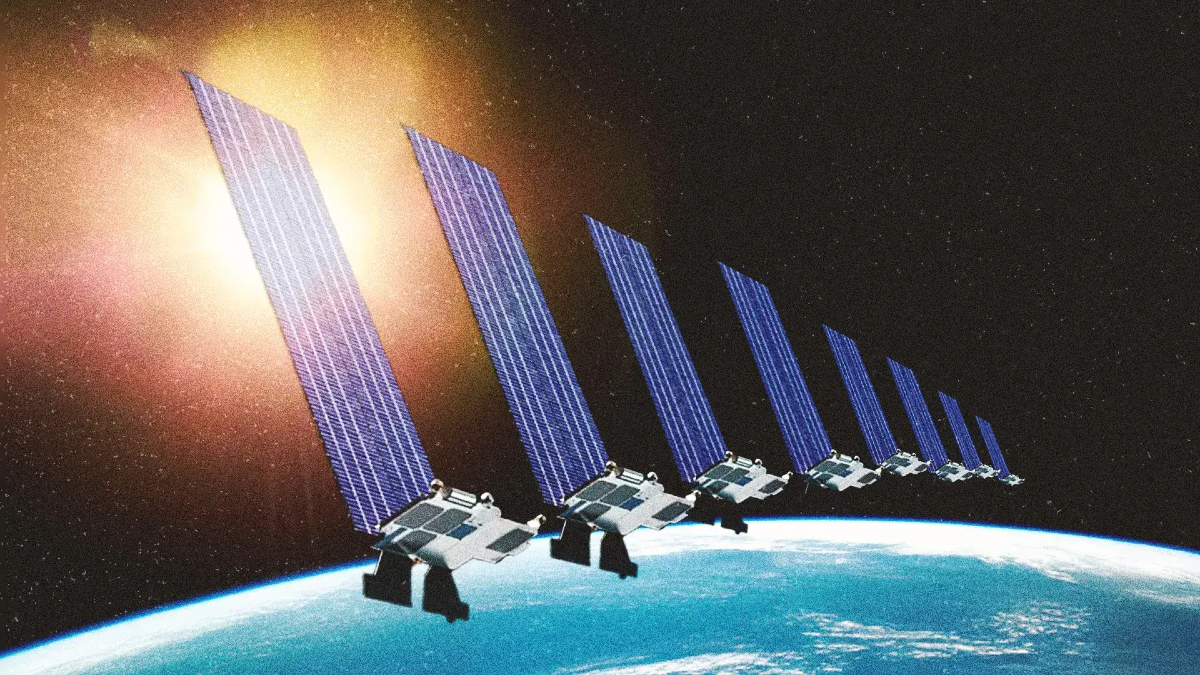
For Elon Musk’s sprawling corporate empire, the new controls create significant uncertainty for his recently announced expansion into space solar power. Back in late January, Musk revealed on a Tesla earnings call that the company aims to scale up domestic U.S. solar cell production to 100 gigawatts annually, covering the entire supply chain from raw material processing to finished panels. Media reports indicate a portion of this new capacity is intended to power SpaceX’s satellite constellations, part of Musk’s broader plan to develop low-cost space-based solar power for orbital AI computing and a future permanent Moon city. Just days after the earnings call announcement, Musk dispatched a delegation to meet with leading Chinese solar technology firms working on perovskite and tandem cell technology, with GCL Group confirming the meeting, though JinkoSolar noted no binding agreements were reached.
In early February, SpaceX completed its acquisition of Musk’s artificial intelligence firm xAI, with the billionaire predicting that within two to three years, space will become the lowest-cost location for large-scale AI computing, powered by near-continuous solar energy from orbiting satellites. Weeks later, Reuters reported that Tesla was in advanced negotiations to purchase roughly $2.9 billion worth of Chinese solar manufacturing equipment, a portion of which would now fall under the proposed export controls.
Perovskite solar cells, which are often paired with silicon in stacked tandem designs, offer unique advantages for space applications unmatched by traditional satellite photovoltaic technology. They are far more efficient, lighter, and more flexible than conventional silicon cells. While perovskite degrades rapidly when exposed to moisture and oxygen on Earth, the near-vacuum environment of space eliminates this risk, and the cells also have the natural ability to self-repair after damage from cosmic radiation, making them the leading emerging option for next-generation satellite power systems.
A October 17 report from China’s state-owned 21st Century Business Herald, citing an unnamed senior industry expert, clarified that under the proposed framework, foreign firms would still be permitted to purchase finished perovskite cells from Chinese manufacturers — only the underlying manufacturing technology and core equipment would be blocked from export. Zhao Lei, a senior solar cell technology researcher at the Chinese Academy of Sciences’ Institute of Electrical Engineering, explained the strategic logic behind the restriction. “Space photovoltaics is the core energy source for strategic industries such as commercial spaceflight, space stations, space computing and deep-space exploration. It serves both civilian and defense needs and bears on the security of China’s space energy strategy,” he said.
Zhao noted that Western nations have maintained a decades-long technology blockade on China in traditional high-performance space solar cell technology, dating back to the 1989 U.S. arms embargo that barred exports of defense and space technologies — including the gallium arsenide-based III-V multi-junction compound cells that have long dominated the satellite power market, controlled under U.S. International Traffic in Arms Regulations. For years, tight controls on high-performance epitaxy manufacturing equipment held back China’s domestic space solar development, but that dynamic has shifted dramatically. While China was locked out of traditional III-V cell supply chains, it has pulled ahead in the development of lower-cost crystalline silicon and perovskite-based tandem cells, and currently hosts the world’s most complete end-to-end solar manufacturing supply chain.
By the end of 2025, Chinese firms controlled 96% of global polysilicon manufacturing capacity and 91.3% of global solar cell production capacity, according to data cited in the 21st Century Business Herald report. Though perovskite solar technology was first developed in Japan in 2009, Chinese companies have led the global push to commercialize and scale mass production. Chinese manufacturer Microquanta Semiconductor launched the world’s first large-scale perovskite module production line in 2023, GCL Group is currently building out a 2-gigawatt commercial production capacity, and LONGi Green Energy Technology set a new global efficiency record of 35.5% for tandem perovskite-silicon cells in July this year.
For Musk, the practical outcome of the controls is clear: he will still be able to integrate Chinese perovskite cells into SpaceX satellites, but he will not be able to import the manufacturing equipment needed to produce the cells domestically in the United States to power his 100-gigawatt production target.
In a parallel development aligned with U.S. export control priorities, Taiwan’s Minister of Economic Affairs Kung Ming-hsin announced in an October 12 interview with Bloomberg that the island will add AI servers and cutting-edge semiconductors to its own controlled export list, bringing its rules in line with American restrictions on advanced tech exports to mainland China. Once the new rules take effect, unlicensed shipments of controlled items to mainland China will be classified as a criminal offense under Taiwan’s Foreign Trade Act. “Going forward, some of our measures on controlled items will correspond to American ones,” Kung said, referencing commitments made under the 2025 Reciprocal Trade Agreement between Taiwan and the United States. He declined to share a specific timeline for the new rules to take effect, and added that Taiwan plans to raise billions of dollars to develop U.S.-linked industrial parks to support a local supply chain for Nvidia and other leading American AI hardware manufacturers.