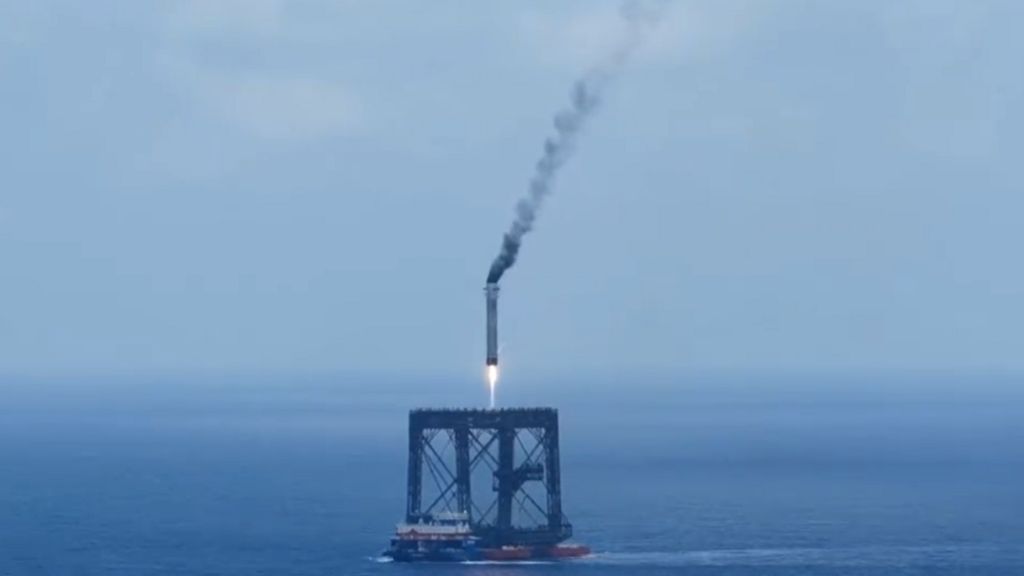
China has marked a transformative milestone in its national space exploration program, achieving the first ever successful vertical landing and recovery of a reusable rocket booster, state-run media has confirmed.
The mission, developed and executed by the China Aerospace Science and Technology Corporation, saw the Long March 10B rocket lift off from the coastal Wenchang Spacecraft Launch Site in China’s southern Hainan Province at 12:15 local time (04:15 GMT) on Friday. Approximately six minutes after the booster separated from the rocket’s upper stage, it completed a controlled vertical descent back to Earth and was successfully retrieved on a purpose-built floating recovery platform in the South China Sea.
This landmark achievement opens a new chapter in global commercial spaceflight, positioning China as an emerging competitor to the long-held U.S. dominance in reusable rocket technology. For nearly a decade, American aerospace firms have led the sector: SpaceX, founded by entrepreneur Elon Musk, completed the first successful orbital reusable rocket landing in December 2015 with its Falcon 9 booster, while Blue Origin—owned by Amazon founder Jeff Bezos—followed with its own successful landing of the New Glenn rocket in November 2025. Today, the Falcon 9 conducts roughly 150 launches annually, with each booster capable of being reused more than 30 times, drastically cutting launch costs for commercial and government clients alike.
Prior to this mission, China conducted its first experimental reusable rocket recovery test in February of this year, when the earlier Long March 10A prototype completed a controlled descent and splashed down near a recovery vessel, stopping short of a full vertical capture. The Long March 10B, which is capable of delivering a minimum payload of 16 metric tons to low-Earth orbit, is functionally comparable to SpaceX’s workhorse Falcon 9, though it employs a unique landing mechanism: unlike the Falcon 9, which lands autonomously on drone ships or ground pads, the Long March 10B uses landing hooks mounted to the booster to catch a reinforced net stretched across the floating recovery platform.
For decades, the global space industry relied on expendable rocket designs, where all segments of the launch vehicle are discarded and destroyed during ascent, driving astronomical costs for every launch. By reusing rocket boosters—the single most expensive component of any launch vehicle—organizations can slash launch costs by up to 90% in some cases, making frequent satellite deployment, deep space exploration, and even commercial space tourism far more accessible.
In reaction to the breakthrough, public shares of Chinese aerospace companies soared on domestic markets immediately after the successful landing was announced. Both China Spacesat and China Satellite Communications saw their share prices rise by 10%—the maximum daily gain allowed under Chinese financial market regulations.