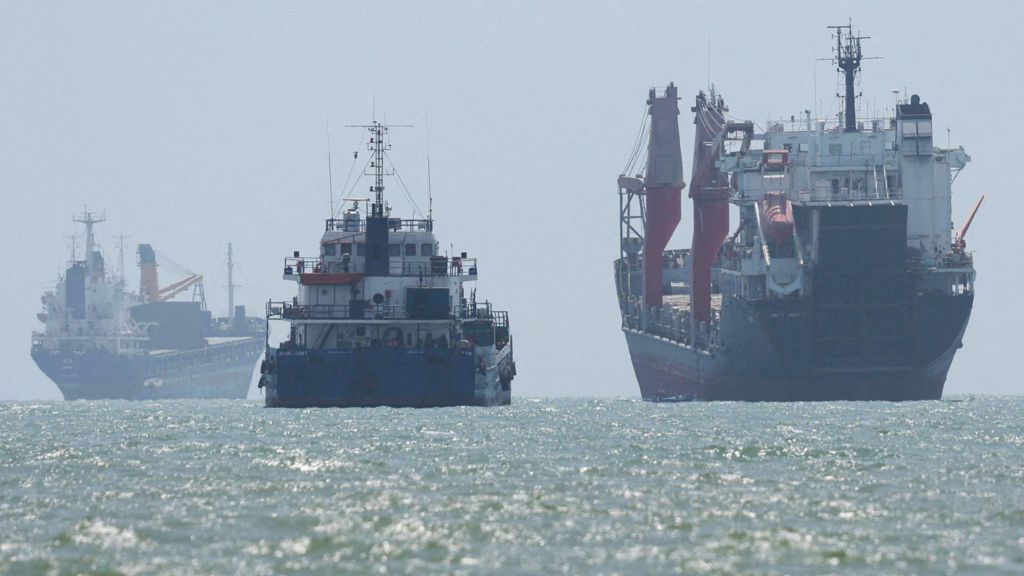
Six months into the ongoing armed conflict between the United States and Iran, Washington has launched what it calls the most aggressive financial offensive in modern history against Tehran, a move that has immediately drawn a firm pushback from Beijing, one of Iran’s key economic partners.
U.S. Treasury Secretary Scott Bessent announced the controversial new sanctions package, dubbed “Operation Economic Outcast”, during a public address on Monday. Framing the measure as an “economic D-Day” aimed at neutralizing the Iranian threat once and for all, Bessent warned that any global bank or business entity that maintains financial ties with Iran would face collective isolation alongside Tehran. He emphasized that the new measures go far beyond the already extensive U.S. sanctions regime that has been in place, noting that Treasury investigators had mapped out every hidden financial channel, intermediary and smuggling network Iran uses to evade restrictions and sell crude oil. The new package blacklists nearly 60 entities, individuals and maritime vessels linked to these operations. While Bessent declined to single out specific countries for targeted criticism, he made clear that no entity, including Chinese financial institutions, is beyond the reach of U.S. penalties. He added that President Donald Trump will imminently hold calls with global heads of state to formally request they cut all economic interactions with the Iranian government.
The announcement comes ahead of a widely anticipated high-stakes meeting between Trump and Chinese President Xi Jinping scheduled for next month. China, which remains the largest purchaser of Iranian crude oil even after trade volumes declined amid the U.S. naval blockade of Iranian ports, has swiftly rejected the new measures. Chinese Foreign Ministry spokesperson Lin Jian reiterated Monday that all economic cooperation between Beijing and Tehran is fully compliant with international law, and the country will not tolerate external interference in this legitimate partnership. “China firmly opposes these illegal unilateral sanctions, and will take all necessary measures to safeguard the legitimate rights and interests of our entities,” Lin stated.
U.S. policymakers are already bracing for potential retaliation from China, which controls the vast majority of global processing capacity for rare earths and other critical minerals—inputs that are indispensable for the production of a wide range of high-tech products globally. Beijing has previously used rare earth export restrictions as a leverage tool during past trade negotiations with Washington, and analysts do not rule out a similar move in response to the latest sanctions.
Tehran has also responded with defiance to the new measures. Iranian Economy Minister Ali Madanizadeh said the country has been anticipating the expanded U.S. restrictions for months and has already put in place a comprehensive two-year contingency plan to manage the economic fallout. He called the new sanctions another doomed venture for Washington that will end in defeat for the U.S. “We are fully prepared, and we have our own tools to navigate this challenge. We have been waiting for these measures for a long time,” Madanizadeh told Iranian state television.
The latest escalation comes as diplomatic efforts to resolve the six-month conflict have stalled, and a 60-day temporary ceasefire expired last week without any breakthrough toward a permanent peace deal. The ongoing conflict has already sent shockwaves through global energy markets: Iran effectively blocked most commercial traffic through the Strait of Hormuz, the strategically critical chokepoint through which roughly a fifth of global oil shipments pass, while the U.S. has also implemented its own naval blockade limiting Iranian exports. These combined disruptions have driven sharp increases in global oil prices over the past six months.
Even before the official responses from Beijing and Tehran, independent analysts have expressed widespread skepticism that the new sanctions will achieve Washington’s stated goals. David Oxley, chief climate and commodities economist at Capital Economics, told the BBC that the direct impact on Iran’s total energy revenue is likely to be far more limited than the U.S. claims. Oxley noted that roughly 90 percent of Iran’s current oil exports go to China, a country that has never recognized U.S. unilateral sanctions and has shown little willingness to back down to U.S. pressure in the past. “We suspect that the new package will have only a limited direct impact on Iranian energy flows in the short term,” Oxley said.
Ali Vaez, deputy director of the Middle East and North Africa Program at the International Crisis Group, echoed this assessment. Vaez explained that China has long viewed U.S. unilateral sanctions as illegitimate under international law, and only complies with multilateral sanctions approved through formal international institutions. While neighboring countries including Pakistan, Turkey and Iraq are eager to maintain positive relations with Washington, Vaez noted that these nations simply cannot afford to completely sever economic ties with Iran, a key trading partner and neighbor. He added that broad economic pressure campaigns against the Iranian government have consistently failed in the past, because the regime is willing to absorb significant economic pain and shift the bulk of the hardship onto ordinary Iranian citizens.
Beyond China, other major Iranian trade partners including India and Russia have yet to issue formal responses to the U.S. announcement as of Monday.