The global humanoid robot sector is undergoing rapid evolution, with Chinese manufacturers emerging as dominant players in mass production and market deployment, even as industry observers warn of persistent gaps between manufacturing capacity and real-world commercial demand. Against a backdrop of aging domestic populations and rising labor costs across major economies, Chinese robotics startups are positioning humanoid robots as a transformative solution for everything from industrial logistics to consumer household services, drawing strong early interest from both public and private buyers.
China and the United States currently split leadership in the global race to develop this emerging market, which Morgan Stanley estimates could grow to a $5 trillion valuation. While the U.S. maintains an edge in developing the high-performance artificial intelligence that acts as the advanced “brain” for humanoid systems, China leverages its status as the world’s manufacturing hub to lead in mass production capability, hardware supply chains, and the collection of real-world data required to train robot models.
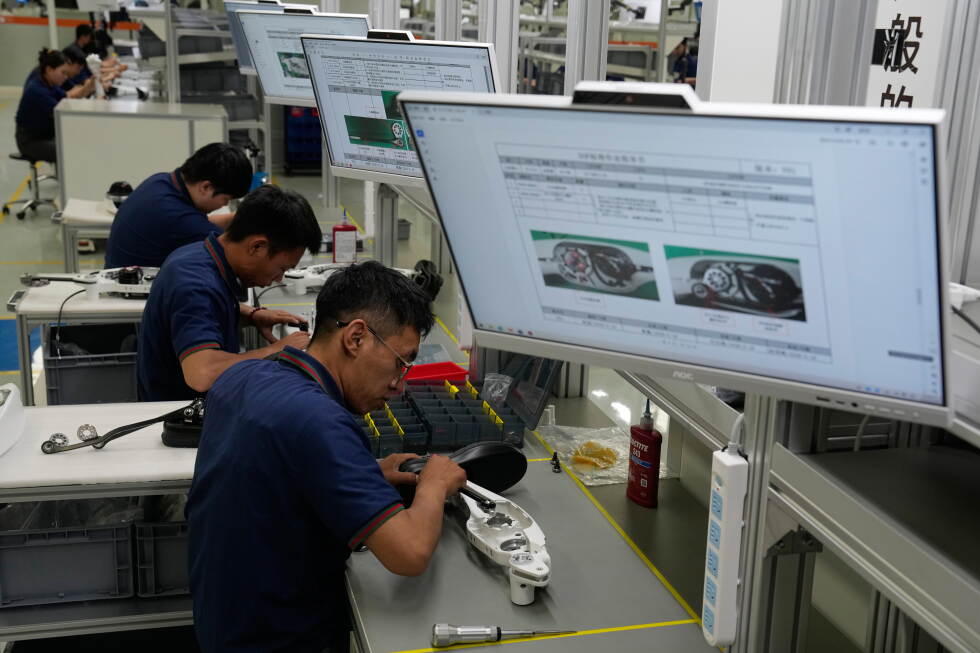
Chinese startups are already logging thousands of orders for their humanoid products, spanning government agencies, state-owned enterprises, and private commercial clients. Shanghai-based AI humanoid developer Matrix Robotics, led by former Tesla engineer Allan Zhang, counts roughly 1,000 orders for its flagship MATRIX-3 model, a 5.6-foot-tall robot with precision-controlled manipulator hands priced at approximately $99,000 per unit. Zhang revealed at a recent Macao robotics expo that clients include major coffee chains and hospitality groups, and while the firm has only produced a few hundred units to date, it has the capacity to scale output to 5,000 units annually in 2025 if demand holds.
Shenzhen-based EngineAI offers a more affordable full-sized humanoid model, with a basic configuration priced at 180,000 yuan ($26,600), targeted at roles including security patrols, museum tour guides, and public performance displays. The company’s brand and marketing head Issac Li says the firm’s next core goal is to expand deployment into more diverse everyday operational scenarios. Leading Chinese manufacturers AGIBOT and Unitree already dominated global shipments in 2025, with each delivering more than 5,000 units that year, compared to just a few hundred or fewer from top U.S. competitors like Figure AI and Tesla. Unitree, one of the sector’s standouts, reported 1.7 billion yuan ($250 million) in 2024 revenue and a net profit of over 278 million yuan ($41 million), marking it as one of the few profitable players in the young industry.
China’s industry growth has also received substantial backing from national policy. The country’s 2026-2030 five-year plan explicitly names humanoid robotics as a key frontier technology to develop, and by 2025, China was home to more than 140 humanoid robot manufacturers producing over 330 distinct models. Data from Barclays shows Chinese humanoid robots already account for roughly 85% of global supply, and Morgan Stanley projects that annual Chinese sales will more than double in 2025 to around 28,000 units. Industry analysts forecast that widespread adoption will drive down average costs from $46,000 in 2024 to roughly $21,000 by 2050, with Chinese models already selling for 20% less than comparable foreign alternatives on average thanks to localized supply chains, with some entry-level models priced below $6,000.
Despite this rapid production expansion, industry experts and even government regulators warn that significant hurdles remain before widespread commercialization can be achieved. As early as 2024, China’s Ministry of Industry and Information Technology publicly warned of the risk of industry overcapacity and a market bubble, given the slow pace of viable commercial application development. Most analysts agree that current demand lags far behind existing manufacturing capacity, with most humanoid robots still designed for demonstration rather than reliable functional work in unstructured, unpredictable real-world environments.
“The use cases of these robots are still so limited,” notes Chibo Tang of venture capital firm Gobi Partners, which invests in early-stage robotics startups. “Without the demand and without that scale from the market, these companies are not able to really go into mass production sustainably.” Samm Sacks, a senior fellow at U.S.-based think tank New America focused on Chinese technology, explains that the core economic barriers remain steep: humanoid robots are still costly to manufacture, prone to operational breakdowns, and only able to function reliably in highly controlled environments. “There’s a long way to go to get to a level of functionality where people will actually feel comfortable having them in their homes providing care for elderly or children,” Sacks added.
While industry leaders identify industrial logistics as the most near-term viable commercial market for humanoids, many factories across China and the globe already rely on cheaper, more specialized non-humanoid robotic arms for repetitive single tasks, reducing immediate demand for full humanoid systems. The challenge of commercialization is not unique to China: startups in the U.S. and Japan have also struggled to secure consistent bulk buyers for their humanoid models in industrial and service settings.
Beyond cost and functionality, developers also face the hurdle of accumulating sufficient high-quality diverse real-world data to train robots to handle multiple complex tasks. Eric Guo, founder and CEO of Shenzhen-based AI² Robotics, notes that building a large enough dataset spanning a wide range of public and private scenarios will take years of scaling. “The mass production capability in the robotic area is still at the very early stage,” Guo said.
Even with these challenges, deployment of humanoid robots in real-world Chinese settings has accelerated sharply over the past year, aided by greater public openness to new technology compared to many other markets. Ye Tian, a former Apple engineer and CEO of Chinese robotics startup RoboScience, notes that Chinese consumers are “used to this rapid change in terms of technology,” creating a more receptive market for early-stage testing.
Industry insiders remain optimistic about long-term potential, even as they acknowledge near-term headwinds. Lian Jye Su of technology research firm Omdia argues that as the technology matures, humanoids will increasingly take over heavy-lifting and repetitive mundane tasks in warehouses, factories, and ports. Matrix Robotics’ Allan Zhang adds that humanoids can also fill critical gaps in dangerous or labor-short sectors, and predicts a massive untapped consumer market for robots that handle household chores across hundreds of millions of Chinese homes. Early consumer tests already hint at both the potential and remaining flaws: Beijing content creator Yang Ning, who recently tested a robotic cleaning helper that could sort shoes, fold laundry, and replace garbage bags, called the demonstration “amazing” but noted the model was still inefficient, too large, and difficult to maneuver in small living spaces.
Looking ahead, Omdia forecasts that annual shipments of advanced humanoid robots could surpass 1 million units by the early 2030s, as costs fall and functionality improves, turning a niche experimental sector into a global technology staple.