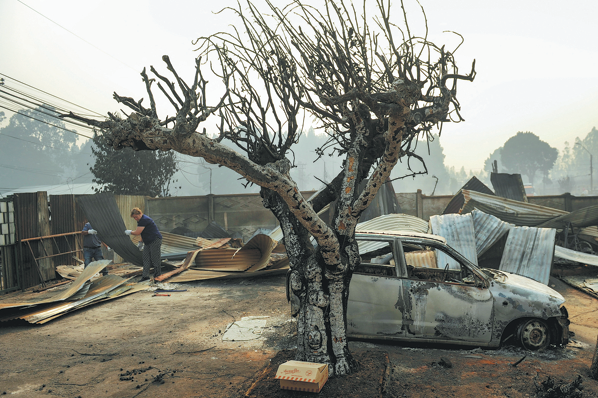
Southern Chile continues to confront devastating wildfires for the third consecutive day, with the confirmed death toll rising to 20 as flames consume entire communities. The infernos, which ignited on Saturday across the Nuble and Biobio regions approximately 500 kilometers south of Santiago, have been exacerbated by unseasonably warm temperatures and powerful winds characteristic of the southern hemisphere’s summer peak.
Official reports indicate approximately 1,000 residences have been either completely destroyed or severely damaged. Chilean President Gabriel Boric confirmed that while firefighting crews have successfully contained certain blazes, numerous fires remain highly active, with new outbreaks emerging in the neighboring Araucania region.
The government has declared a ‘state of catastrophe’ in the hardest-hit areas, enabling military deployment to assist in disaster response. Soldiers now patrol devastated landscapes where melted automobiles, twisted metal skeletons, and residential ruins testify to the fires’ destructive power.
Survivors recount terrifying escapes as walls of flame advanced toward residential areas. Yagora Vasquez, a resident of the severely impacted port town of Lirquen, described grabbing her son and fleeing while her brother rescued their dog. Many residents returned Monday to sift through ashes and debris, attempting to salvage remnants of their former lives.
The tragedy carries particular irony for some survivors who previously relocated inland following Chile’s devastating 2010 tsunami that claimed over 500 lives, only to confront what one resident termed ‘a wave of fire, not water.’ Mareli Torres, who lost her two-story family home of nearly two decades, characterized the wildfire destruction as ‘much more devastating’ than previous natural disasters.
More than 3,500 firefighters continue battling blazes amid temperatures hovering around 25°C, slightly cooler than weekend conditions. Scientific research from Santiago’s Center for Climate and Resilience Research indicates climate change has established conditions for extreme fire seasons through prolonged drying and warming trends in south-central Chile.
The current catastrophe echoes previous fire emergencies, including February 2024 fires near Viña del Mar that killed 138 people. This ongoing disaster coincides with extreme weather events across Latin America, including heatwaves exceeding 40°C in Brazil and wildfires in Argentina’s Chubut province, highlighting regional climate vulnerabilities.