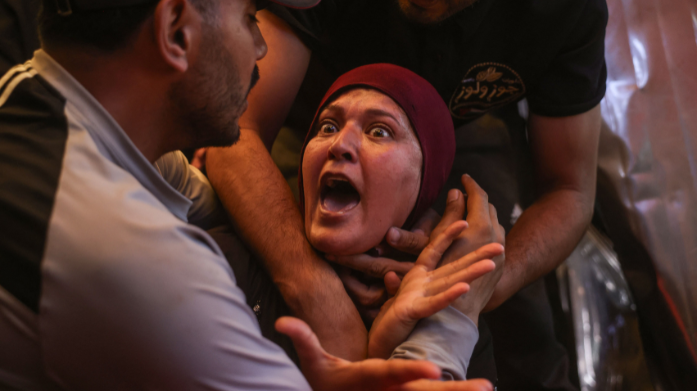
A fresh wave of Israeli military operations across the Gaza Strip has left at least 13 Palestinians dead, including children, a teenage fisherman, and police officers, in violence that spans from Sunday to Monday, according to Palestinian official reports and local media. The death toll breaks down to nine fatalities recorded on Sunday, with four additional lives lost on the second day of attacks.
Among the most recent deadly incidents, an Israeli airstrike launched early Monday hit temporary displacement tents in the al-Mawasi region of southern Gaza, a area that has been repeatedly labeled a “safe zone” for displaced Palestinians by Israeli authorities, claiming the lives of two civilian residents. A separate strike in the densely populated northern town of Jabalia killed two more people, one of whom was a child.
The rising death toll also includes 14-year-old Hadeel Ayman Jundiya, who succumbed to critical injuries she sustained in earlier Israeli airstrikes on Gaza City on Sunday. In the central Rimal neighborhood of Gaza City, four civilians were killed when Israeli forces targeted a vehicle carrying civilians near Palestine Square.
Off the central Gaza coast near Deir al-Balah, Israeli naval forces opened fire on Palestinian fishing boats, killing 15-year-old fisherman Muhammad Musa Abu Giab, who had headed out to sea to provide food for his family. In a social media post confirming the teenager’s death, journalist Ramy Abdu highlighted the deadly reality of daily life in Gaza: even searching for basic sustenance has become a death sentence. Zakaria Bakr, coordinator of the Union of Fishermen’s Committees in Gaza, added that Israeli naval forces also detained multiple other fishermen working in the area during the same incident.
In southern Gaza’s Khan Younis district, an Israeli strike on a Palestinian police checkpoint located west of the city killed five officers.
Parallel to the ongoing military violence, the Israeli Coordination and Government Activities in the Territories (COGAT), the body that manages Israeli activities in Gaza and the West Bank, announced Sunday that the Karem Abu Salem (Kerem Shalom) crossing—Gaza’s primary entry point for humanitarian aid deliveries—would be closed following renewed cross-border conflict with Iran. The border crossing was reportedly reopened on Monday morning, but persistent concerns remain that escalating regional hostilities could once again cut off critical aid flows into the blockaded enclave.
This latest disruption to aid access comes months into a humanitarian crisis that has already left Gaza desperately short of nearly all essential supplies. Even after a US-brokered ceasefire agreement was signed in October 2024, which aimed to end two years of large-scale Israeli military operations in Gaza by halting offensive attacks and scaling up humanitarian aid deliveries, Israel has consistently violated the terms of the truce. Under the agreement, Israel was required to allow 600 aid trucks into Gaza daily, but in practice, only an average of 200 trucks have entered each day.
For months, United Nations agencies, international human rights organizations, and Palestinian residents have sounded the alarm over catastrophic shortages of food, clean drinking water, fuel, medical medication, and other basic necessities. Even during the formal ceasefire period, Israeli forces have continued to carry out targeted airstrikes and ground operations across Gaza, with the Palestinian Ministry of Health recording at least 970 Palestinian deaths since the truce took effect. Violence has intensified steadily in recent weeks, with 119 Palestinians killed in the month of May alone.
Since the start of large-scale Israeli military operations in Gaza in October 2023, nearly 73,000 Palestinians have been killed by Israeli forces. Thousands more remain unaccounted for, trapped under the rubble of destroyed buildings across the enclave, with little hope of recovery efforts amid ongoing access restrictions and bombing.