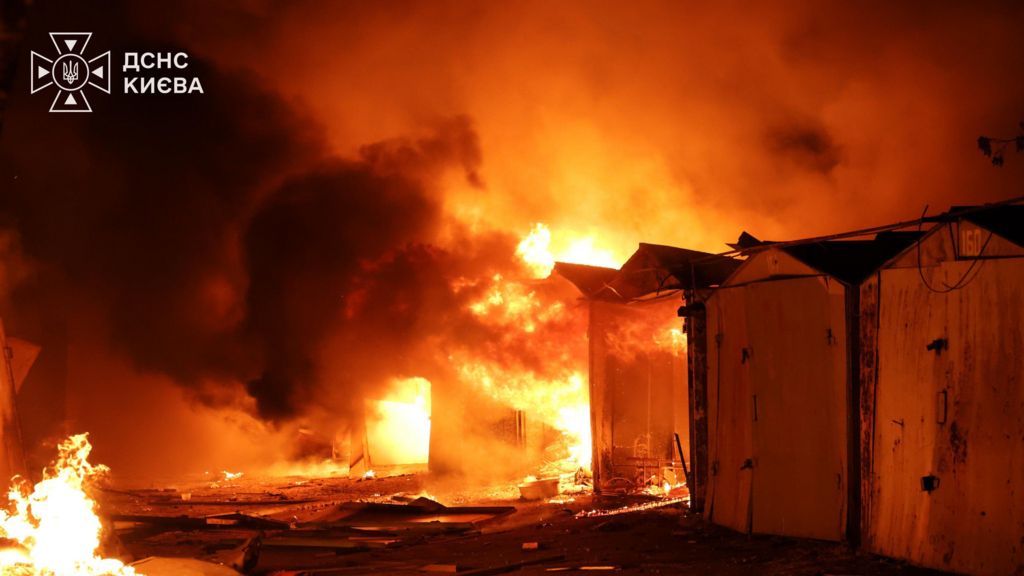
A new wave of overnight Russian ballistic missile strikes targeting areas near Kyiv has left at least three people dead — one of them a child — and three more wounded, marking a sharp escalation of hostilities just days after a broader series of attacks across Ukraine claimed 21 lives.
The attacks, which unfolded in the early hours of Saturday, targeted locations east of Ukraine’s capital, with residents reporting deafening, powerful explosions across the region. Falling missile debris damaged multiple residential apartment blocks and parked civilian vehicles, and ignited a separate blaze at a commercial structure, according to Timur Tkachenko, head of Kyiv’s regional military administration.
Kyiv Mayor Vitaly Klitschko confirmed via Telegram that emergency response teams were working to contain two large fires: one at a multi-story building and another at a fuel storage facility within the city limits. Ukraine’s State Emergency Service (DSNS) published on-the-ground images showing raging fires at garages, a local business, and a residential outbuilding in Kyiv’s Holosiivskyi district, noting that the full count of casualties is still undergoing verification.
The attack comes as Ukrainian President Volodymyr Zelensky touched down in Belgrade for his first official visit to Serbia, a trip scheduled amid growing Ukrainian warnings that dwindling stocks of anti-missile interceptors have severely weakened the country’s ability to fend off Russian air assaults. Zelensky has made it a priority to build broader international support for Ukraine’s defensive efforts, but the trip faces inherent diplomatic friction: Serbian President Aleksandar Vučić has repeatedly refused to join international sanctions against Russia, despite Serbia’s ongoing bid to earn membership in the European Union. The Balkan country has provided humanitarian aid to Ukraine and pledged to support post-war reconstruction efforts, and Friday’s scheduled talks between the two leaders were expected to cover bilateral economic ties, Serbia’s EU accession process, and regional and global security issues.
In comments earlier this week, Zelensky highlighted the human cost of delayed arms supplies from Western and international partners. He stated that holdups in deliveries of anti-ballistic defense systems have directly led to “horrific casualties and widespread destruction,” emphasizing that expanded interceptor capabilities “could have saved countless lives” during recent deadly Russian strikes. He added that the volume of interceptor supplies from allied nations has dropped “significantly” throughout 2024, leaving critical gaps in Ukraine’s air defense network.
The latest exchange of hostilities follows a series of targeted Ukrainian strikes deep inside Russian territory earlier this month, which hit two major Russian oil refineries and destroyed several Moscow-linked commercial vessels operating in the Black Sea. Zelensky confirmed the strikes were a deliberate strategy to reduce the oil revenues that Russia relies on to fund its full-scale invasion of Ukraine.
Recent diplomatic mediation efforts aimed at de-escalating the 2.5-year conflict have stalled, creating a vacuum that has paved the way for a sharp uptick in offensive attacks from both Russian and Ukrainian forces in recent weeks.