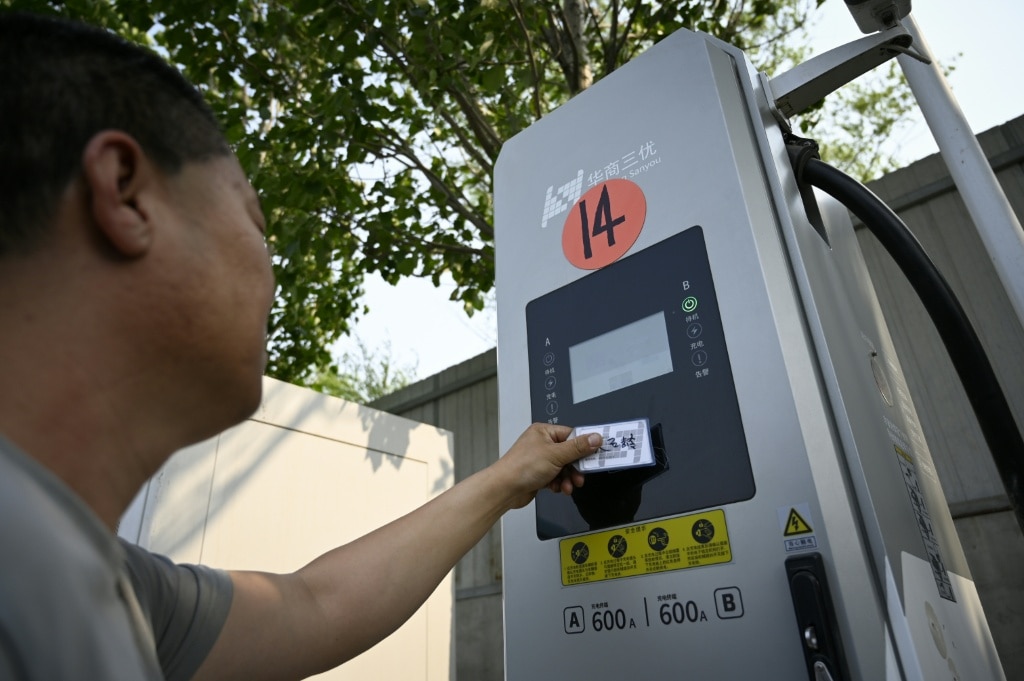
An hour’s drive from central Beijing, a gritty open-air charging lot hums with nonstop activity: heavy-duty trucks roll in, top up their batteries in minutes, and pull out again to deliver goods across northern China. This small stop is just one thread in a fast-expanding web of electric truck infrastructure that is upending China’s $500-billion logistics industry, and poised to reshape global road freight in the coming years.
While China’s global leadership in electric passenger cars has been well documented for over a decade, the transition of heavy-duty commercial trucks to zero-emission powertrains is a far more recent shift, one that has accelerated sharply over just the past four years. Industry analysts and market data show the transition is moving far faster than many predicted, driven by falling battery costs, aggressive policy support, and a growing network of public charging and battery-swapping stations that solve the core range concerns that long held back adoption.
Experts mark last year as the turning point for heavy-duty electric vehicle adoption in China. “Last year was the breakthrough for heavy electrified vehicles in China,” explained Lauri Myllyvirta, co-founder of the Centre for Research on Energy and Clean Air and a leading analyst of China’s energy transition. “If the infrastructure is there, the economics are there for an increasing number of logistics routes and requirements.”
Market data bears this out: new energy (predominantly electric) truck models accounted for 29% of all new truck sales in China in 2025, up from just 14% in 2024, according to Commercial Vehicle World, a Beijing-based market intelligence firm. As recently as 2021, electric trucks made up less than 1% of total sales. Manufacturers and analysts widely expect the electric share of sales to cross 50% within the next three to five years, a milestone that would lock in the end of diesel truck growth in China.
For the drivers who operate these trucks every day, the shift to electric models has brought immediate quality-of-life and cost improvements. At the Miyun District charging station, 43-year-old truck driver Wang, who switched to an electric rig last year, described the difference from his old diesel model as night and day. “It’s such a breeze!” he told AFP while connecting his truck to a fast charger. “My old vehicle had over 10 gears, and its operation was so cumbersome. But with this one, you don’t have to do a thing — it’s all automatic.”
Wang added that the push toward electric trucks is driven by both national policy incentives and basic market economics that make zero-emission models more profitable for logistics companies and independent drivers alike. “It’s just survival of the fittest. Now, with freight expenses and everything, people are trying to earn a bit more, and this one has lower operating costs.”
Another driver at the station, Zhang, switched to an electric Howo-branded truck, built by state-owned manufacturer Sinotruk, two months ago after years driving a natural gas-powered rig. Hauling sand and gravel for short-haul construction trips around Beijing, Zhang noted that his new truck has a maximum range of 240 to 250 kilometers, which works for his daily route but is not yet suited for long-haul cross-country trips. “The power is pretty strong, the acceleration is fast. It’s all about speed, but the range is a bit lacking,” he said.
As domestic adoption grows increasingly rapid, Chinese electric truck manufacturers are now setting their sights on international markets, following the same expansion path that turned Chinese passenger EV brands into global competitors. “Similar to passenger vehicles, China’s heavy truck manufacturers are beginning to view export markets as an inevitable strategy due to rising competition and the eventual saturation in the Chinese market,” said Christopher Doleman, an energy analyst at the Institute for Energy Economics and Financial Analysis.
Doleman added that recent global energy market volatility sparked by the ongoing Middle East war has acted as an unexpected accelerant for this global transition. “There is likely to be higher demand for electric heavy-duty vehicles as fleet owners try to minimise their vulnerability to volatile diesel costs,” he explained. Han Wen, founder of Belgium-based electric truck startup Windrose Technology, confirmed that the shift has already boosted demand for zero-emission models globally.
Founded in 2022, Windrose leverages China’s world-leading EV supply chain to compete in the emerging global long-haul electric truck market, going head-to-head with Tesla’s Semi. Han notes that range remains the biggest technical barrier to full adoption, but his company’s current models already deliver up to 700 kilometers on a full charge, with plans to push that to 1,000 kilometers by 2030. With road approval already secured across Europe, the U.S., China and South America, Windrose is ramping up production rapidly: it targets building 1,000 trucks this year, 10,000 in 2026, and 100,000 annually by 2030.
For industry insiders like Han, the economic case for electric trucks is already settled, and the end of diesel dominance is not far away. “Economically, there is no more question at all that electric is superior,” he said. “I think we’re right on the cusp of a total obliteration of diesel trucks as a product category.”