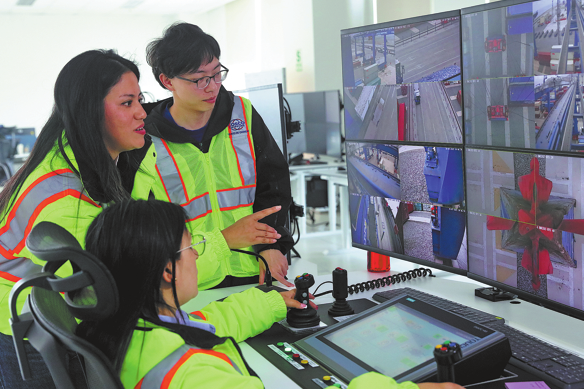
Peru’s Chancay Port has completed its inaugural year of commercial operations, establishing itself as a pivotal maritime gateway transforming Sino-Latin American trade dynamics. The facility, which marked its first anniversary on November 15, has rapidly gained significance amid growing cargo flows between China and South American nations.
According to Carlos Aquino, Professor of International Economics at Peru’s National University of San Marcos, the port is already reshaping regional trade patterns. “The volume of cargo departing directly for China continues to increase, encompassing not only Peruvian exports but also goods from Ecuador, Chile, and Colombia,” Aquino noted. This direct routing reduces transit duration by approximately ten days, yielding an estimated 30 percent reduction in freight expenses.
Customs data reveals substantial trade growth through the port, with Chinese imports via Chancay exceeding $759 million in value during 2025. Vehicles and machinery constitute the primary commodities, while 79 percent of customs declarations designate China as their destination, underscoring the deepening commercial relationship.
Javier Eduardo Franco Castillo, Peru’s Customs Administration Chief, emphasized the nation’s commitment to enhancing trade security and efficiency, stating: “We continue to facilitate international logistics chains and combat smuggling to support trade with the world’s main economies, including China, our principal trading partner.”
The port’s emergence has stimulated competitive responses within Peru’s maritime sector. The country’s largest port at Callao is undertaking infrastructure upgrades to remain competitive, now offering direct connections to Chinese and Asian ports. This heightened competition has already reduced freight costs for both Peruvian exporters and importers.
Beyond port operations, Chancay’s influence extends to broader infrastructure development. Aquino highlighted how increased goods movement is revitalizing proposals for highway projects and the long-discussed bi-oceanic railway connecting Peru and Brazil. Additionally, two export-processing zones planned near the port could enable Peru’s transition from raw material exports to value-added manufacturing.
The port’s improved efficiency particularly benefits perishable agricultural exports including blueberries, grapes, and avocados, while Chinese imports such as electronics, automobiles, and industrial machinery have become more affordable. Chancay has also emerged as a crucial entry point for Chinese electric vehicles expanding across South American markets.
Aquino concluded that Peru is evolving into both the entry point for Chinese and Asian goods in South America and the exit port for South American exports to China and Asian markets, positioning Chancay to become a major logistics hub connecting China and Latin America.