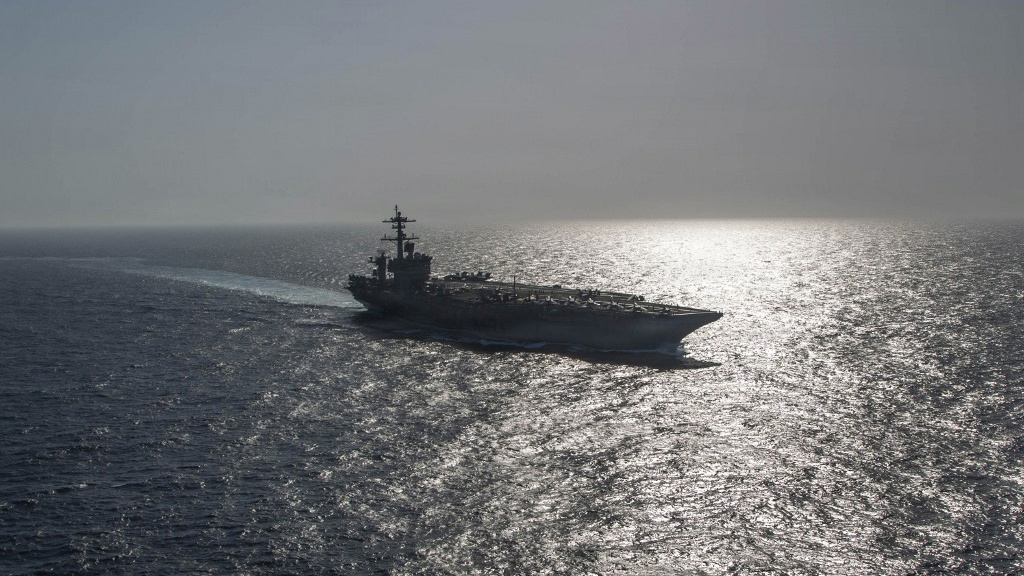
Against a backdrop of months-long heightened tensions between the United States and Iran over control of the strategic Strait of Hormuz, the top commander of U.S. Central Command, Admiral Bradley Cooper, has traveled to the Arabian Sea to inspect the USS Abraham Lincoln, the nuclear-powered aircraft carrier leading the U.S. blockade of Iranian maritime activity.
Cooper’s on-board visit comes amid growing public scrutiny of the Lincoln’s unprecedented deployment: the carrier and its 5,000-plus crew have spent more than 250 consecutive days on station in the Middle East without a single scheduled port call — a break from standard deployment protocols that have left the crew grappling with widespread mental health distress, dwindling supply stocks, and plummeting morale.
During his remarks to the crew Saturday, Admiral Cooper framed the extended deployment as a historic milestone, stating, “History will record this deployment as one of the most operationally intense and consequential of the modern era.” But his words come as multiple alarming incidents have underscored the depth of the crew’s crisis. CNN first reported earlier this month that a sailor wearing a life vest fell overboard from the Lincoln; the service member was rescued within an hour and evacuated from the ship for urgent medical care, according to the network. That incident was far from an isolated event. U.S. military-focused publications Stars and Stripes and Navy Times have separately documented a second incident where crew members intervened to stop a fellow sailor from jumping overboard, as exhaustion and mental strain spread across the vessel. In testimony shared at a public town hall with Acting Secretary of the Navy Hung Cao, one spouse told officials her husband assigned to the Lincoln has become so despondent that he “hopes he doesn’t wake up tomorrow,” Stars and Stripes reported.
In response to mounting concerns from U.S. lawmakers over the well-being of the Lincoln’s crew, Pentagon officials confirmed this week the carrier will soon rotate out of the region. It will be replaced by the USS George Washington, the Wall Street Journal reported Thursday. The planned rotation comes just after U.S. Secretary of War Pete Hegseth publicly stated the U.S. blockade of Iran could be maintained “indefinitely,” even as clashes over control of the Strait of Hormuz — a critical chokepoint through which 20% of the world’s oil supplies pass — continue with no ceasefire agreement on the horizon. Tensions between Washington and Tehran have escalated sharply in recent months: Iran has targeted commercial vessels carrying oil and petroleum products owned by Gulf states outside the strait, while the U.S. has launched reciprocal strikes against vessels linked to the Iranian government and military.
While nine-month at-sea deployments are standard for U.S. aircraft carriers during active wartime operations, even extended deployments almost always include regular port stops to restock essential supplies, perform maintenance, and give crew members critical time off to rest and recover. The Lincoln’s extended stretch without any port access is highly unusual and has amplified strain on personnel.
Admiral Cooper’s regional trip also included stops in Israel, Bahrain, Iraq, Jordan, Saudi Arabia and the United Arab Emirates, where he held high-level talks with senior political and military leaders across the Gulf and Middle East, a Centcom spokesperson confirmed.
On Sunday, Iran’s armed forces general staff issued a defiant public statement, pledging to achieve the “complete defeat” of both the U.S. and Israel in the Middle East. The statement emphasized that Iran’s legacy of “resistance” to Western and Israeli influence has been fully passed to a new generation of Iranian fighters.