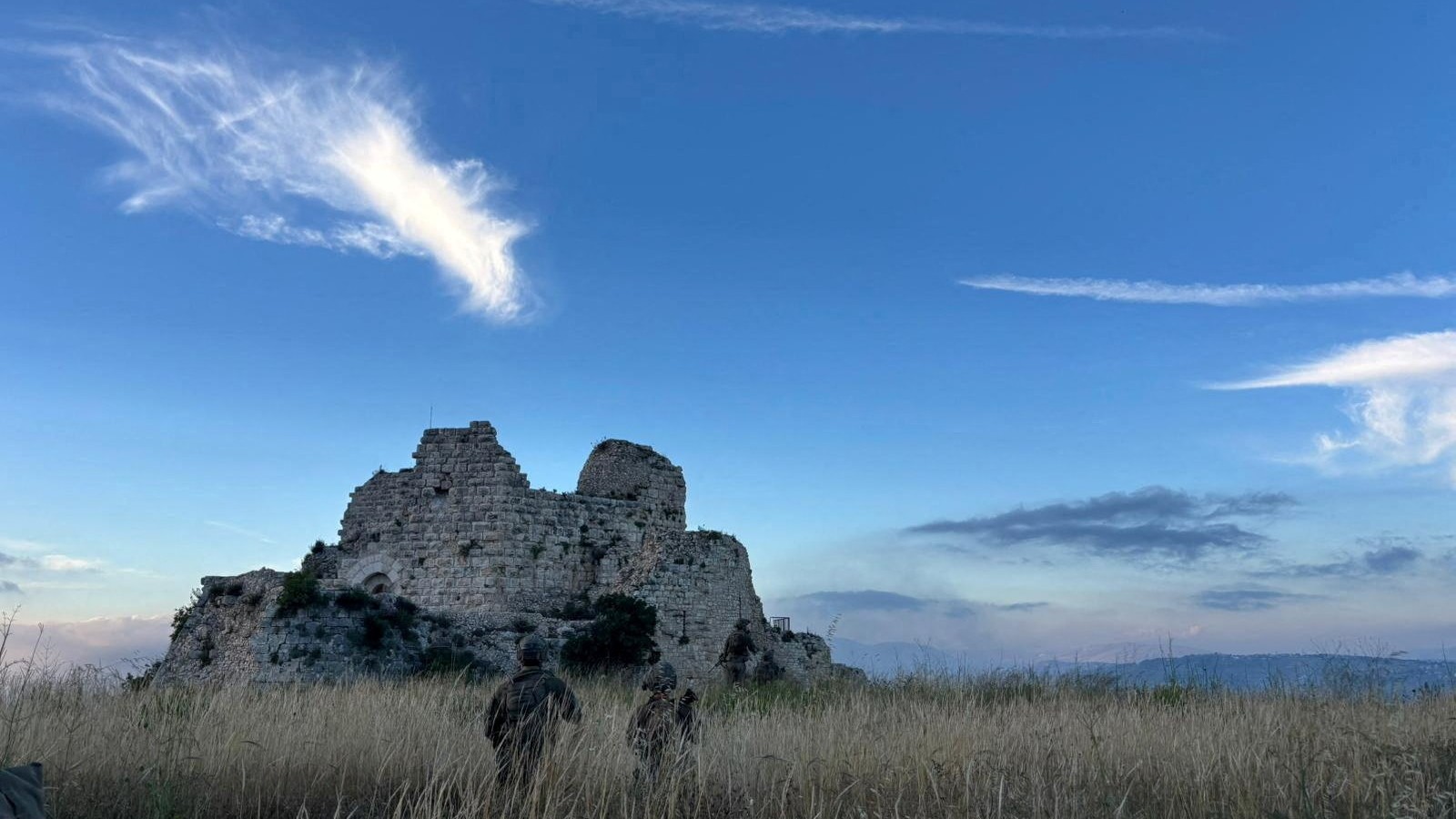
Last week, Israel released footage of its troops capturing Lebanon’s iconic Beaufort Castle, a 1,000-year-old Crusader-era fortress overlooking sweeping vistas of southern Lebanon. The imagery, which shows Israeli flags flying over the ancient battlements, was crafted to project military dominance, but it also hints at a far broader, long-term territorial ambition playing out across southern Lebanon and neighboring Syria. When Israeli soldiers scanned the fortress’s ancient basalt walls, they would have encountered another, more modern feature: concrete bunkers, leftover from a decades-long occupation that ended 25 years ago. Between 1982 and 2000, the Israeli military maintained a permanent garrison at Beaufort Castle, which became a repeated target of Hezbollah guerrilla attacks that ultimately forced Israel’s full withdrawal. A quarter of a century later, Israel is once again building fortified military outposts on occupied high ground across newly seized territory, this time stretching from the Mediterranean coast of Lebanon across the Golan Heights to Syria’s Yarmouk Basin on the Jordanian border.
Analysis of months of satellite imagery, alongside on-the-ground testimony from Lebanese, Syrian and Hezbollah sources, confirms that Israel has engaged in a systematic, large-scale construction of military infrastructure across occupied areas of both countries since late 2024, a development that strongly indicates a plan for permanent occupation. Multiple regional military and political sources tell Middle East Eye that despite repeated Israeli pledges of withdrawal, there is no expectation that Israel will abandon these new positions. As one senior Lebanese military source put it: “If you are planning to withdraw, you do not carry out this much work.”
Israel first launched its full-scale invasion of Lebanon in October 2024, escalating a year of cross-border clashes that Hezbollah initiated in protest of Israel’s military campaign in Gaza. By the time Israel signed a ceasefire agreement on 27 November 2024 that committed it to full withdrawal, Lebanon had already suffered catastrophic damage: most of Hezbollah’s senior leadership had been killed, more than 4,000 Lebanese civilians and combatants had died in Israeli strikes, and over one million people had been displaced from southern Lebanon and parts of Beirut. The terms of the agreement required Israel to complete its withdrawal within 60 days, in exchange for Hezbollah moving its forces north of the Litani River. But even after an extended deadline passed, Israel refused to withdraw from five key hilltop positions it seized in the first days of the invasion. All five outposts are strategically located on high ground that offers unobstructed surveillance over large swathes of southern Lebanon, running along nearly all of Lebanon’s 79-kilometer border with Israel. The outposts overlook multiple depopulated Lebanese towns and villages, many of which have already been completely leveled by Israeli strikes.
Satellite imagery tracking construction at these sites shows that work began as early as October 2024, starting with the demolition of nearby civilian structures. Israel used air strikes, controlled detonations and bulldozers to raze entire neighborhoods and border communities. Over the following months, the imagery records the widening of access roads, large-scale land clearing, and the construction of earthen defensive fortifications. By the start of 2025, prefabricated accommodation units and military vehicles began appearing at the sites. Most notably, large-scale construction accelerated after the ceasefire took effect, when Israel had formally agreed to withdraw. Between January and September 2025, Israel rapidly expanded the outposts: fortifications were widened, heightened and extended along key access roads, base perimeters were expanded, roads were further broadened, and concrete watchtowers were erected. By November 2025, satellite imagery shows a sharp increase in both accommodation capacity and military vehicle presence at all five sites. “For 15 months, we watched the Israelis bring in reinforcements, conduct drilling works, and open roads around these sites – steps that suggest an intention to remain permanently,” the Lebanese military source explained.
Israel is also making use of, and expanding, patrol tracks originally built by the United Nations Interim Force in Lebanon (UNIFIL), the UN peacekeeping mission that has operated in the region for 20 years and is scheduled to end operations in 2027. Israel’s westernmost outpost at Labbouneh sits just 150 meters from an existing UNIFIL base and just two kilometers from UNIFIL’s coastal main headquarters, while its outpost at Tal Dowary near Houla is just 1.5 kilometers from a UNIFIL peacekeeping position.
A source close to Hezbollah describes the outposts as dual-purpose operational hubs: “They are designed defensively, making it impossible to approach them, while also allowing offensive operations to be launched from them.” The source, who has direct knowledge of developments in southern Lebanon, says Israel intends the bases to support a five-kilometer deep occupied buffer zone inside Lebanese territory. Hostilities resumed in early March 2025 after Israel killed Ali Khamenei, Iran’s supreme leader and a key spiritual figure for Lebanese Shia communities, prompting Hezbollah to resume attacks amid fears of a new full-scale Israeli invasion. Weeks later, Israeli Prime Minister Benjamin Netanyahu approved the construction of additional new outposts inside Lebanese territory. Serving Israeli soldiers told Israeli newspaper Haaretz that these newer positions are clearly not temporary. “These are permanent outposts that will be manned for a long time,” one soldier said. “Nobody really knows where this is going.”
Despite Israel’s fortified presence, the effectiveness of its southern Lebanon outposts remains open to question. While Hezbollah suffered heavy losses during the invasion and subsequent ceasefire, the group has already reorganised its forces in southern Lebanon within view of Israeli positions. Since hostilities resumed, Hezbollah has carried out repeated attacks across border areas, and Israeli troops have failed to secure full control over villages located near their bases, including the town of Khiam. Israel’s hold on newer outposts has been even more fragile: Hezbollah fighters even managed to film themselves removing an Israeli flag from an outpost near the western Lebanese town of al-Bayyada.
A new U.S.-backed ceasefire proposal was presented to both parties last Thursday, but the text makes no mention of requiring an Israeli withdrawal from the occupied areas, which now make up roughly one-fifth of Lebanon’s total territory. Israel announced its acceptance of the plan but has continued to carry out strikes in Lebanon and seize additional territory. Hezbollah secretary-general Naim Qassem has said the group rejects any ceasefire that does not include a commitment to full Israeli withdrawal from all Lebanese territory. A Hezbollah source warns that Israel is pursuing a strategy to permanently separate southern Lebanon from the rest of the country, noting that the previous ceasefire allowed Israel to solidify its permanent foothold. “According to current assessments, Israel is now trying to entrench itself in every position it has reached and turn those positions into fixed centres,” the source said. “Yet so far, beyond the positions it already established, fortified and turned into centres during the previous war, everything newly created remains unfortified and vulnerable at any moment to attacks by the resistance.”
Israel’s permanent occupation push is not limited to Lebanon. The end of the 2024 Lebanon invasion coincided with the collapse of Bashar al-Assad’s government in Syria, opening a path for Israel to seize new territory in the country’s southwest. On 27 November 2024, the same day the Lebanese ceasefire took effect, Syrian opposition forces launched an offensive from their Idlib stronghold that reached Damascus and toppled Assad within two weeks. As opposition leader Ahmed al-Sharaa’s forces consolidated control of the capital, Israel launched widespread strikes on Syrian military sites and moved its own troops into and beyond the UN-monitored neutral buffer zone along the Golan Heights. One of the first strategic sites Israel seized was the summit of Mount Hermon, the Levant’s second-highest peak at 2,814 meters. Netanyahu made a high-profile visit to Mount Hermon that December, publicly stating that Israeli forces would not withdraw from the summit for at least a year. As of mid-2026, Israeli troops remain in control of the peak.
Israel has now built a 70-kilometer chain of outposts stretching from the summit of Mount Hermon to the Yarmouk River on the Syrian-Jordanian border. Middle East Eye has identified at least 10 new Israeli bases and observation posts in newly occupied Syrian territory since the fall of Assad, eight of which are located inside the original neutral buffer zone. The buffer zone was established along the Purple Line – the armistice boundary of the Israeli-occupied Golan Heights – after the 1973 Middle East war, and is monitored by the UN Disengagement Observer Force (UNDOF). Satellite imagery also shows Israel has built extensive lines of earthen fortifications along the Purple Line, including raised earthen mounds that allow military vehicles to access high vantage points for surveillance.
Carmit Valensi, head of the Syrian program at Israel’s Institute for National Security Studies (INSS), a leading Israeli security think tank, says Israel’s push into Syria is driven by deep distrust of the new Syrian government led by al-Sharaa. Valensi says the 7 October 2023 Hamas attacks on southern Israel “shattered” the long-standing Israeli assumption that deterrence – “the main pillar of Israeli strategy” – would prevent enemy attacks. “From that point on, Israel decided to adopt what we might call the buffer zone strategy, which obviously we can see clearly in Syria and Lebanon and Gaza,” she told Middle East Eye.
Israeli bases are now distributed across three Syrian provinces: Quneitra, Daraa, and the Damascus Countryside. Mirroring the pattern in Lebanon, earthen berms with embedded watchtowers surround fortified troop accommodation and vehicle staging areas. All bases are located on strategic high ground, key road junctions, and terrain that overlooks corridors connecting the Golan Heights to Damascus. At the Tulul al-Humr outpost, Israeli troops are positioned just 40 kilometers from the Syrian capital. “In western Daraa, positions were selected specifically because they provide commanding oversight over valley entrances and surrounding villages,” a military source from the new Syrian government explained. Many of these bases are also located close to UNDOF peacekeeping positions: one outpost north of the village of Hader, in the foothills of Mount Hermon, sits just 500 meters from an existing UNDOF base. Notably, as Israel expanded its own base over the course of several months, the adjacent UNDOF position also expanded.
There are key differences between Israel’s construction in Syria and its activity in Lebanon. Almost all of Israel’s new Syrian outposts are built on land previously controlled by Assad’s Syrian Arab Army. “Initially, Israel’s ground operations in southwestern Syria focused on the destruction of former Syrian Arab Army positions, followed by the construction of new military infrastructure,” the Syrian military source said. “This process included mine-laying operations, the demolition of civilian homes, forced displacement, and the destruction of agricultural land and forested areas – methods that strongly resemble practices observed in both Gaza and the West Bank.” For example, satellite imagery shows Israel has expanded an old Syrian position on a hilltop near Hader, converting it into a large, fully functional base with new buildings and support facilities. In southern Syria, Israel has seized the al-Jazira military barracks, a hilltop position that overlooks both the Yarmouk and Ruqqad rivers. Near Quneitra, the provincial capital that Israel reduced to a ghost town decades ago, two new Israeli bases have been built on the ruins of old Syrian military compounds.
Unlike in southern Lebanon, where Israel repurposed pre-existing dirt roads and tracks for its outposts, Israel has carved entirely new roads into Syrian terrain to connect its bases, with links extending back into the Golan Heights and the main Golan town of Majdal Shams. Most of these new roads have been paved to allow rapid movement of troops and equipment. The largest new Israeli base in occupied Syria is located at Jubata al-Khashab, a staging post built in a forested area near the Purple Line, connected by paved roads to more advanced forward outposts. Satellite imagery confirms the base hosts large numbers of military vehicles and weapons storage facilities. “In terms of the characteristics of these positions and bases, we can assume that there is a long-term intention,” Valensi said.
Across both Lebanon and Syria, a clear pattern has emerged: Israel systematically expands and fortifies its military infrastructure during periods of supposed ceasefire and diplomatic negotiation. While there is no formal active conflict between Israel and the new Syrian government, the Syrian leadership has approached the United States to negotiate an agreement that would end Israeli occupation and strikes on Syrian territory. “Ceasefires have increasingly functioned as diplomatic delays that provide Israel with opportunities to entrench itself militarily, exploit operational gaps, and consolidate territorial control. In practice, there is little evidence of a genuine diplomatic process,” a senior Syrian military source said. The source added that Israel rapidly expanded its presence in Syria after the U.S. established a “joint fusion mechanism” for coordination and de-escalation between the three countries in January 2026. Since that agreement was signed, Israeli checkpoints have appeared on multiple key roads in western Daraa between Tal Ahmar al-Gharbi and the al-Jazira barracks. “Data collected between February and May indicates that Israel is not genuinely pursuing negotiations or diplomacy. Rather, it is using diplomatic processes as windows of opportunity for long-term entrenchment,” the source said.
Valensi warns that Israel’s permanent occupation of large areas of Syria is ultimately unsustainable, noting that the Israeli military has already been drained by two and a half years of constant regional conflict. She also argues that the long-term costs of a permanent aggressive Israeli presence in Syria far outweigh any tactical benefits. “In my opinion, it causes much more damage than advantages,” she said. According to Syrian military sources, Israel has carried out an average of 17.5 raids on Syrian villages each month over the past year, alongside mass arrests, periodic shelling of farmland, and forced evictions of local communities. Valensi notes that this sustained pressure has already shifted Syrian public discourse toward Israel. “We clearly see the change and the shift in the Syrian discourse towards Israel from rather more moderate, restrained stances into much more radical ones,” she said.