
The Indian government has firmly dismissed social media allegations that the Light Combat Aircraft (LCA) Tejas Mk1 experienced an oil leak during its display at the Dubai Airshow 2025. The Press Information Bureau’s (PIB) Fact Check unit labeled these claims as ‘false’ and ‘propaganda-driven,’ emphasizing that the viral videos circulating online depict a routine procedure rather than a technical malfunction. The footage in question shows the standard draining of condensed water from the aircraft’s Environmental Control System (ECS) and On-Board Oxygen Generating System (OBOGS), a common practice in humid environments like Dubai. The PIB reiterated that the Tejas Mk1 has a proven performance record and has successfully participated in numerous international airshows. The Indian Air Force contingent arrived at Al Maktoum Airbase for the Dubai Airshow, which ran from November 17 to 21, showcasing the aircraft’s capabilities. Air Marshal Narmdeshwar Tiwari, Vice Chief of Air Staff, expressed optimism about foreign interest in the Tejas, highlighting the growing defense cooperation between India and the UAE. The Indian Air Force also performed high-maneuver displays with the Tejas, drawing significant attention from the audience. The PIB urged the public to verify facts before sharing unverified claims, reinforcing the aircraft’s reliability and technical integrity.
分类: world
-

Israel’s ‘ethnic cleansing’ of West Bank camps amounts to war crimes, HRW says
Human Rights Watch (HRW) has accused Israel of committing war crimes and crimes against humanity through the forced displacement of Palestinians from refugee camps in the occupied West Bank. In a comprehensive report released on Thursday, HRW detailed that 32,000 individuals were forcibly removed from their homes in January and February 2024, with no permission granted for their return. Israeli forces have continued military operations in these camps, deliberately demolishing civilian infrastructure and homes. The report highlights large-scale assaults on the Jenin, Tulkarm, and Nur Shams refugee camps in the northern West Bank, where civilians were expelled and infrastructure systematically destroyed. HRW’s findings are based on interviews with 31 displaced Palestinians, satellite imagery, videos, and photographs, which confirm widespread destruction. The report, titled ‘All My Dreams Have Been Erased’: Israel’s Forced Displacement of Palestinians in the West Bank,’ also reveals that Israeli authorities have denied residents the right to return, even in the absence of active military operations. Soldiers have reportedly fired at individuals attempting to access their homes, with only a few allowed to retrieve belongings. The military has bulldozed and razed areas to create wider access routes and blocked all entrances to the camps. According to the United Nations Satellite Centre (Unosat), at least 1,460 buildings have been damaged in the three camps as of October 2023. These actions are part of a broader escalation by Israeli forces in the West Bank, which has included nearly 7,500 raids on Palestinian towns and villages in 2025 alone, as reported by the UN humanitarian affairs office (OCHA). Over the past two years, Israeli forces have killed more than 1,000 Palestinians and arrested thousands more in the occupied West Bank. HRW’s senior refugee and migrant rights researcher, Nadia Hardman, emphasized the urgent need for international action, calling for targeted sanctions on Israeli officials, including Prime Minister Netanyahu and Defence Minister Katz, and the enforcement of International Criminal Court warrants.
-

Two trains collide head-on in Czech Republic, injuring dozens
A severe head-on collision between two passenger trains in the Czech Republic on Thursday resulted in dozens of injuries, with four individuals reported to be in serious condition. The incident occurred approximately 132 kilometers (82 miles) south of Prague, the nation’s capital. Emergency responders, including firefighters, worked diligently to rescue the trapped driver of one of the trains, as reported by the CTK news agency. Visual evidence from the scene depicted significant damage to the front sections of both trains. Martin Kuba, the regional governor, informed Czech television that nine people sustained moderate injuries, while 25 others suffered minor injuries. Transport Minister Martin Kupka stated on X that the crash is currently under investigation, with preliminary findings indicating that one of the trains may have disregarded a stop signal. The incident has raised concerns about railway safety protocols in the region.
-

Weekly quiz: Why was KPop Demon Hunters banned by a school?
This week witnessed a series of significant global events that captured public attention. Former U.S. President Donald Trump ordered the release of the highly anticipated Epstein files, shedding light on a controversial chapter in recent history. Meanwhile, the United Kingdom experienced severe weather conditions, with heavy rain and cold temperatures disrupting daily life. On a more uplifting note, the BBC’s annual Children In Need appeal achieved a remarkable milestone, raising over £45 million for charitable causes. These events, while diverse in nature, underscore the dynamic and interconnected nature of global affairs. As we reflect on the past seven days, it’s worth considering the broader implications of these developments and their impact on society. For those eager to test their knowledge of recent events, quizzes curated by Ben Fell offer an engaging way to stay informed and revisit key moments from the week.
-

Colombian scientists recover cannon, coins and porcelain cup from 300-year-old Spanish shipwreck
Colombian authorities announced on Thursday the recovery of several artifacts from the legendary Spanish galleon San José, which sank in the Caribbean Sea in 1708 after an attack by an English fleet. Among the retrieved items are a cannon, three coins, and a porcelain cup, marking the first tangible findings from the historic shipwreck. The recovery is part of a government-authorized scientific investigation initiated last year to study the wreckage and determine the causes of its sinking. The galleon, located in 2015 by Colombian researchers, remains a subject of legal and diplomatic disputes, with its exact location classified as a state secret. The San José is believed to carry a treasure trove of 11 million gold and silver coins, emeralds, and other precious cargo from Spanish-controlled colonies, potentially worth billions of dollars. President Gustavo Petro’s administration emphasized that the expedition’s primary goal is research, not treasure recovery. The artifacts will undergo conservation at a specialized lab dedicated to the project. The wreckage lies 600 meters (nearly 2,000 feet) deep in the Caribbean Sea. While the prevailing theory suggests an explosion caused the ship’s sinking, the Colombian government has proposed alternative explanations, including hull damage. The San José has also sparked a legal battle involving Colombia, Spain, and the U.S.-based Sea Search Armada, which claims a $10 billion share of the treasure, alleging its discovery in 1982.
-

US clears $93 million sale of Javelin anti-tank system, Excalibur projectiles to India
The United States has greenlit a significant defense deal with India, approving the sale of Javelin anti-tank missile systems and Excalibur guided artillery munitions worth $93 million. This decision, announced by the US Defence Security Cooperation Agency (DSCA) on Wednesday, marks India’s first acquisition under the US foreign military sales program since bilateral relations faced strain in August. The friction arose when former President Donald Trump imposed a 50% tariff hike on Indian goods in response to New Delhi’s procurement of Russian oil. The latest sale underscores Washington’s commitment to fortifying its strategic alliance with India, a key player in maintaining regional stability and economic progress in the Indo-Pacific and South Asia. India has requested 216 Excalibur projectiles and 100 Javelin systems, with RTX Corp and its joint venture with Lockheed Martin serving as the principal contractors. This deal follows India’s recent reorder of General Electric fighter jet engines for its domestically produced Tejas combat aircraft.
-

Pakistan army kills 23 militants near Afghan border
In a decisive response to escalating violence, Pakistan’s security forces have neutralized 23 militants in targeted operations near the Afghan border. The raids, conducted in the volatile Kurram district of Khyber Pakhtunkhwa province, come just a week after a devastating suicide bombing outside a court in Islamabad claimed 12 lives and left dozens injured. The Pakistani military has identified the militants as members of the Pakistani Taliban (TTP) or its affiliated groups, further accusing India of providing support to these insurgents. The statement from the army emphasized Pakistan’s unwavering commitment to eradicating foreign-sponsored terrorism, which it claims is orchestrated from neighboring Afghanistan. Islamabad has repeatedly accused Kabul of harboring militant groups, particularly the TTP, which has been responsible for numerous deadly attacks within Pakistan. The recent surge in cross-border violence has exacerbated tensions between the two nations, with last month’s clashes marking the most severe conflict in years. Despite a fragile ceasefire agreement, negotiations to finalize its terms have stalled, with both sides blaming each other for the deadlock. The border remains closed, and the region continues to grapple with instability as both nations trade accusations and brace for further unrest.
-

Fire prompts evacuations at UN climate talks in Brazil, but officials say no one hurt
A sudden fire erupted at the venue of the U.N. climate talks in Belem, Brazil, on Thursday, leading to swift evacuations on the penultimate day of the conference. Fortunately, no injuries were reported, according to officials. The blaze, which originated near the China pavilion, rapidly spread to adjacent structures, including several Africa pavilions and a youth-focused pavilion. Organizers confirmed that the fire was quickly brought under control, with firefighters and security teams responding promptly and maintaining vigilance at the site. Samuel Rubin, an organizer of an entertainment and culture pavilion, recounted witnessing flames a few pavilions away, prompting his team and others to use fire extinguishers as smoke filled the area. The fire also affected a health and sciences pavilion, as reported by technical personnel Victoria Martins and Júlia Aguiar. Journalists, including those from the Associated Press, were evacuated from the media center as a precaution. The incident, while disruptive, did not derail the conference’s proceedings, which are set to conclude on Friday.
-

Philippines: Woman who faked nationality to become mayor jailed for trafficking
In a landmark ruling, Alice Guo, a Chinese national who fraudulently assumed Philippine citizenship to become a town mayor, has been sentenced to life imprisonment for her involvement in human trafficking and overseeing a transnational scam operation. The Manila Regional Court delivered the verdict on Thursday, marking a significant victory in the fight against corruption and organized crime in the Philippines. Guo, 35, was found guilty of managing a sprawling Chinese-operated online gambling center in Bamban town, where hundreds of individuals from various countries were coerced into running scams under the threat of torture. The complex, which included office buildings, luxury villas, and a swimming pool, was raided in March 2024 after a Vietnamese worker escaped and alerted authorities. Over 700 victims from the Philippines, China, Vietnam, Malaysia, Taiwan, Indonesia, and Rwanda were rescued during the operation. Documents seized at the site confirmed Guo’s role as the president of the company owning the compound. Despite her election as mayor, a court ruling in June 2024 declared her ineligible for the position, citing her undisputed Chinese citizenship. Guo, who fled to Indonesia in September 2024, was arrested and extradited to face trial. She and seven co-defendants, including Jaimielyn Santos Cruz and Walter Wong Rong, were convicted and sentenced to life imprisonment. State prosecutor Olivia Torrevillas hailed the verdict as a triumph against human trafficking, cybercrime, and corruption. Senator Risa Hontiveros, who spearheaded the Senate investigation into Guo, praised the decision and vowed to continue probing Chinese intelligence operations in the Philippines. The case has shed light on the rampant transnational scam industry in Southeast Asia, which reportedly defrauded victims of up to $37 billion in 2023. The Philippines, under former President Rodrigo Duterte, became a hub for such operations due to lax licensing regulations. However, in 2024, President Ferdinand Marcos imposed a nationwide ban on offshore gambling in response to public outrage over the Guo case, expelling foreign nationals involved in the industry.
-
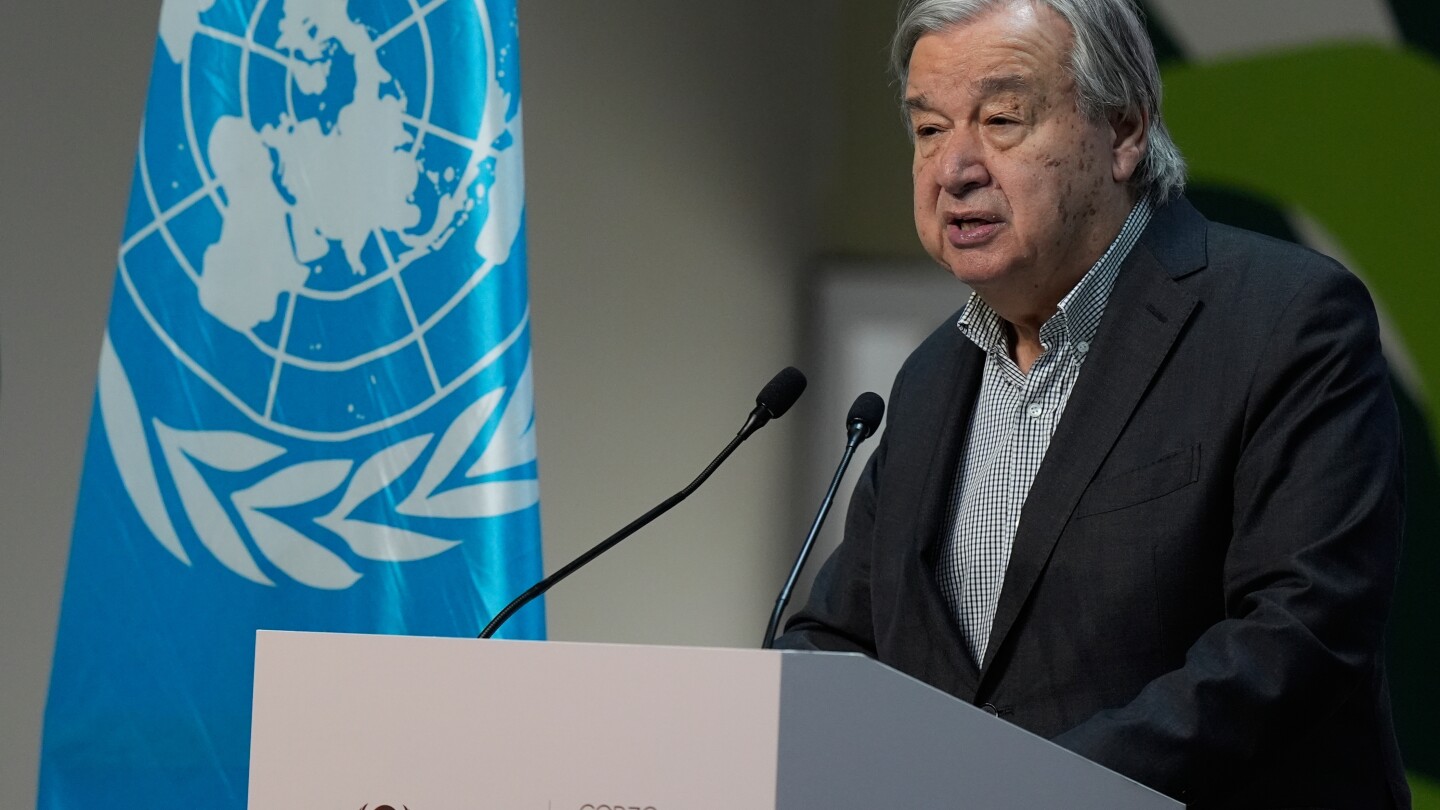
UN secretary general urges nations at climate talks to be flexible to get results
BELEM, Brazil — U.N. Secretary-General António Guterres issued a compelling call for compromise and flexibility during the final days of the COP30 climate summit in Belem, Brazil. Addressing negotiators on Thursday, Guterres emphasized the urgency of delivering tangible results, even if they fall short of the most ambitious measures sought by some nations. “We are down to the wire, and the world is watching Belem,” he declared, urging participants to engage in good faith despite the missed deadline for progress on key issues earlier in the week. The summit, which often extends beyond its two-week schedule, has drawn global attention as communities on the front lines of climate change demand action. Guterres highlighted the plight of those affected by flooding, failed harvests, and lost livelihoods, stating, “They’ve heard enough excuses and demand results.” On contentious topics such as phasing out fossil fuels and providing financial aid to poorer nations, Guterres expressed confidence in the possibility of compromise, rejecting the notion that weaker measures equate to failure. He also called on wealthy nations to significantly increase adaptation finance, tripling it from $40 billion to $120 billion annually, to help vulnerable countries cope with climate-induced disasters. Earlier in the week, officials from disaster-stricken nations delivered emotional appeals for immediate action. Guterres stressed that while no delegation would achieve all its goals, every country, particularly major emitters, must contribute more. Key unresolved issues include delivering $300 billion in annual financial aid, strengthening climate plans, addressing trade barriers, and improving transparency in reporting progress. COP30 President André Corrêa do Lago had set a Wednesday deadline for a package deal on these issues, but no agreement was reached. Over 80 countries have advocated for a detailed roadmap to transition away from fossil fuels, a topic that remains contentious despite a general agreement at the previous COP in Dubai. Guterres referenced this agreement but stopped short of committing to a detailed plan, a stance that contrasts with Brazilian President Luiz Inácio Lula da Silva’s earlier push for specificity. The summit continues under mounting pressure to deliver meaningful climate action.