分类: world

  • Chinese coast guard rams and damages a Philippine vessel off an island in the South China Sea

    Chinese coast guard rams and damages a Philippine vessel off an island in the South China Sea

    In a recent escalation of tensions in the disputed South China Sea, a Chinese coast guard vessel employed a high-pressure water cannon against a Philippine government ship anchored near Thitu Island, a territory occupied by the Philippines. The incident, which occurred on Sunday, resulted in minor structural damage to the Philippine vessel, BRP Datu Pagbuaya, though no injuries were reported among its crew. The Philippine coast guard condemned the act as a dangerous and provocative maneuver, emphasizing that such aggression would not deter their commitment to protecting national sovereignty.

    The Chinese coast guard defended its actions, claiming that the Philippine vessels had illegally entered what it referred to as Chinese waters near Sandy Cay, a cluster of sandbars situated between Thitu Island and China’s artificial Subi Island base. According to Chinese authorities, the Philippine ships ignored repeated warnings, prompting the coast guard to take lawful measures to drive them away. Beijing reiterated its longstanding claim over virtually the entire South China Sea, despite a 2016 international arbitration ruling that invalidated such claims. The ruling, supported by the United States and its allies, has been consistently rejected by China.

    The Philippine coast guard released video footage showing the Chinese vessel firing the water cannon at the BRP Datu Pagbuaya, striking both the ship and its flags. Commodore Jay Tarriela, a spokesperson for the Philippine coast guard, affirmed that such bullying tactics would not force Manila to relinquish any territory. Meanwhile, Chinese coast guard spokesperson Liu Dejun accused the Philippines of undermining regional peace and stability, placing full responsibility for the incident on the Philippine side.

    Thitu Island, known as Pag-asa in the Philippines, is the largest of nine islands and reefs inhabited by Philippine forces in the Spratlys archipelago, a highly contested region of the South China Sea. China has transformed several barren reefs into militarized artificial islands, including Subi, which lies just over 20 kilometers from Thitu. The latest confrontation adds to the challenges faced by the Philippine government, which is also grappling with natural disasters, including recent earthquakes and typhoons that have devastated parts of the country.

    Philippine coast guard commandant Admiral Ronnie Gil Gavan vowed that the harassment would only strengthen their resolve to protect Filipino fisherfolk and uphold national sovereignty. The incident underscores the ongoing territorial disputes in the South China Sea, involving multiple nations and raising concerns over regional stability.
  • A Myanmar town lies in shambles as both sides in civil war vie for control

    A Myanmar town lies in shambles as both sides in civil war vie for control

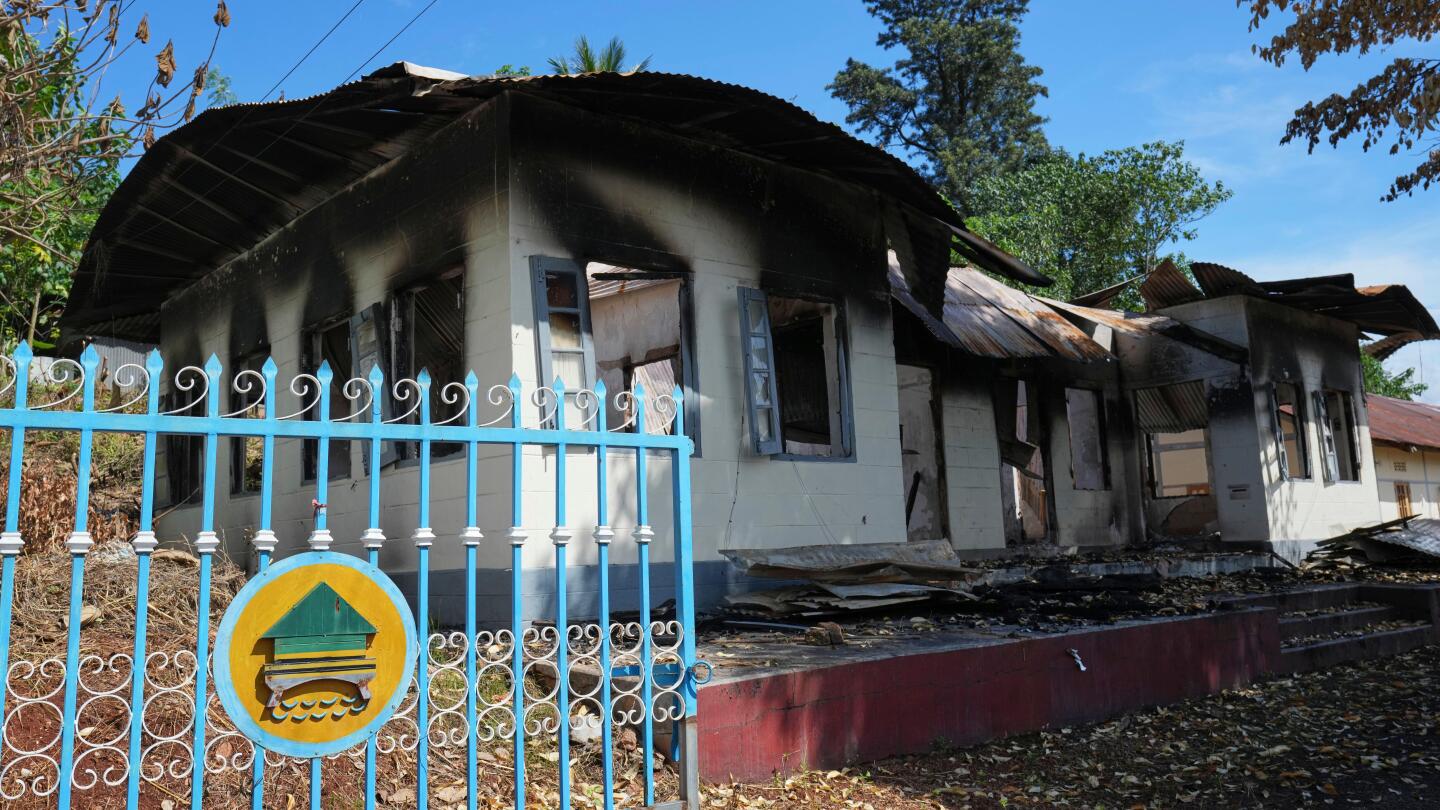
    KYAUKME, Myanmar — Ten days after its recapture by Myanmar’s military government, the town of Kyaukme remains a ghostly shadow of its former self. Schools have reopened, but the once-bustling market is eerily empty, with vendors hastily closing their stalls at the sight of visiting journalists. The Associated Press, granted rare access to the war-torn area under military supervision, documented the devastation on Friday. The town, located in Shan State, is now a scene of charred wreckage, with official buildings such as the courthouse, police station, and government housing reduced to ruins. The hospital’s operations have been temporarily relocated to a nearby Chinese temple, and at least one fire engine lies burnt out. While civilian houses appear mostly unscathed, the majority of the town’s 46,000 residents have fled, leaving Kyaukme a desolate shell. The ethnic militia previously in control accused the military of causing the destruction through air strikes and heavy weapons, while government soldiers claim the militia destroyed structures during their retreat. Kyaukme’s strategic location on a highway connecting central Myanmar to China has made it a focal point in the ongoing civil war, which erupted after the military ousted Aung San Suu Kyi’s elected government in 2021. The town has changed hands twice since then, most recently falling back to the military on October 1 after a three-week battle. Army checkpoints now dot the road from Nawnghkio, a recently recaptured town, to Kyaukme, with unexploded ordnance and land mines posing ongoing threats. Locals who remain, unable to afford relocation, describe a town on the front lines of conflict, with residents unwilling to return until nearby areas are secured.

  • Afghanistan says it has killed 58 Pakistani soldiers in overnight border operations

    Afghanistan says it has killed 58 Pakistani soldiers in overnight border operations

    In a dramatic escalation of tensions between neighboring nations, Afghanistan announced on Sunday that its forces had killed 58 Pakistani soldiers in overnight border operations. The Taliban government described the action as a retaliatory response to repeated violations of Afghan territory and airspace by Pakistan. Earlier in the week, Afghan authorities had accused Pakistan of bombing Kabul and a market in eastern Afghanistan, though Islamabad denied responsibility. The Taliban’s chief spokesman, Zabihullah Mujahid, claimed that Afghan forces had also captured 25 Pakistani army posts and wounded 30 soldiers. The Torkham border crossing, a vital trade route between the two countries, remained closed on Sunday, further straining relations. Pakistan, meanwhile, accused Afghanistan of harboring members of the banned Tehreek-i-Taliban Pakistan (TTP), a group Islamabad blames for deadly attacks within its borders. Kabul has consistently denied these allegations. Pakistani Prime Minister Shehbaz Sharif condemned the Afghan assault, asserting that Pakistan’s army had responded decisively, destroying several Afghan posts and forcing a retreat. Qatar’s Foreign Ministry expressed concern over the escalating tensions, urging both sides to prioritize dialogue and restraint. The conflict underscores the fragile security dynamics along the 2,611-kilometer Durand Line, a border Afghanistan has never formally recognized.

  • Indian student captured by Ukraine joined Russian army to avoid drug charges, says mother

    Indian student captured by Ukraine joined Russian army to avoid drug charges, says mother

    In a startling development, Ukraine has detained an Indian national, Sahil Majothi, who is accused of fighting for Russian forces. This marks the first known instance of an Indian being captured in the ongoing Ukraine conflict. Sahil, a 22-year-old from Gujarat, initially traveled to Russia in January 2024 to pursue a degree in computer engineering. However, his journey took a tragic turn when he was allegedly framed in a drug case in April 2024, leading to his arrest and subsequent detention for six months. Facing a seven-year prison sentence, Sahil reportedly joined the Russian army to avoid incarceration, as revealed in a video released by Ukraine’s 63rd Mechanized Brigade. In the video, Sahil claims he was given the choice between military service or jail time, with promises of payment that never materialized. After undergoing 15 days of training in September 2024, he was deployed to the battlefield a year later. Sahil alleges that he deserted Russian forces following an altercation with his commander and sought help from Ukrainian troops. The Indian government has acknowledged the case and is investigating, though no formal communication has been received from Ukraine. Sahil’s mother, Hasina Majothi, has appealed for his safe return, stating that her son was coerced into joining the military. This incident highlights broader concerns over the recruitment of Indian nationals into the Russian army, with reports indicating that over 150 Indians have enlisted, some on student or visitor visas. The Indian government has repeatedly warned its citizens against participating in the Ukraine conflict, emphasizing the grave risks involved.

  • How the autumn climbing season turned deadly in the Himalayas

    How the autumn climbing season turned deadly in the Himalayas

    The autumn hiking season in the Himalayas, once characterized by clear skies and breathtaking views of snow-draped peaks, is now increasingly marred by extreme weather events. Meteorologists report that the monsoon season, traditionally ending by mid-September, now extends into October, bringing with it dangerous conditions. Last weekend, a sudden blizzard stranded hundreds of tourists near the eastern face of Mount Everest at an altitude of over 4,900 meters. Despite a well-coordinated rescue effort that saved nearly 600 trekkers, one person succumbed to hypothermia and altitude sickness. Similar incidents occurred on the Nepal side, where a South Korean mountaineer died on Mera Peak. Communication lines were severely disrupted by torrential rains and heavy snowfall, delaying the dissemination of information. Landslides and flash floods in Nepal have claimed around 60 lives in the past week. Riten Jangbu Sherpa, a mountain guide, noted that such extreme weather is highly unusual for October, a month typically known for clear skies. Archana Shrestha, deputy director general at Nepal’s department of hydrology and meteorology, highlighted that the past decade has seen monsoons lasting until the second week of October, a significant shift from historical patterns. The interaction between the monsoon and westerly disturbances, which bring cold air from the Mediterranean, is exacerbating these conditions. Scientists warn that this trend is likely to continue, making flexible scheduling and experienced leadership crucial for safe Himalayan expeditions.

  • Oman authorities issue warning, advisory ahead of weather conditions

    Oman authorities issue warning, advisory ahead of weather conditions

    Authorities in Oman have issued a stern warning to residents as the nation braces for severe weather conditions expected to bring heavy rainfall and potential flash floods. The Meteorological Department of Oman has forecasted intense convective rain across several northern governorates, including Al Batinah North and South, Al Dhahirah, Al Dakhiliyah, and Al Buraimi, from 2 PM to 10 PM on Saturday, October 11, 2025. Rainfall is predicted to range between 20–60 mm, with the possibility of thunderstorms and strong winds reaching speeds of 15–35 knots (28–64 km/h).

    The advisory, disseminated by Oman Police, urges residents to exercise extreme caution. Key recommendations include avoiding the crossing of wadi streams, maintaining safe driving distances, reducing vehicle speed, and using windshield wipers for clear visibility. The Civil Aviation Authority has also emphasized the importance of staying away from low-lying areas and valleys to mitigate the risk of flash floods.

    In addition to the northern regions, light to moderate rain of 5–10 mm is expected in some coastal areas of Muscat, accompanied by active winds that may reduce horizontal visibility. The weather system is also anticipated to impact the northern parts of Al Sharqiyah North and South, as well as Al Wusta governorates, particularly around the Wilayat of Masirah, with rainfall amounts between 10–30 mm.

    Residents are advised to stay updated on weather developments and adhere to safety guidelines to ensure their well-being during this period of adverse weather conditions.

  • At least 60 people killed in drone strike in besieged Sudan city

    At least 60 people killed in drone strike in besieged Sudan city

    The ongoing conflict in Sudan has forced hundreds of thousands of people to flee their homes, with the besieged city of El-Fasher now teetering on the brink of collapse. A recent drone strike on a displacement shelter in El-Fasher has claimed at least 60 lives, marking a grim escalation in the violence. The attack, carried out by the paramilitary Rapid Support Forces (RSF), targeted the Dar al-Arqam camp, located within a university, using two drone strikes and eight artillery shells. According to the resistance committee for El-Fasher, composed of local citizens and activists, the strike resulted in the indiscriminate killing of children, women, and the elderly, with many victims reportedly burned beyond recognition. The RSF has maintained a 17-month siege on El-Fasher, aiming to seize the Sudanese army’s last stronghold in the Darfur region. The resistance group has described the situation as ‘beyond disaster and genocide,’ with residents enduring constant bombardment, severe food shortages, and the spread of disease. Sudan has been engulfed in conflict since 2023, following a power struggle between top commanders of the RSF and the Sudanese army, which has precipitated one of the world’s most severe humanitarian crises.

  • Watch: North Korea shows off huge missile at military parade

    Watch: North Korea shows off huge missile at military parade

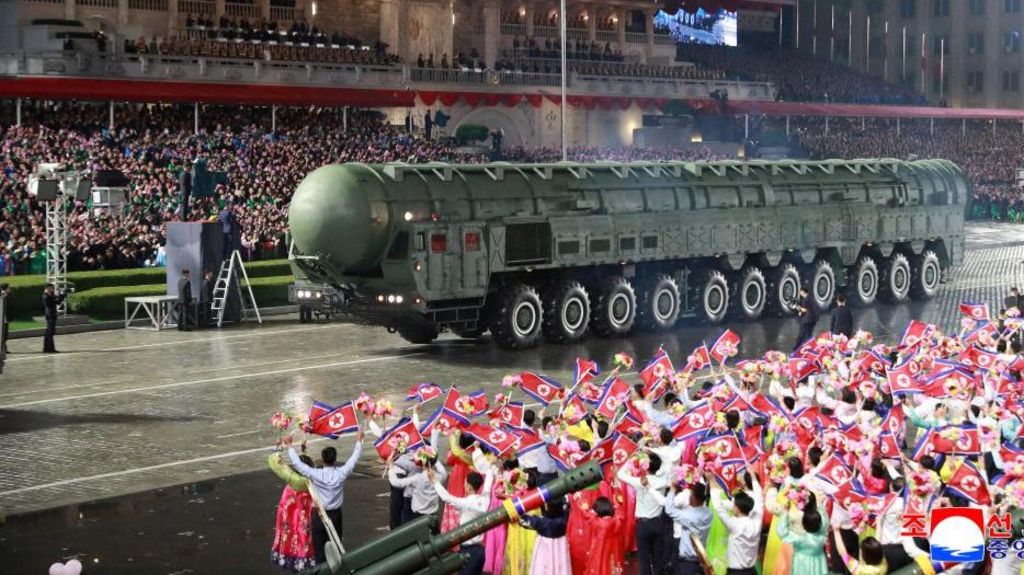
    In a striking display of military might, North Korea showcased its colossal Hwasong-20 missile during a recent military parade. The event, which took place in Pyongyang, highlighted the regime’s continued focus on advancing its strategic weapons capabilities. The Hwasong-20, with its imposing size, is believed to possess the capacity to carry multiple nuclear warheads, signaling a significant escalation in North Korea’s nuclear ambitions. Analysts suggest that this development could have profound implications for regional security and international relations, particularly in the context of ongoing tensions with the United States and its allies. The parade, attended by high-ranking officials and military personnel, underscored North Korea’s commitment to bolstering its defense systems despite widespread economic sanctions and diplomatic pressures. The unveiling of the Hwasong-20 serves as a stark reminder of the challenges posed by North Korea’s persistent pursuit of advanced military technology.

  • Can anything knock China off its mountain?

    Can anything knock China off its mountain?

    The geopolitical landscape has undergone significant shifts in recent years, with the once-anticipated battle for global hegemony between the United States and China now appearing less likely. This change is largely attributed to America’s own strategic missteps, particularly under the Trump administration, which has alienated key allies essential for countering China’s growing influence. Tariffs imposed by the U.S. have further weakened its already struggling manufacturing sector, leaving the nation isolated against a China that is four times its size. Meanwhile, China has continued to assert its dominance in trade negotiations, effectively positioning itself as the world’s preeminent power by default. This has led to speculation that the 21st century may indeed become the ‘Chinese century,’ though it will likely differ from the ‘American century’ in how China wields its power and influence. However, history reminds us that rising powers often squander their potential, as seen with Germany, Japan, and Russia in the 20th century. While China’s demographic challenges and macroeconomic issues pose significant threats, its sheer size and strategic investments in technology and manufacturing suggest that it may still maintain its dominance for decades to come. Internal dissent and potential political instability remain the most plausible threats to China’s rise, but if these are managed effectively, the world may continue to witness the unfolding of the ‘Chinese century.’

  • Mexico floods leave at least 27 dead and more missing

    Mexico floods leave at least 27 dead and more missing

    Torrential rains that battered Mexico on October 10 and 11 have unleashed catastrophic flooding and landslides, claiming at least 27 lives and leaving many others unaccounted for. The deluge, which caused rivers to overflow, wreaked havoc across multiple regions, with Hidalgo in eastern Mexico bearing the brunt of the disaster, reporting 16 fatalities. The floods swept away homes, vehicles, and bridges, leaving thousands of houses either damaged or completely destroyed. Fast-moving floodwaters inundated streets, carrying cars and debris, while highways were blocked and electricity supplies were severed.