分类: society

  • Parents accused of hiding daughter’s HIV infection and neglect

    Parents accused of hiding daughter’s HIV infection and neglect

    Italian authorities are pursuing criminal charges against a couple accused of systematically denying medical care to their nine-year-old daughter who was born with HIV, in a case that has shocked the medical community and raised questions about parental responsibility.

    According to court documents and Italian media reports, the mother allegedly concealed her HIV-positive status during pregnancy and deliberately traveled to Spain in 2017 to deliver the child outside conventional medical facilities. The couple, whose identities remain protected under Italian privacy laws, subsequently returned to Italy with their newborn but reportedly avoided all medical supervision for the following six years.

    The situation came to light in July 2023 when the parents finally sought medical attention for their daughter after she developed persistent fever and respiratory symptoms. Physicians noted the child exhibited severe malnourishment, significant dental decay, mobility difficulties, and remained in diapers despite her age. Medical staff reportedly threatened to involve law enforcement when the parents initially resisted hospitalization recommendations.

    During subsequent hospital examinations, healthcare professionals discovered the child’s HIV-positive status, prompting the parents to disclose the mother’s medical history. Prosecutors in Bologna have filed charges of severe maltreatment resulting in serious bodily harm, alleging the parents failed to conduct basic HIV transmission testing or provide essential medical care, including standard childhood vaccinations.

    The defendants maintain their innocence through legal representation, denying allegations of vaccine opposition or intentional evasion of Italian healthcare protocols. They assert their relocation to Spain for childbirth was motivated by family connections rather than medical avoidance, noting the mother’s Colombian heritage and Spanish residency. The defense further claims the child received medical attention in Spain until 2019, though documentation remains unclear.

    A preliminary hearing scheduled for May will determine whether the case proceeds to trial, with the central legal question focusing on parental intent and the threshold for medical neglect in pediatric care.

  • Exploring ancient China: How procuratorates protect IPR of cultural heritage

    Exploring ancient China: How procuratorates protect IPR of cultural heritage

    China’s procuratorial organs are spearheading a specialized judicial campaign to protect the intellectual property rights of cultural heritage publications, with the ancient Dunhuang murals becoming a focal point of these enforcement efforts. These exquisite 1,600-year-old frescoes, which draw millions of visitors annually to their Gansu Province location, have become vulnerable to sophisticated intellectual property theft despite authorized anthologies being legally available to the public.

    The initiative emerged in response to a growing market for pirated copies of official Dunhuang publications. Unauthorized producers have flooded markets with inferior quality reproductions that undermine both the artistic integrity of the cultural treasures and the economic viability of legitimate publishers. These counterfeit editions, often marketed deceptively as authentic, compromise the visual fidelity and historical accuracy that characterize authorized publications.

    Procuratorial authorities have implemented a multi-faceted legal strategy that combines criminal prosecution with civil public interest litigation. Through specialized intellectual property divisions within prosecutor’s offices, authorities are conducting systematic reviews of copyright compliance across the cultural heritage sector. This judicial oversight extends to online marketplaces where digital reproductions of the murals are frequently traded without proper authorization.

    The enforcement mechanism operates through close coordination between cultural heritage experts, copyright specialists, and digital forensics teams. This collaborative approach enables investigators to trace distribution networks, identify production sources, and quantify the economic damage caused by copyright infringement. The procuratorates’ intervention has resulted in numerous successful prosecutions and the establishment of legal precedents for cultural IP protection.

    Beyond immediate enforcement, the initiative includes public education components designed to increase awareness about cultural IP rights. Museums and cultural institutions are receiving guidance on implementing stronger copyright protection measures for their collections and publications. The comprehensive approach represents a significant advancement in how China balances cultural preservation with intellectual property enforcement in the digital age.

  • Shandong sees sustained progress in afforestation and urban greening

    Shandong sees sustained progress in afforestation and urban greening

    As China commemorated its 48th National Tree Planting Day on March 12, 2026, Shandong Province unveiled remarkable achievements in its comprehensive environmental conservation programs. Under the leadership of Zhao Xiaohui, Director of the Shandong Provincial Department of Natural Resources, the eastern Chinese province has demonstrated significant progress in expanding forest coverage and integrating ecological considerations into urban development strategies.

    According to official statistics released during a press conference, Shandong’s forested areas now encompass approximately 3 million hectares, with national and provincial-level public welfare forests constituting roughly 25% of this total. The province has established nine specialized national forest tree breeding centers dedicated to sustainable forestry practices, with particular emphasis on cultivating key species including poplar, black locust, and black pine varieties.

    A distinctive characteristic of Shandong’s environmental approach involves the seamless incorporation of green space expansion within urban planning frameworks. Since the initiation of the 14th Five-Year Plan period (2021-2025), provincial authorities have created more than 450 major urban parks and established over 3,900 kilometers of interconnected urban greenways. These developments have elevated per capita park green space to 18.66 square meters, significantly enhancing urban livability standards.

    Beyond ecological improvements, Shandong’s forestry initiatives have generated substantial economic benefits for local communities. The programs have facilitated the cultivation of high-value traditional crops including chestnuts and persimmons across various regions. These agricultural activities are increasingly combined with forest wellness tourism and ecotourism ventures, creating diversified income streams for rural populations.

    The province has developed numerous nationally recognized geographical indication products, including Yantai apples, Laiyang pears, Zhanhua winter jujubes, Pingyin roses, and Heze peonies. Additionally, Shandong has established four national-level forest wellness bases, further strengthening the integration of ecological conservation with economic development.

    Director Zhao emphasized that emerging sectors combining environmental protection with agricultural and tourism activities have experienced continuous expansion in both operational scale and financial returns. The province has simultaneously maintained stable forest coverage rates while progressively reducing areas affected by desertification and sandy land degradation, demonstrating the effectiveness of its comprehensive environmental management strategies.

  • Sichuan’s peach, plum blossom festival drives rural income growth

    Sichuan’s peach, plum blossom festival drives rural income growth

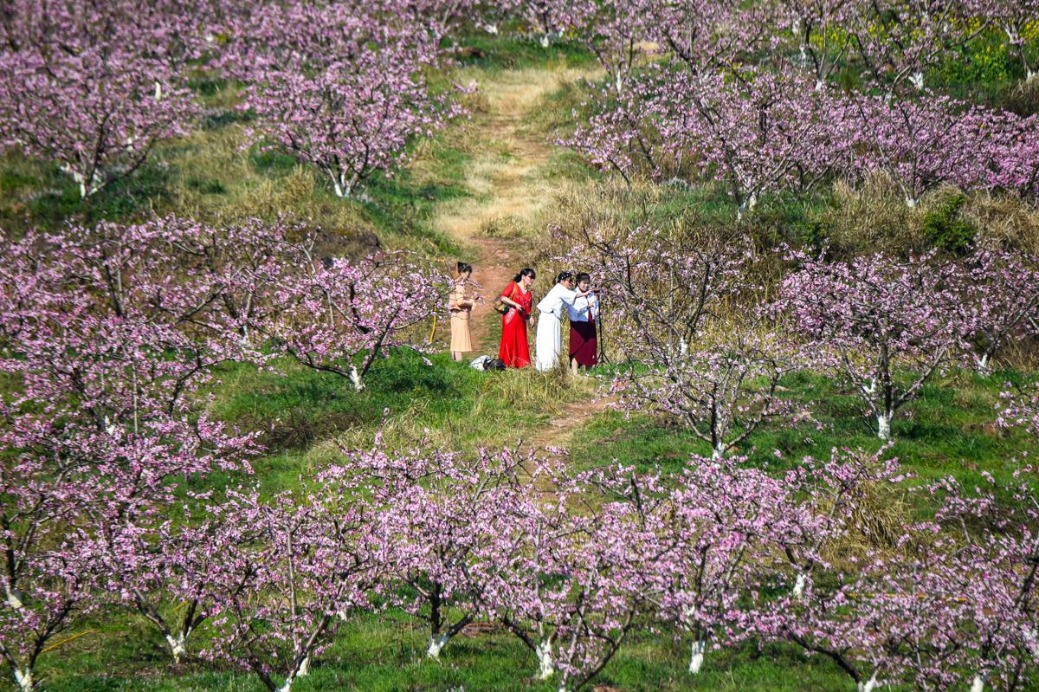
    The hillsides of Xinyuan township in Peng’an county, Sichuan province, have transformed into a vibrant tapestry of peach and plum blossoms, signaling not just the arrival of spring but a remarkable economic revival for local communities. The inaugural day of the 16-day Peach and Plum Blossom Festival on Tuesday attracted substantial visitor numbers, creating new pathways for rural income generation and regional development.

    Against the backdrop of warming spring temperatures, the festival offers visitors a multifaceted experience combining natural beauty with cultural immersion. Attendees can wander through picturesque flower-lined pathways, capture the breathtaking spring scenery through photography, sample authentic local cuisine, and purchase freshly harvested agricultural products directly from farmers.

    This year’s edition introduces innovative digital components including an online photography competition, a dedicated Douyin (China’s TikTok equivalent) hashtag challenge, and live-streamed virtual tours conducted by social media influencers. These technological integrations represent a strategic enhancement to the festival’s traditional offerings, simultaneously boosting its cultural appeal while expanding the commercial reach of local agricultural products.

    The blossom-themed economy has emerged as a significant driver of rural vitalization in the region, demonstrating how agricultural tourism can effectively supplement farmers’ incomes while promoting regional specialty products. The festival model successfully merges ecological beauty with economic opportunity, creating sustainable development patterns that extend beyond traditional farming activities.

    Local authorities have positioned the event as a cornerstone of their rural development strategy, leveraging the region’s natural assets to create lasting economic benefits. The combination of physical tourism and digital engagement strategies represents a comprehensive approach to rural development in the digital age, potentially serving as a replicable model for other agricultural regions across China.

  • Ancient observatory in Xizang marks spring sowing season with rituals

    Ancient observatory in Xizang marks spring sowing season with rituals

    In the highlands of Tibet, an ancient astronomical tradition marking the agricultural new year resumed with ceremonial grandeur at the historic Dakpo Observatory in Maldrogungkar county. On Thursday, corresponding to the 21st day of the first Tibetan month, local farmers and herders gathered at this centuries-old site to witness the precise celestial alignment that traditionally inaugurates the spring sowing season.

    Dressed in vibrant traditional attire, participants brought ritual offerings including butter tea and chemar—a ceremonial vessel filled with grains symbolizing prosperity and abundance. The pivotal moment occurred as the first beam of sunlight penetrated through a specially designed aperture in the observatory structure, striking a calibrated measuring stone with exact precision. This photometric event, meticulously calculated through ancestral astronomical knowledge, serves as Tibet’s official natural signal for initiating spring planting and irrigation activities across the region’s central agricultural zones.

    Dorje, assistant researcher at the Xizang Institute of Astronomy and Calendrical Calculation and secretary-general of the Xizang Astronomy and Calendar Society, emphasized the site’s unique cultural significance. “The Dakpo platform represents the only operational astronomy observatory of its kind in the region, maintaining an uninterrupted 300-year legacy,” he stated. “It functions as a comprehensive system integrating celestial observation, mathematical calculation, and temporal guidance—a cornerstone of Tibet’s distinctive astronomical traditions.”

    Beyond its agricultural scheduling function, the observatory’s sophisticated methodology enables calculation of solar terms, seasonal pattern monitoring, and even weather prediction capabilities. The ritual celebration incorporated educational components including scientific lectures, cultural performances, and community services such as free medical consultations, blending ancient wisdom with contemporary community engagement. This enduring practice demonstrates the sophisticated integration of astronomical science with agricultural practicality, preserving a living cultural heritage that continues to guide Tibet’s farming communities in harmonious synchronization with natural cycles.

  • Cartoonist freed after 15 years in prison without charge in Eritrea

    Cartoonist freed after 15 years in prison without charge in Eritrea

    Eritrean authorities have released prominent political cartoonist Biniam Solomon after 15 years of imprisonment without formal charges or legal proceedings, according to confirmations from family members and associates. The artist, widely known by his professional pseudonym Cobra, was apprehended in Asmara in 2011 during a government crackdown on dissent.

    Now in his early sixties, Solomon endured severe isolation throughout his detention, completely cut off from familial communication and receiving only intermittent medical attention. A relative disclosed that the latter segment of his imprisonment occurred within Asmara’s notoriously austere ‘crime investigation’ facility, commonly reported to house political dissidents and conscientious objectors under exceptionally harsh conditions.

    Solomon’s artistic career flourished during a brief period of media liberalization following Eritrea’s independence from Ethiopia. Between 1997 and 2001, his incisive cartoons critiquing socio-political issues appeared in various private publications until the government shuttered all independent media outlets citing national security concerns. Despite losing an arm during childhood, Solomon established himself as both a respected physicist educator and prolific artist, authoring three collections of his satirical work.

    His liberation coincides with a series of unexplained releases of long-term detainees, though thousands remain incarcerated without trial according to United Nations estimates. Human rights organizations have consistently documented systematic abuses within Eritrea’s penitentiary system, including inadequate nutrition, medical neglect, and extreme psychological distress – allegations consistently refuted by national authorities.

    The circumstances surrounding Solomon’s release remain opaque, with no official explanation provided by Eritrean officials. International observers note that while these developments may signal potential shifts, the absence of transparent judicial processes continues to raise concerns about the country’s human rights record.

  • Sly fox sneaks onto cargo ship in Southampton and arrives in New York

    Sly fox sneaks onto cargo ship in Southampton and arrives in New York

    A remarkable transatlantic journey has culminated in sanctuary for an unlikely voyager. A two-year-old male red fox, weighing approximately 11 pounds (5 kg), has been placed under professional care at the Bronx Zoo’s Animal Health Center after being discovered as a stowaway aboard a cargo ship that traveled from Southampton, UK, to the Port of New York and New Jersey.

    The unexpected passenger was detected by U.S. officials during a routine cargo inspection on February 19th. Following its discovery, the animal was promptly transferred to the wildlife experts at the Bronx Zoo for evaluation and care. The vessel had previously been docked at the English port city of Southampton, though the precise method by which the fox gained access remains undetermined.

    Initial veterinary assessments indicate the animal is in surprisingly good condition despite its arduous journey. Keith Lovett, the zoo’s Director of Animal Programs, reported to the Associated Press that the fox “seems to be settling in well” after having “gone through a lot.” A comprehensive health screening is currently underway to ensure the animal carries no diseases.

    The Port of Southampton authorities expressed amusement at the unusual incident. A spokesperson for Associated British Ports Southampton remarked that while they handle diverse cargo from vehicles to container shipments, “even we were surprised to find a fox had booked itself a transatlantic crossing,” jokingly suggesting the animal might have preferred “swapping the Solent for the Staten Island Ferry.”

    According to the Bronx Zoo’s statement, red foxes (Vulpes vulpes) rank among the world’s most widely distributed carnivorous mammals, recognized for their distinctive reddish coat and bushy white-tipped tail. Their remarkable adaptability enables them to thrive across diverse habitats spanning Europe, Asia, North America, and parts of Africa, with diets ranging from fruits to rodents.

    The zoo has confirmed that once veterinary clearance is obtained, wildlife specialists will identify an appropriate long-term habitat for the transatlantic traveler, ensuring its continued wellbeing following its extraordinary journey.

  • One house, two faiths, one fasting season

    One house, two faiths, one fasting season

    In a remarkable display of interfaith unity, Nigerian couple Olanrewaju and Kaosara are jointly observing the sacred fasting periods of Ramadan and Lent—a rare convergence not witnessed since 1993. This extraordinary alignment of Islamic and Christian calendars has created a unique opportunity for cross-cultural spiritual connection in religiously diverse Nigeria.

    The couple’s experience reflects a broader phenomenon occurring across multifaith households in Africa’s most populous nation. While Olanrewaju abstains from food and drink from dawn to dusk in observance of Ramadan, Kaosara maintains her Lenten sacrifices, creating mutual understanding and respect within their shared domestic space.

    Religious scholars note this calendrical coincidence occurs only periodically due to differences between the lunar Islamic calendar and solar-based Gregorian system. The current overlap provides a powerful counter-narrative to religious tensions, demonstrating how shared values of discipline, reflection, and spiritual purification transcend theological differences.

    Community leaders have highlighted such personal stories as models for peaceful coexistence in Nigeria’s complex religious landscape. The couple’s approach to maintaining各自的 religious traditions while supporting each other’s spiritual practices offers a template for interfaith harmony that extends beyond theological boundaries.

  • Senegal approves tougher anti-gay law as rights groups raise concerns

    Senegal approves tougher anti-gay law as rights groups raise concerns

    Senegal’s National Assembly has overwhelmingly passed sweeping legislation that significantly intensifies penalties for same-sex relationships while criminalizing any form of homosexuality advocacy. The parliamentary vote saw 135 members in favor, zero against, and three abstentions, paving the way for presidential ratification that would enact the stringent measures into law.

    This legislative initiative fulfills campaign commitments made by President Bassirou Diomaye Faye and Prime Minister Ousmane Sonko, emerging amid heightened enforcement actions against alleged homosexual activities. The new statute doubles maximum imprisonment terms from five to ten years for same-sex acts and introduces substantial fines reaching 10 million CFA francs (approximately $17,600).

    Government spokesperson Amadou Moustapha Ndieck Sarré defended the legislation against international condemnation, asserting that it reflects Senegal’s cultural and religious values. “The overwhelming majority of Senegalese people reject homosexuality,” Sarré stated. “Our cultural foundations firmly oppose such practices.”

    Conservative advocacy groups, including the moral values organization And Sàmm Jikko Yi, have long pressured authorities for stricter anti-homosexuality measures. These entities argue that the strengthened legal framework is essential for preserving Senegal’s societal norms.

    However, human rights organizations have issued grave warnings regarding the legislation’s potential consequences. Larissa Kojoué, researcher at Human Rights Watch, emphasized that “criminalizing same-sex conduct and arresting individuals based on sexual orientation violates multiple internationally protected rights, including principles of equality and non-discrimination.”

    Medical and public health experts express particular concern about the law’s impact on HIV prevention efforts. Dr. Charles Dotou, head of Senegal’s LGBTQ Association, cautioned that the legislation would drive vulnerable communities underground, potentially creating “chaos in society” through increased fear and migration.

    Dr. Safiétou Thiam, executive secretary of Senegal’s National Council for the Fight Against AIDS, warned that the law jeopardizes decades of public health progress. “We risk undermining the results of 30 to 35 years of efforts in combating HIV/AIDS,” Thiam noted, highlighting that Senegal currently maintains one of West Africa’s lowest HIV prevalence rates at 0.3% among adults.

    This legislative development aligns with a broader trend across Africa, where several nations including Uganda, Ghana, Burkina Faso, and Mali have recently implemented or proposed stringent anti-LGBTQ+ measures. The Senegalese legislation specifically targets what it describes as “acts against nature,” expanding both punitive measures and their application to those perceived as promoting homosexual relationships.

  • Celebrity chef René Redzepi resigns from iconic Danish restaurant Noma after abuse allegations

    Celebrity chef René Redzepi resigns from iconic Danish restaurant Noma after abuse allegations

    COPENHAGEN, Denmark — The gastronomic world was shaken this week as René Redzepi, the visionary chef behind Copenhagen’s revolutionary Noma restaurant, announced his resignation following escalating allegations of systemic workplace abuse and assault. The departure marks a dramatic fall for the culinary innovator whose New Nordic cuisine earned three Michelin stars and transformed Denmark’s culinary reputation globally.

    The controversy reached critical mass when The New York Times published an investigative piece featuring testimonies from 35 former employees detailing years of verbal abuse and physical assault allegedly perpetrated by Redzepi and his management team. These accounts, corroborated by Instagram posts from former fermentation lab head Jason Ignacio White, describe a toxic environment where staff faced punched during service, psychological trauma, and career-ending anxiety.

    Redzepi’s tearful Instagram video apology acknowledged his responsibility while conceding that changes implemented in recent years “do not repair the past.” The timing proved particularly damaging, coinciding with the launch of Noma’s $1,500-per-meal pop-up in Los Angeles, which subsequently lost key sponsors and attracted protesters.

    Industry analysts suggest Redzepi’s departure was necessary for the restaurant’s survival. “René Redzepi is the face of Noma, he is Noma,” stated Kristoffer Dahy Ernst, editor-in-chief of Danish food magazine Gastro. “To solve the huge problem, you must remove the source.”

    The case has sparked broader conversations about power dynamics in fine dining. Nick Curtin, executive chef of Copenhagen’s Michelin-starred Alouette restaurant, criticized the industry’s tolerance for abuse: “It’s long overdue that we get rid of the notion that sacrifice, humiliation, pain and violence are the building blocks for greatness.”

    Despite Noma’s transformative impact on Scandinavian gastronomy—turning Copenhagen into a global dining destination through its foraging philosophy and flawless execution—the restaurant now faces an uncertain future. While some locals believe Copenhagen’s culinary scene will endure through Noma’s talented alumni, potential visitors like American tourist Annie Nguyen express reservations: “I personally would not want to continue dining there with that kind of culture. It leaves a bad taste.”