分类: society

  • Swiss ski bar not inspected for five years before deadly fire, mayor says

    Swiss ski bar not inspected for five years before deadly fire, mayor says

    Authorities in the Swiss alpine resort of Crans-Montana have revealed that a nightclub where a catastrophic fire claimed 40 lives and injured 116 people had not undergone mandatory safety inspections for five years. The devastating blaze, believed to have been ignited by sparklers during a celebration, has exposed critical gaps in the region’s safety enforcement system.

    Mayor Nicolas Feraud addressed journalists during a emotionally charged press conference on Tuesday, expressing profound regret over the institutional failure. “We regret that – we owe it to the families and we will accept the responsibility,” Feraud stated, though he conceded he could provide no immediate explanation for the five-year inspection gap at La Constellation bar.

    The tragedy has prompted immediate regulatory changes, with local authorities announcing a complete ban on sparklers in all entertainment venues. Additionally, the municipality has commissioned an external contractor to conduct comprehensive safety audits across all 128 entertainment establishments in the region.

    Feraud contextualized the oversight by explaining administrative challenges following a 2016 merger of four village councils into the larger Crans-Montana authority. The current five-person inspection team remains responsible for monitoring over 10,000 buildings across the expanded jurisdiction.

    Despite mounting pressure, the mayor confirmed he has no intention of resigning, stating “I’m not resigning, no, and I don’t want to.” The matter now moves to the judicial realm, with Swiss prosecutors having opened a criminal investigation into the circumstances surrounding the deadly fire.

  • Over 6,000 migratory whooper swans flock to E China’s Rongcheng to spend winter

    Over 6,000 migratory whooper swans flock to E China’s Rongcheng to spend winter

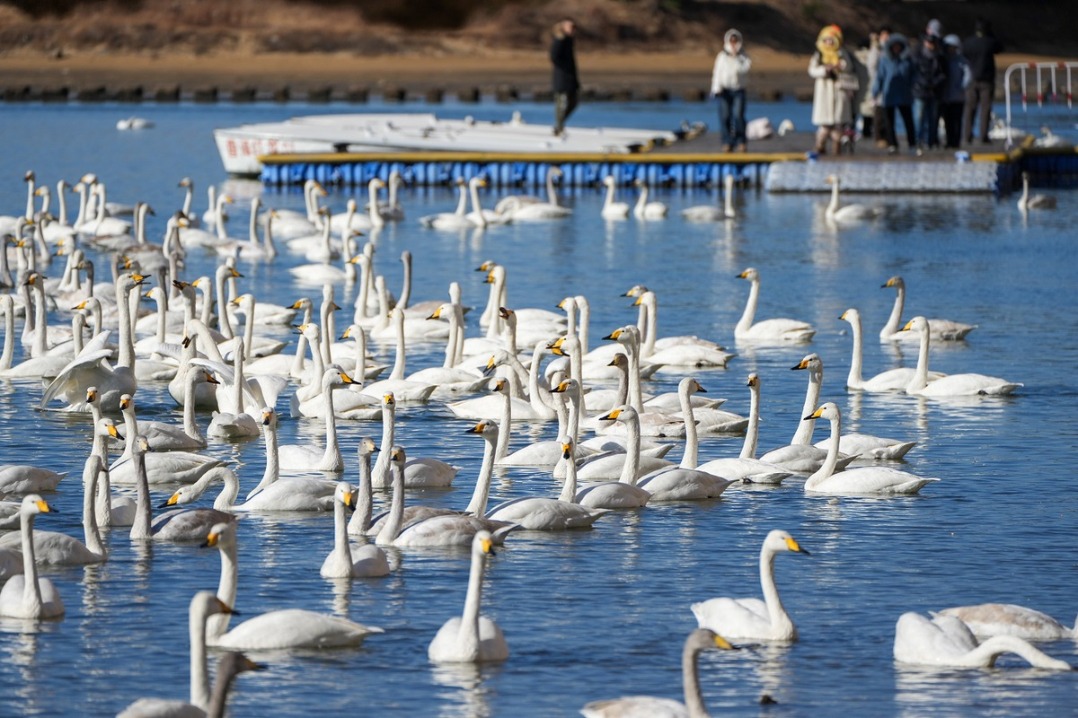
    The coastal city of Rongcheng in China’s Shandong province has become the seasonal sanctuary for an extraordinary gathering of over 6,000 migratory whooper swans, according to recent wildlife observations. These majestic birds, recognized by their distinctive yellow-and-black bills and resonant calls, have undertaken their annual journey from breeding grounds in Mongolia and Siberia to escape the harsh northern winter.

    The arrival of these elegant creatures transforms Rongcheng’s landscape into a living tapestry of white feathers against blue waters, creating a breathtaking natural spectacle that attracts both wildlife enthusiasts and photographers. The swans typically begin their migration in late autumn, with peak numbers arriving between December and January, remaining until approximately March when they commence their return north.

    Rongcheng’s unique geographical position along the East Asian-Australasian Flyway—a critical migratory route—combined with its abundant food sources and protected wetlands, makes it an ideal wintering habitat. Local conservation efforts have played a significant role in creating a safe environment for these protected species, with authorities establishing dedicated feeding stations and monitoring programs to ensure their wellbeing.

    This annual phenomenon not only represents a remarkable wildlife event but also serves as an indicator of regional ecological health. The consistent return of such substantial numbers suggests successful environmental conservation measures in the area. The spectacle has additionally boosted local ecotourism, with visitors flocking to witness the magnificent assembly of swans that has become synonymous with Rongcheng’s winter identity.

  • Swiss bar where fatal New Year’s blaze broke out had last fire safety inspection in 2019

    Swiss bar where fatal New Year’s blaze broke out had last fire safety inspection in 2019

    A devastating fire that erupted during New Year’s celebrations at Le Constellation bar in the Swiss resort town of Crans-Montana has revealed alarming safety inspection failures, with authorities confirming no fire safety assessments had been conducted since 2019. The tragedy claimed 40 lives and left 116 injured, making it one of Switzerland’s deadliest nightclub disasters in recent history.

    Investigative findings indicate the blaze originated from festive sparkling candles positioned atop Champagne bottles that ignited when they came into proximity with the ceiling. The criminal investigation now focuses on whether soundproofing materials complied with safety regulations and if the candles were legally permitted for indoor use. Valais regional prosecutors have opened a criminal case against the bar managers for suspected involuntary homicide, involuntary bodily harm, and negligently causing a fire.

    Municipal authorities acknowledged with profound regret that mandatory periodic safety inspections lapsed for five consecutive years (2020-2025), despite previous assessments in 2016, 2018, and 2019 that had requested modifications. Nicolas Féraud, head of Crans-Montana’s municipal government, expressed bitter regret over the oversight but could not immediately explain the inspection gap. The identification process proved particularly challenging due to the severity of burns, requiring DNA sampling from families to confirm victims.

    In response to the catastrophe, local authorities have implemented immediate safety reforms including an indoor fireworks ban and commissioned an external agency to conduct future establishment inspections. The investigation continues to determine exact attendance numbers during the incident and whether previous modifications, including a 2015 veranda construction permit and interior work, contributed to the tragedy.

  • Dubai tenants seek free parking as tariffs rise; rights depend on lease terms

    Dubai tenants seek free parking as tariffs rise; rights depend on lease terms

    A significant shift in parking dynamics is unfolding across Dubai’s residential landscape as tenants increasingly seek to incorporate parking spaces into their lease agreements. This trend emerges in direct response to the emirate’s implementation of a variable parking tariff system in April 2025, which has substantially increased public parking costs throughout the city.

    The innovative parking management strategy employs dynamic pricing based on location, time of day, and demand levels, resulting in a 51% year-on-year increase in average hourly parking rates to approximately Dh3.03 by the third quarter of 2025. Premium zones including Downtown Dubai, Business Bay, Deira, and Jumeirah now command significantly higher peak-hour charges, though off-peak and overnight parking remain complimentary.

    Legal experts emphasize that parking rights remain exclusively contractual matters rather than automatic entitlements. According to Igor Abalov, Managing Partner at Lawford Legal Advisors FZ-LLC, the lease agreement serves as the definitive document determining tenant rights. ‘The tenant’s ability to assert claims depends solely on what is expressly agreed and recorded in writing,’ Abalov stated, noting this represents one of the most frequently contested issues before Dubai’s Rental Disputes Centre.

    Legal professionals distinguish between specific allocated parking spaces recorded in title deeds and general parking facilities provided as building amenities. Hassan El Agawani, an associate at BSA Law, clarified that ‘providing a parking space is not mandatory unless stipulated in the contract,’ adding that rising tariffs cannot override the principle of freedom of contract.

    Dr. Hassan El Hais, a legal consultant, highlighted protective measures within Dubai’s regulatory framework, particularly referencing Law No. (6) of 2019 on Jointly Owned Property. This legislation prevents unit owners from leasing residential units separately from attached jointly owned parts, including parking spaces. The standardized Ejari tenancy contract template facilitates this process through its ‘Additional Terms’ section, allowing parties to insert specific parking allocations without additional costs.

    For existing leases, amendments require mutual agreement through formally executed addenda. Article 14 of Dubai Law No. (33) of 2008 enables either party to request modifications with 90 days’ notice before contract expiration. In cases where landlords refuse to provide contractually agreed parking spaces, tenants may issue formal notices and escalate matters to the Rental Disputes Centre, potentially seeking rent adjustments or compensation.

    As enforcement mechanisms tighten and parking expenses continue to climb, legal professionals stress that tenants who neglect to secure explicit parking rights upfront face substantially higher living costs throughout their tenancy periods, making precise contractual language increasingly crucial in Dubai’s evolving urban environment.

  • SPC decries child abuse by families

    SPC decries child abuse by families

    In a groundbreaking judicial intervention, China’s Supreme People’s Court has issued a forceful condemnation of domestic violence against minors, establishing child welfare as the paramount consideration in family education and legal proceedings. The court’s position emerged from a distressing case involving a 15-year-old girl, identified pseudonymously as Xiao Yu, who suffered systematic physical abuse from her mother and stepfather under the guise of disciplinary measures.

    The case revealed that Xiao Yu, who lost her biological father at a young age, contacted authorities after enduring repeated violent incidents. Police investigations confirmed the couple routinely employed physical restraint and violence under the pretense of education, resulting in the teenager exhibiting signs of depression. In an unprecedented response, law enforcement successfully petitioned for a personal safety protection order on her behalf.

    Judicial authorities mandated multiple protective measures: the stepfather was ordered to vacate the family residence, both parents were prohibited from any contact with the victim, and local police and community organizations were tasked with ongoing monitoring. The court additionally sentenced the mother to six months of compulsory family education guidance in coordination with prosecutors.

    The ruling highlighted critical familial dysfunctions, noting the mother’s profound failure to provide emotional support and recognize her daughter’s psychological needs, while condemning the stepfather’s erroneous belief that violence constituted legitimate parenting. This environment, the court found, prevented healthy guardian-child relationships and exacerbated domestic conflicts.

    Beyond immediate protections, the judiciary emphasized that legal orders alone provide only temporary solutions. The court advocated for comprehensive approaches addressing root causes of family violence through parental education and behavioral correction. Psychological research cited in the ruling indicated children raised in violent households often perpetuate cycles of abuse, either as perpetrators or victims, with excessively harsh discipline frequently replicating across generations.

    The case represents one of six significant rulings recently publicized by the Supreme People’s Court demonstrating strengthened enforcement of China’s Family Education Promotion Law and Law on the Protection of Minors. Other cases addressed school bullying and support for children of incarcerated parents, reflecting the judiciary’s expanded commitment to minor protection through coordinated legal and social support mechanisms.

  • Indian gang rape survivor back home after a week in hospital

    Indian gang rape survivor back home after a week in hospital

    A 26-year-old mother of two has been discharged from a Faridabad hospital following a brutal gang rape that has ignited fresh outrage across India. The assault occurred in the early hours of December 30th when the victim, awaiting transport after visiting a friend, was offered a lift by two men in an ambulance.

    According to her sister’s account, the men drove the woman to a secluded area where they perpetrated the assault before throwing her from the moving vehicle. She was discovered hours later with severe head trauma, facial injuries, and multiple fractures, and was admitted to the hospital around 5:30 AM.

    Law enforcement officials report that a swift investigation led to the arrest of two suspects and the impounding of the ambulance used in the crime. Senior police official Mukesh Kumar stated that authorities are awaiting judicial approval for an identification parade, wherein the survivor will be asked to identify the perpetrators from a lineup.

    The case has drawn immediate parallels to the notorious 2012 Delhi bus gang rape, a landmark event that triggered mass protests and resulted in stricter anti-rape legislation, including capital punishment for the most heinous offenses. Despite these legal reforms, official data reveals a persistent crisis: nearly 30,000 rapes were reported in 2023 alone, alongside thousands of attempted assaults and hundreds of child rape cases.

    Shalini Chopra, a social worker and opposition politician who met with the survivor, confirmed the woman is ‘better but still in pain’ as she begins her recovery. The incident has intensified scrutiny on India’s ongoing struggle with sexual violence, highlighting the gap between legislative action and on-the-ground realities for women’s safety.

  • Collectors line up for Year of the Horse stamps

    Collectors line up for Year of the Horse stamps

    A remarkable scene unfolded across Chinese cities as collectors braved winter temperatures to secure newly released Year of the Horse zodiac stamps. China Post officially launched the commemorative collection on Monday, triggering an enthusiastic response from philatelic enthusiasts nationwide.

    In Beijing, dedicated collectors began forming queues outside post offices as early as Sunday afternoon. By 8 AM on launch day, sidewalks were lined with enthusiasts spanning generations—from veteran stamp aficionados to younger collectors wrapped in heavy winter coats, all anticipating the special release.

    The 2026 stamp collection carries particular cultural significance following UNESCO’s 2024 recognition of Spring Festival traditions as Intangible Cultural Heritage. This designation has amplified public engagement with traditional customs and symbolic celebrations.

    The two-stamp set, with a combined face value of 2.40 yuan ($0.34), features distinct artistic interpretations. The first design portrays a vibrant red horse traversing cloud formations, symbolizing sustained economic and social development while reflecting national aspirations outlined in the 15th Five-Year Plan (2026-30). The complementary stamp depicts three horses galloping in unison amid auspicious patterns, representing collective effort and national unity in advancing socialist modernization and comprehensive rejuvenation.

    Within Chinese cultural context, the horse embodies potent symbolism—representing vitality, perseverance, and achievement. The creature is frequently associated with the popular idiom “Ma Dao Cheng Gong,” conveying the notion of immediate success upon its arrival. Historically valued for transportation and economic contributions, horses remain among the most favored zodiac signs, perceived as heralds of energy and progress.

    China Post’s zodiac stamp series, initiated in 1980, consistently generates substantial collector interest. The 2026 edition marks a procedural innovation through a dual-track selection process incorporating public submissions alongside expert and popular voting—a first in the program’s history.

    Liu Aili, Chairman of China Post Group, emphasized that “this represents not merely a design breakthrough but a vivid practice of sharing cultural development with the people.” This sentiment resonated with public participants, including one Beijing collector who reported involvement in the voting process three months prior: “Witnessing the stamps I helped select finally reach public sale makes this collection profoundly meaningful to me.”

    The issuance includes 26.68 million basic stamp sets alongside specialized formats and collectible booklets. A collaborative souvenir sheet featuring designs from mainland China, Hong Kong, and Macao postal departments debuted simultaneously. The stamps will remain available for six months through designated postal outlets and digital platforms including China Post’s official application and WeChat stores.

  • New shuttle bus eases access to medical hub

    New shuttle bus eases access to medical hub

    A new direct shuttle bus service connecting Futian Port and the University of Hong Kong-Shenzhen Hospital commenced operations on Monday, marking a significant advancement in cross-boundary medical integration between Hong Kong and mainland China. The transportation initiative addresses critical last-mile connectivity challenges for patients seeking specialized healthcare services at the pioneering medical institution.

    The shuttle service will operate on a three-month trial basis, offering affordable transit at just 2 yuan ($0.28) per ride with complimentary service for seniors aged 60 and above. Operating daily from 8 am to 6 pm, the buses depart every 30 minutes with an approximate travel time of 30 minutes between destinations. Multiple payment options including cash and transportation cards ensure accessibility for all passengers.

    Kenneth Cheung Man-chee, Chief Executive of HKU-Shenzhen Hospital, emphasized the institution’s role as a testing ground for cross-boundary medical cooperation. ‘We are systematically reducing barriers to medical integration through enhanced connectivity in medical talent, pharmaceuticals, equipment, payment systems, emergency transfers, and information sharing,’ Cheung stated.

    The transportation solution arrives amid rapidly growing demand for northbound medical care among Hong Kong residents. Patient testimonials highlight the service’s practical benefits: Hong Kong resident Mr. Ho noted that while taxi fares between the port and hospital typically range from 20-40 yuan, and metro travel requires two transfers, the direct bus offers both affordability and convenience—particularly crucial for chronic disease patients requiring frequent visits.

    Mainland patient Brian Zhong, who accompanies his mother monthly for osteoporosis treatment, highlighted additional advantages: ‘This streamlined connection enables mainland patients to conveniently continue to Hong Kong for family visits or tourism after medical appointments,’ reflecting the service’s role in deepening people-to-people exchanges.

    The hospital serves as a critical access point for medications approved in Hong Kong but not yet available on the mainland. As the pilot institution for multiple cross-boundary healthcare initiatives, it has facilitated the cross-boundary use of Hong Kong-approved drugs and medical devices, plus healthcare voucher programs for Hong Kong seniors—recording 140,000 voucher transactions by the end of 2025.

    Statistical evidence confirms the growing trend: over 22% of the hospital’s outpatients are Hong Kong residents, with University of Hong Kong research from August 2025 showing a dramatic increase in border-crossing medical visits. While only 5.9% of Hong Kong residents sought medical care on the mainland before 2011, this figure surged to 60% between 2019 and 2023. The drug and medical device program has now expanded to 71 medical institutions across Guangdong province.

  • Yangtze belt sees GDP, green growth

    Yangtze belt sees GDP, green growth

    China’s Yangtze River Economic Belt has demonstrated remarkable progress in balancing economic expansion with environmental restoration over the past decade, according to senior government officials. The region has achieved a dual triumph of economic advancement and ecological rehabilitation, with water quality standards showing dramatic improvement alongside substantial GDP growth.

    At a State Council Information Office briefing commemorating the 10th anniversary of President Xi Jinping’s pivotal symposium on Yangtze development, National Development and Reform Commission Deputy Director Wang Changlin revealed striking statistics. The proportion of river sections achieving ‘fairly good’ or superior water quality ratings surged from 67% in 2015 to an impressive 96.5% by 2025, while the region’s economic output more than doubled during the same period.

    The economic significance of the Yangtze belt within China’s national framework has substantially increased, with its contribution to the national GDP expanding from 42.2% to 47.3% over the ten-year span. This growth occurred alongside the implementation of President Xi’s directive prioritizing ecological restoration over large-scale development, establishing environmental protection as the region’s guiding principle.

    Significant environmental milestones include the virtual elimination of black and odorous water bodies in prefecture-level cities along the Yangtze, achieved through comprehensive pollution control measures targeting industrial, agricultural, and shipping sources. The mainstream Yangtze has been transformed from containing Grade V quality sections to maintaining consistent Grade II standards throughout its entire course.

    Biodiversity conservation has shown particularly encouraging results since the implementation of a comprehensive 10-year fishing ban effective January 1, 2021. Monitoring data from 2021-2024 documented 344 indigenous fish species in the Yangtze basin, representing an increase of 36 species compared to pre-ban levels.

    Despite these achievements, challenges persist. Jiang Kaiyong, Director of the Yangtze Basin Fishery Supervision Administration, noted that 99 historically recorded fish species remain undetected, with flagship species like the Chinese sturgeon continuing to face critical endangerment. Occasional illegal fishing incidents further complicate conservation efforts.

    The Ministry of Agriculture and Rural Affairs has committed to strengthening interdepartmental cooperation with local authorities to enhance law enforcement coordination and improve biodiversity conservation capabilities, ensuring the continued protection of the Yangtze’s ecological resources while supporting high-quality regional development.

  • Three men stranded in Queensland floodwaters rescued by helicopter crew based 500km away

    Three men stranded in Queensland floodwaters rescued by helicopter crew based 500km away

    In a remarkable display of aerial rescue operations, a medical helicopter crew executed a marathon 510-kilometer mission to save three men trapped in treacherous flood conditions across northwest Queensland. The Mount Isa-based LifeFlight aeromedical team responded to multiple distress calls after torrential rains transformed the region into a quagmire, approximately 1,550 kilometers northwest of Brisbane.

    The most extraordinary case involved a lone walker who had abandoned his vehicle and trekked nearly 40 kilometers through knee-deep mud in a desperate survival attempt. When the rescue helicopter located the stranded car, the occupant was missing. Crew members followed his footprints across the flooded landscape, eventually discovering the severely dehydrated and exhausted man 38 kilometers from his original location. He received immediate medical treatment from a Queensland Ambulance Service critical care paramedic before being airlifted to Hughenden Airport for hospitalization.

    Simultaneously, the same rescue team performed a winch extraction of two other men in their 40s whose vehicle had become completely immobilized 70 kilometers south of Hughenden. Investigation revealed the pair had been navigating from Brisbane to Darwin using Google Maps, which directed them onto flooded roads unsuitable for travel. After repeatedly getting bogged and eventually abandoning their trailer, they became permanently stuck just 500 meters from a major flooded creek crossing.

    LifeFlight pilot Andrew Caldwell described the challenging conditions: ‘We managed to land on a little high spot in the road that was solid enough to take the helicopter. The gentleman we found had no shoes, no water, no food, and his phone appeared flat. He looked absolutely exhausted – you could tell on his face he was sick of walking.’

    All three rescued individuals were assessed by flight paramedics and transported to medical facilities, highlighting the critical importance of specialized emergency services in remote Australian regions during severe weather events.