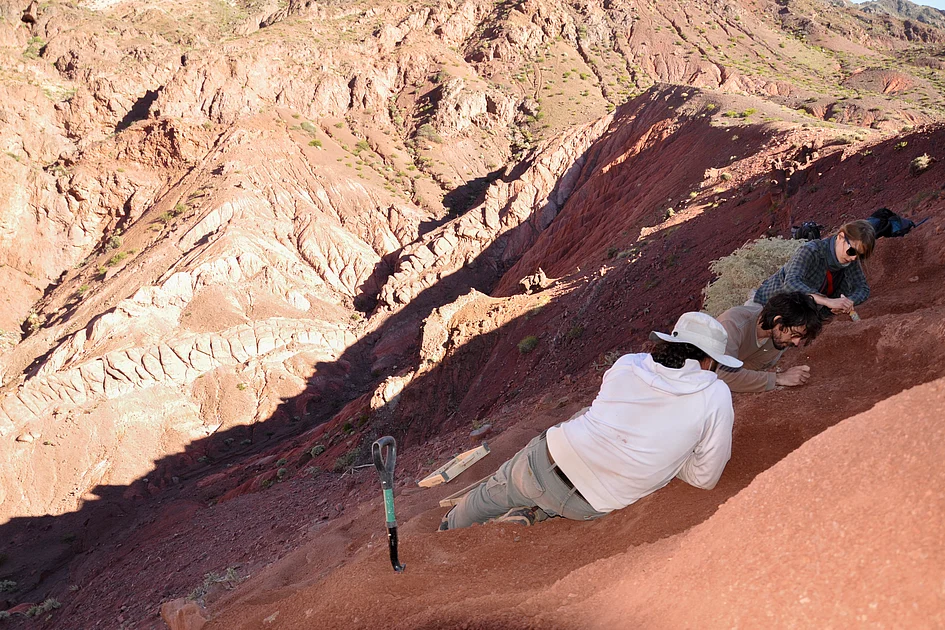
In a groundbreaking discovery, Argentinian scientists have unearthed the fossilized remains of one of the world’s oldest dinosaur species in the Andes Mountains. The find, announced by the CONICET research agency, includes a nearly complete skeleton of a small long-necked reptile named Huayracursor Jaguensis. The fossil was discovered at an altitude of 3,000 meters in Argentina’s northwest region. The team recovered part of the dinosaur’s skull, a complete vertebral column extending to the tail, and nearly intact forelimbs and hindlimbs. Published in the prestigious journal Nature, the discovery is expected to provide valuable insights into the evolutionary history of dinosaurs. Agustin Martinelli, one of the study’s authors, estimates that the Huayracursor roamed the Earth between 230 and 225 million years ago, placing it at the end of the Triassic period. This era marked the emergence of the first dinosaurs and the ancestors of mammals. Despite belonging to a lineage of herbivorous dinosaurs that later evolved into long-necked giants, the Huayracursor Jaguensis was relatively small, measuring about two meters in length and weighing approximately 18 kilograms. The discovery underscores the significance of the Triassic period in the evolution of life on Earth and highlights Argentina’s rich paleontological heritage.
分类: science
-

Nobel laureate Philippe Aghion says creative upbringing shaped his vision of innovation and freedom
PARIS (AP) — Philippe Aghion, the distinguished French economist and recent Nobel laureate, attributed his groundbreaking insights into innovation and economic growth to his family’s creative legacy. On Monday, Aghion, who shared the 2023 Nobel Memorial Prize in Economic Sciences with Joel Mokyr of Northwestern University and Peter Howitt of Brown University, paid tribute to his mother, Gaby Aghion, the visionary founder of the iconic fashion house Chloé. In an exclusive interview with The Associated Press from his Parisian apartment in the Latin Quarter, the 69-year-old professor highlighted how his mother revolutionized the fashion industry by introducing luxury ready-to-wear, a concept that offered women a more liberated and practical alternative to traditional haute couture. ‘I grew up with innovators. My mother invented luxury ready-to-wear,’ Aghion remarked, emphasizing her pioneering role in shaping modern fashion. He also reminisced about his childhood, surrounded by influential artists, including the legendary designer Karl Lagerfeld, who once assisted him with his German homework. Aghion’s research, which redefined the understanding of how technological advancements fuel economic prosperity, continues to be inspired by the themes of freedom and creativity that permeated his upbringing. His apartment, adorned with books on art and liberty, serves as a testament to the enduring influence of these values on his academic pursuits.
-

Farmer finds car-sized Nasa probe in Texas field
In an unexpected turn of events, a farmer in Edmonson, Texas, stumbled upon a NASA research probe the size of a car in his field. The probe, which had gone missing during a mission, veered off its intended trajectory and crash-landed on October 2. The incident has sparked widespread interest, as such occurrences are rare and often shrouded in mystery. NASA officials have since confirmed the discovery and are investigating the cause of the deviation. The probe, designed for advanced scientific research, was on a critical mission to gather data on atmospheric conditions. The crash landing has raised questions about the safety protocols and tracking mechanisms employed by the space agency. Meanwhile, the farmer, who wishes to remain anonymous, expressed both surprise and concern over the unexpected visitor. Local authorities have cordoned off the area to ensure public safety and facilitate NASA’s recovery efforts. This incident serves as a reminder of the unpredictable nature of space exploration and the challenges faced by scientists and engineers in ensuring mission success.
-
Rare wildflowers blanket Atacama desert
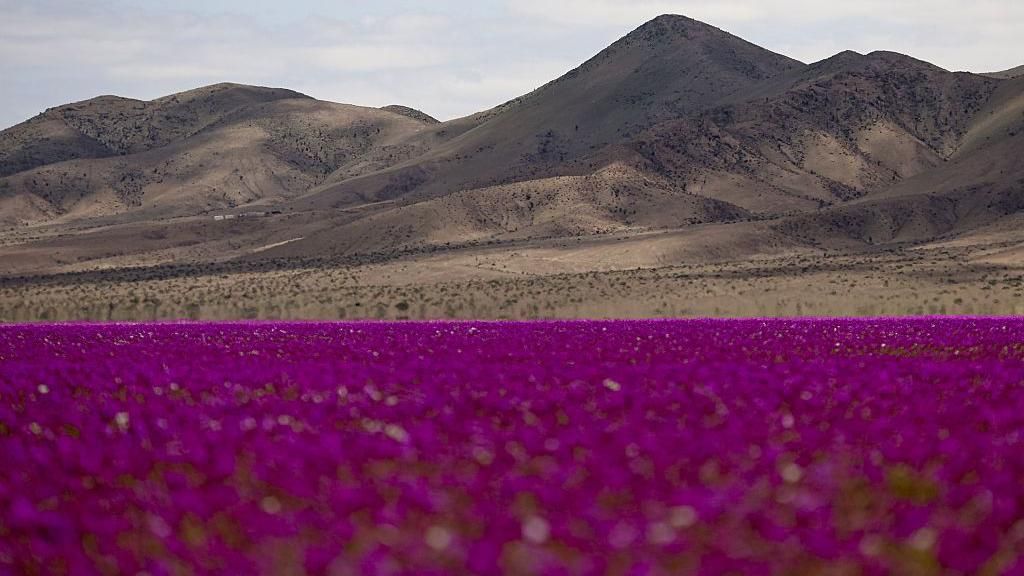
The Atacama Desert in Chile, renowned for its extreme aridity and status as one of the clearest places on Earth for stargazing, has undergone a stunning transformation. Typically a barren landscape, the desert has been blanketed by a vibrant carpet of wildflowers, a phenomenon triggered by unusually heavy rainfall during the southern hemisphere’s winter months. This rare event, which occurs only every few years, has brought dormant seeds to life, creating a breathtaking display of over 200 species of wildflowers, some of which are endemic to the region. The desert, which usually receives less than 15mm of rain annually, saw more than 12mm in August alone, with most of it falling in a single day. Additionally, a rare snowfall occurred in June, further contributing to the unique conditions. According to Chile’s National Forest Corporation (CONAF), this year’s bloom, which began in late August, will reach its peak in the coming weeks. This is the second consecutive year the phenomenon has occurred, following similar conditions in 2024. The Atacama’s wildflower bloom not only highlights the resilience of nature but also underscores the impact of climatic variations on even the most extreme environments.
-

Scientist’s off-grid hike interrupted by news of Nobel Prize win
In a remarkable twist of fate, Dr. Fred Ramsdell, a prominent US immunologist, discovered he had won the Nobel Prize in Medicine while on a remote hiking trip in Montana’s grizzly bear territory. The news reached him not through a direct call from the Nobel Committee but via a flood of text messages to his wife, Laura O’Neill, who was accompanying him on the adventure. Dr. Ramsdell, who had his phone on airplane mode, initially dismissed the announcement, only to be convinced by the overwhelming evidence of over 200 congratulatory messages. The award recognizes his groundbreaking research, conducted alongside two other scientists, into how the immune system combats infections. The trio will share a prize fund of 11 million Swedish kronor (£870,000). After receiving the messages, the couple drove to a nearby town to secure a phone signal, allowing Dr. Ramsdell to finally connect with the Nobel Committee nearly 20 hours after their initial attempts. Dr. Thomas Perlmann, Secretary-General of the Nobel Assembly, described this as the most challenging winner contact since 2016. Dr. Ramsdell’s lab, Sonoma Biotherapeutics, humorously noted that he was “living his best life” off-grid during the ordeal. This incident adds to the Nobel Prize’s history of quirky winner announcements, including economist Paul Milgrom’s missed call in 2020 and novelist Doris Lessing’s blunt reaction in 2007.
-
The before and after images showing glaciers vanishing before our eyes
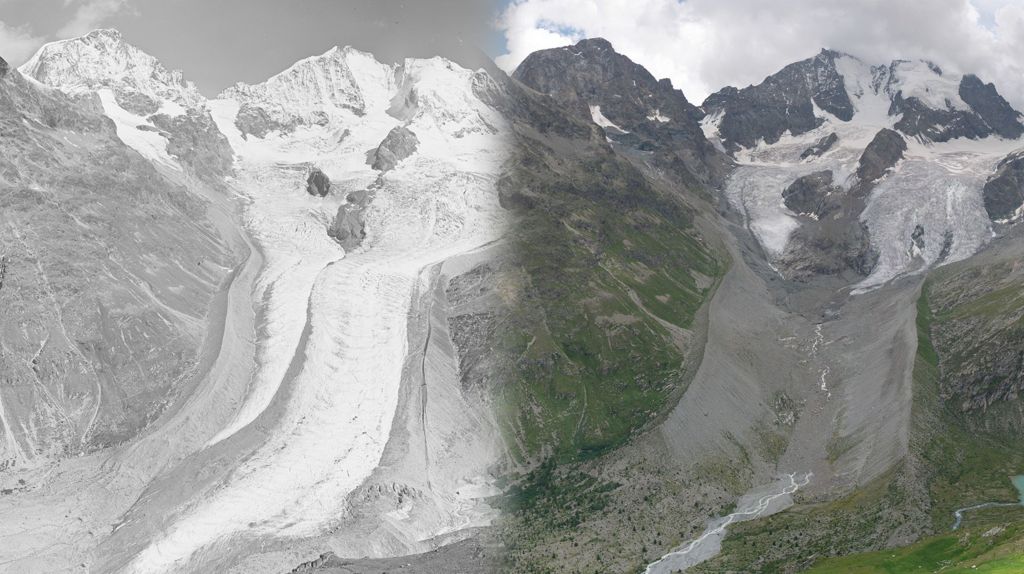
When Matthias Huss first set foot on the Rhône Glacier in Switzerland 35 years ago, the ice was a mere stroll from his family’s parking spot. Today, the journey takes half an hour, and the glacier’s retreat is a poignant reminder of the rapid changes unfolding across the planet. Huss, now the director of Glacier Monitoring in Switzerland (GLAMOS), recalls the glacier’s former grandeur with a sense of loss. ‘Every time I go back, I remember how it used to be,’ he says. His story is not unique. Glaciers worldwide are shrinking at an alarming rate, with 2024 alone seeing a staggering loss of 450 billion tonnes of ice outside Greenland and Antarctica, according to the World Meteorological Organization. This equates to a colossal ice block measuring 7km in height, width, and depth—enough to fill 180 million Olympic swimming pools. Switzerland’s glaciers have been particularly hard-hit, losing a quarter of their ice in the past decade. Satellite images and ground photographs starkly illustrate the transformation. The Rhône Glacier, for instance, now features a lake where ice once stood. Similarly, the Clariden Glacier, once in equilibrium, has melted rapidly this century. Smaller glaciers, like the Pizol Glacier, have vanished entirely. ‘It definitely makes me sad,’ Huss admits. The Great Aletsch Glacier, the largest in the Alps, has receded by 2.3km over 75 years, replaced by trees. While glaciers have naturally fluctuated over millennia, the accelerated retreat of the past 40 years is unequivocally linked to human-induced climate change. Burning fossil fuels has released vast amounts of CO2, warming the planet and destabilizing these icy giants. Even if global temperatures stabilize, glaciers will continue to retreat due to their delayed response to climate change. However, there is hope. Research published in *Science* suggests that limiting global warming to 1.5°C above pre-industrial levels could preserve half the world’s mountain glaciers. Yet, current projections indicate a 2.7°C rise by the century’s end, risking the loss of three-quarters of glacial ice. The consequences are profound. Rising sea levels threaten coastal populations, while mountain communities dependent on glacial meltwater for agriculture, drinking water, and hydropower face dire challenges. In Asia’s high mountains, often called the Third Pole, 800 million people rely on glacial meltwater, particularly in the Indus River basin. ‘That’s where we see the biggest vulnerability,’ says Prof. Regine Hock of the University of Oslo. Despite the grim outlook, scientists emphasize the power of human action. ‘It’s sad,’ Hock reflects, ‘but it’s also empowering. If we decarbonize, we can preserve glaciers. We have it in our hands.’
-

Study shows the world is far more ablaze now with damaging fires than in the 1980s
A groundbreaking study published in the journal *Science* has revealed that the frequency of the world’s most destructive wildfires has quadrupled since the 1980s, driven by human-induced climate change and the encroachment of urban areas into wildlands. The research, conducted by a team of international fire scientists from Australia, the United States, and Germany, shifts the focus from the traditional metric of acres burned to the economic and human toll of these disasters. By analyzing the 200 most damaging wildfires since 1980, the study found that these catastrophic events have increased by 4.4 times over the past four decades, with 43% occurring in the last ten years alone. The findings underscore a “climate-linked escalation of societally disastrous wildfires,” according to lead author Calum Cunningham, a pyrogeographer at the University of Tasmania. The study highlights that extreme fire weather conditions—hot, dry, and windy—are becoming more frequent due to the burning of fossil fuels, exacerbating the risk of devastating fires. Additionally, the expansion of urban areas into fire-prone regions, known as the wildland-urban interface, has further amplified the crisis. Cunningham emphasized that while wildfires are a natural phenomenon, human activities have significantly intensified their frequency and severity. The research also noted that economic data on wildfires is often inaccessible, complicating global assessments. However, by combining insurance data from Munich Re with the International Disaster Database, the team was able to provide a comprehensive analysis. Experts not involved in the study, such as Jacob Bendix of Syracuse University and Mike Flannigan of Thompson Rivers University, praised the research for its innovative approach and warned that the trend of increasing extreme fire weather poses a dire challenge for the future. The study calls for urgent action to mitigate climate change and improve wildfire preparedness to prevent further loss of life and economic devastation.
-

How smelly shoes inspired India’s Ig Nobel prize-winning study
A peculiar yet pervasive problem in households worldwide—smelly shoes—has inspired two Indian researchers to delve into the science behind the stench. Vikash Kumar, an assistant professor of design at Shiv Nadar University, and his former student Sarthak Mittal, embarked on a journey to understand how foul-smelling footwear affects the experience of using a shoe rack. Their innovative research not only addressed a common annoyance but also earned them the Ig Nobel Prize, a prestigious award celebrating unusual and imaginative scientific endeavors. The duo’s study began with a simple observation: students often left their shoes outside their rooms due to the overpowering odor, not due to a lack of space. A survey of 149 university students revealed that more than half had felt embarrassed by their own or someone else’s smelly shoes. Traditional remedies like tea bags or baking soda proved ineffective. Turning to science, the researchers identified Kytococcus sedentarius, a bacterium thriving in sweaty shoes, as the primary culprit. Their experiments demonstrated that a brief exposure to UVC light effectively killed the bacteria and eliminated the odor. However, timing was crucial—too much exposure damaged the shoes. Their solution? A prototype shoe rack equipped with UVC tube lights, designed to store and sterilize shoes simultaneously. The Ig Nobel Prize recognized their work, highlighting the fun and imaginative side of science. The award has not only brought recognition but also inspired the researchers to explore more unconventional scientific questions. As Kumar aptly put it, today’s smelly sneakers could pave the way for tomorrow’s groundbreaking discoveries.
-

Meet the history-making astronauts headed for the Moon
NASA’s Artemis II mission, set to launch as early as February 2026, marks a historic return to lunar exploration after a 50-year hiatus. Commander Reid Wiseman and his crew, including mission specialist Christina Koch, Canadian astronaut Jeremy Hansen, and Victor Glover, are poised to embark on a journey that promises to redefine humanity’s understanding of the Moon and beyond. The mission, part of NASA’s broader Artemis program, aims to establish a sustained human presence on the lunar surface and pave the way for future Mars exploration.
-
China’s dual-use asteroid-collision research threatens satellites
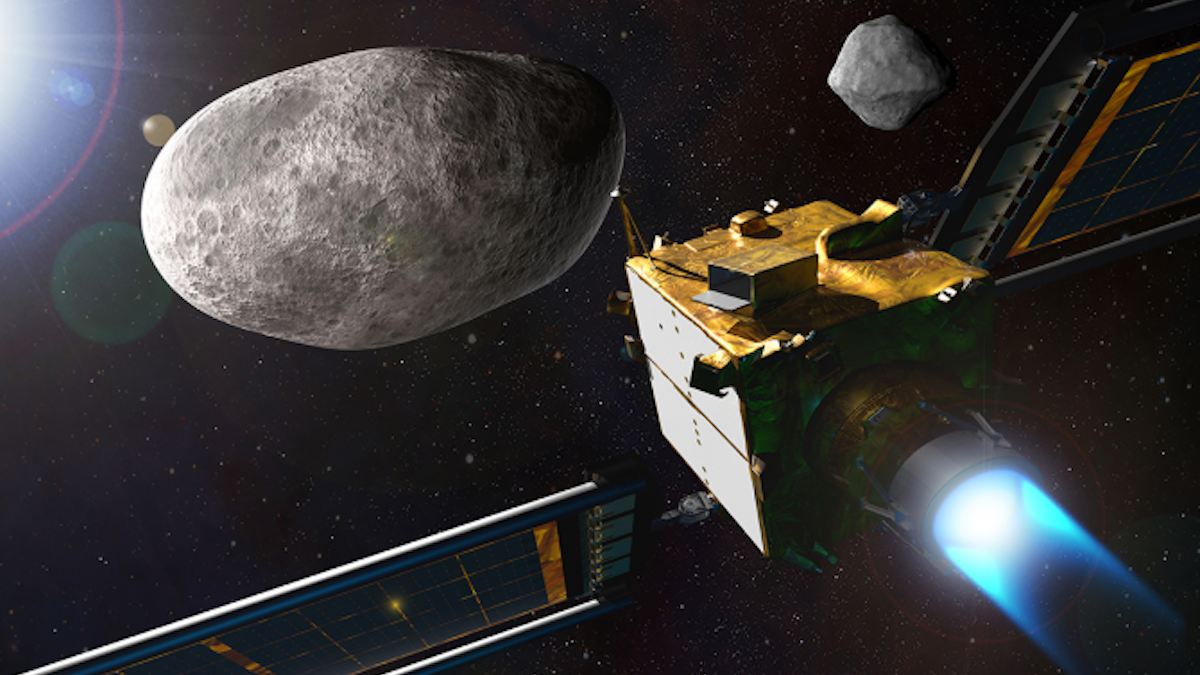
China has announced a groundbreaking mission to deliberately impact a near-Earth asteroid by 2030, marking a significant leap in its planetary defense and asteroid resource utilization capabilities. This initiative, revealed by Wu Weiren, chief designer of China’s lunar exploration program, underscores the nation’s growing ambitions in space exploration and its intent to lead in planetary defense technologies. The mission involves deploying two spacecraft: one as a kinetic impactor and another as an observer to monitor the collision and its effects. This dual approach aims to validate asteroid deflection techniques and assess their feasibility for planetary defense. The announcement comes three years after NASA’s successful Double Asteroid Redirection Test (DART) in 2022, which demonstrated the potential of kinetic impactors to alter asteroid trajectories. China’s plan, however, goes beyond defense, signaling a strategic vision for deep-space resource extraction and economic exploitation. The mission’s dual-use nature has sparked discussions about its potential military applications, particularly in anti-satellite operations. Despite these concerns, China has invited over 40 countries and organizations to collaborate on joint monitoring and research efforts, emphasizing international cooperation. The mission’s complexity lies in its precision and unpredictability, as scientists grapple with the unknown internal composition of asteroids. China’s long-term strategy includes achieving kinetic impact milestones by 2030, propulsion-based deflection tests by 2035, and mastering full-scale asteroid orbit technology by 2045. This ambitious timeline aligns with the anticipated maturity of asteroid resource utilization, positioning China as a key player in the emerging trillion-dollar space economy.