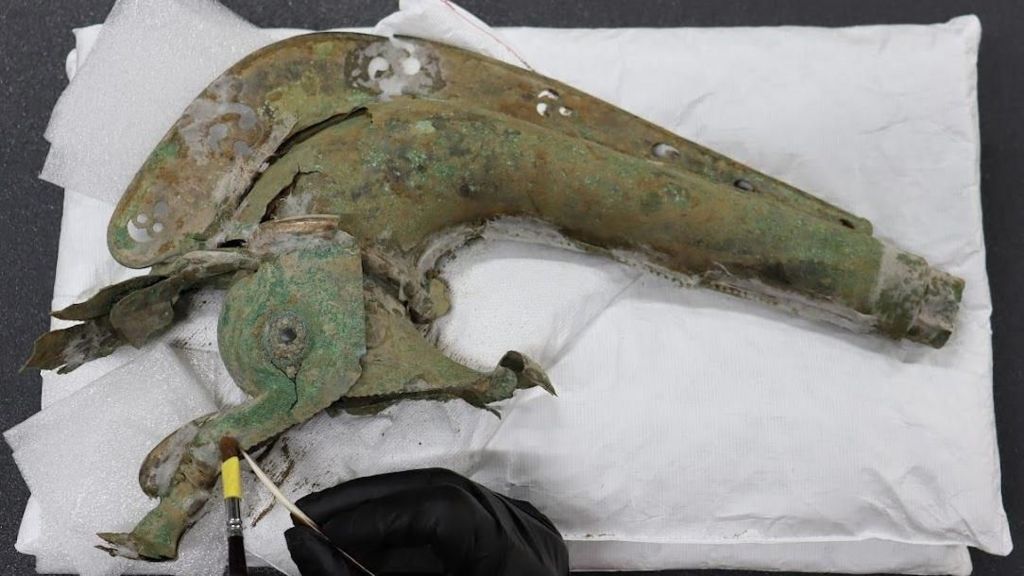
Archaeologists have unearthed what they describe as a “once-in-a-lifetime discovery” in a Norfolk field near Thetford—an extraordinary Iron Age hoard containing two of Britain’s rarest archaeological artifacts found together for the first time. The excavation team from Pre-Construct Archaeology made the groundbreaking discovery during routine work on a construction site last year, uncovering Europe’s most complete carnyx (a ceremonial war trumpet) and Britain’s first-ever boar’s head flag standard.
The carnyx represents an unprecedented find with its pipe, mouthpiece, and bell all remarkably intact after approximately 2,000 years underground. Crafted from extremely thin sheets of metal that have become exceptionally brittle over centuries, the instrument has been preserved with what conservator Jonathan Carr describes as “a wonderful little eye, which is a remarkable survivor.” This specimen joins only two other carnyces previously discovered in Britain.
Equally significant is the boar’s head standard, created from sheet bronze and serving as a military rallying point during battle. The boar held profound symbolic meaning for Iron Age warriors, representing ferocity and strength in combat. Dr. Fraser Hunter, Iron Age and Roman curator at National Museums Scotland, emphasized that “the full research and conservation of these incredibly fragile remains will reshape our view of sound and music in the Iron Age.
The hoard, dating between 50 BC and AD 50, additionally contained five shield bosses and an iron object of unknown origin. Its connection to the Iceni tribe—the Celtic community famously led by Queen Boudica in her rebellion against Roman occupation—adds historical significance to the discovery. Carnyces were particularly feared by Roman forces, who frequently depicted them as war trophies in their art.
Following meticulous excavation, the artifacts were carefully lifted from the earth in a soil block and underwent advanced scanning to determine their precise positioning before conservation began. The discovery has been reported to the coroner for a treasure inquest, with Historic England coordinating research efforts alongside Norfolk Museums Service and the National Museum of Scotland. The find will be featured on BBC Two’s Digging for Britain, offering the public an unprecedented glimpse into Iron Age warfare and ceremonial practices.