分类: science

  • Brain-computer interface enables mind over matter

    Brain-computer interface enables mind over matter

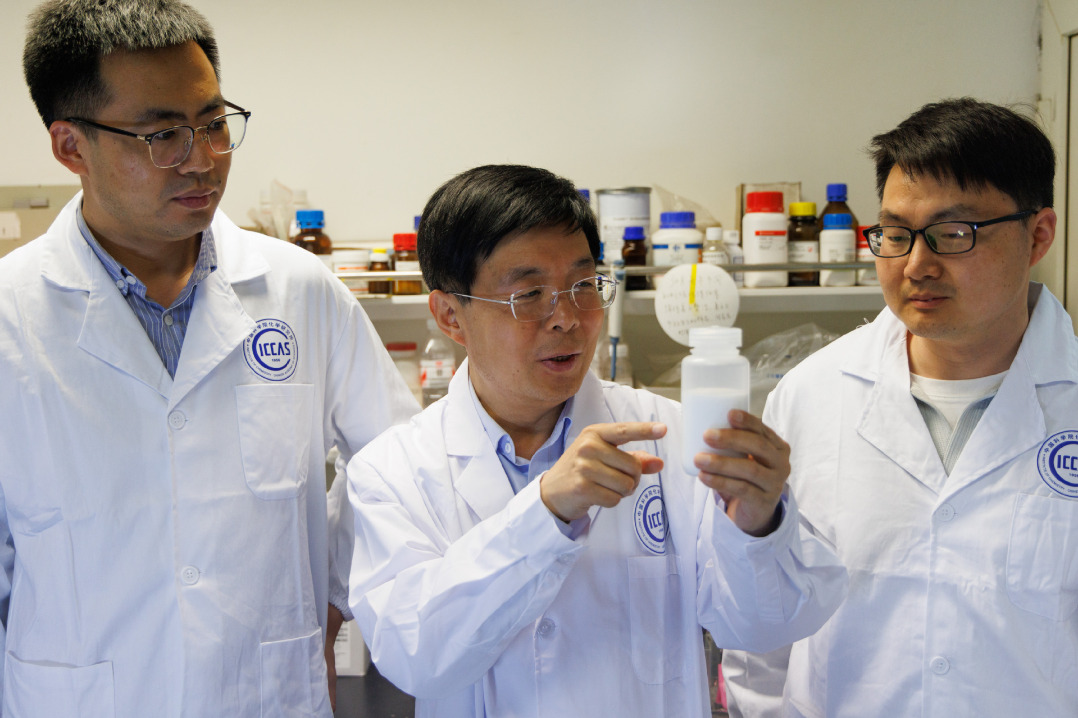
    Chinese neuroscientists have achieved a significant clinical milestone with the successful development of Beinao No 1 NeuCyber Matrix, an advanced brain-computer interface system demonstrating remarkable results in human trials. This groundbreaking technology represents a paradigm shift from conventional machine assistance to enabling partial self-recovery in paralyzed patients.

    The Chinese Institute for Brain Research in Beijing reported that their domestically developed wireless system has shown stable, long-term performance in treating conditions including spinal cord injuries, ALS, and stroke-related paralysis. The system’s effectiveness is exemplified by the case of 31-year-old Xiao Rui, who suffered quadriplegia from a spinal injury two years ago. Remarkably, within just five days post-implantation, Xiao mentally commanded a robotic arm to pour water. One year later, he has regained sufficient control to independently feed himself, including picking up strawberries and bringing them to his mouth.

    Professor Yi Zhiqiang, Director of Neurosurgery at Peking University First Hospital, emphasized the transformative potential: ‘From this pioneering patient, we anticipate Beinao No 1 will deliver groundbreaking advancements benefiting millions with neurological conditions.’ The technology has already been implanted in seven patients, with over thirty clinical trials scheduled across numerous medical institutions nationwide this year.

    The system utilizes innovative membrane electrodes composed of lipid materials that rest on the brain’s surface without penetration, recording electrocorticography signals through direct cortical contact achieved via skull opening. These signals are wirelessly processed and decoded to interpret the patient’s intended movements, enabling control of external devices and even exoskeletons for assisted walking.

    Institute Director Luo Minmin confirmed the system’s exceptional stability and effectiveness, noting: ‘Our patients can now control computer cursors and exoskeleton devices with their thoughts, marking tremendous progress toward functional recovery.’ The research team anticipates completing clinical trials by next year, potentially revolutionizing treatment for global stroke patients with safer, more effective neurotechnology solutions.

    The technological advancement follows the institute’s recent recognition in Nature journal for revealing common mechanisms behind fast-acting antidepressant therapies. The next-generation Beinao No 2 system is currently showcased at Beijing’s prestigious Zhongguancun Forum, demonstrating China’s growing leadership in cutting-edge neuroscience innovation.

  • Ecological civilization paving way to prosperity

    Ecological civilization paving way to prosperity

    In a groundbreaking dialogue between international education and environmental policy, Linda de Boer, a student at prestigious US boarding school Philips Academy Andover, recently engaged with Chinese ecological researcher Zhang Yongsheng to explore China’s transformative approach to sustainable development. The discussion revealed how China’s ecological civilization concept is fundamentally reshaping global understanding of progress and prosperity.

    Director-General Zhang Yongsheng of China’s Research Institute for Eco-civilization, affiliated with the Chinese Academy of Social Sciences, articulated the paradigm shift from traditional industrial development to ecological civilization. Where conventional models since the Industrial Revolution treated environmental protection and economic growth as conflicting priorities, China’s new framework recognizes them as mutually reinforcing elements.

    The transformation gained momentum in 2012 under President Xi Jinping’s leadership, introducing the revolutionary ‘green is gold’ principle that has redefined China’s developmental philosophy. This shift addresses three critical shortcomings of traditional development: environmental unsustainability, social inequality, and the well-being paradox where economic growth doesn’t necessarily translate to increased happiness.

    Ecological civilization represents an evolutionary advancement beyond industrial civilization, characterized by two fundamental distinctions. First, it replaces anthropocentrism with harmonious coexistence within nature’s boundaries. Second, it reimagines the concept of ‘good life’ beyond material consumption, creating development models that simultaneously achieve economic prosperity and environmental sustainability.

    China’s electric vehicle industry exemplifies this transformation. While trailing in traditional automotive manufacturing, China leveraged climate action requirements to establish leadership in the emerging EV sector. This demonstrates how environmental standards can create competitive advantages rather than constraints.

    The green development framework encompasses four strategic pillars: stringent environmental protection, green development through systemic reforms, global openness through free trade agreements, and South-South cooperation sharing green technology with developing nations. China now offers zero tariffs to African countries and reduced tariffs to ASEAN nations, facilitating global green transition.

    China’s environmental journey began parallel to industrialized nations in 1972, though initially constrained by misconceptions that environmental problems were exclusive to capitalist systems. The country’s rapid economic expansion following WTO accession in 2000 exacerbated environmental challenges, revealing the inherent conflicts in traditional industrialization models.

    The turning point emerged in 2005 with then-Zhejiang Party Secretary Xi Jinping’s seminal concept: ‘Lucid waters and lush mountains are invaluable assets.’ This philosophical breakthrough recognized environmental protection as an economic driver rather than burden, initiating China’s transition from environmental management to ecological civilization.

    China’s ambitious climate targets stem from both the unsustainability of previous development patterns and the emergence of new opportunities. The global shift toward carbon neutrality commitments reflects this transformed understanding, accelerated by renewable energy costs dropping approximately 90% and electric vehicles becoming cost-competitive with traditional automobiles.

    China’s experience offers valuable insights for all nations confronting environmental crises. The ecological civilization model demonstrates that developing countries need not follow the ‘develop first, clean up later’ path but can achieve simultaneous economic growth and environmental protection from development’s earliest stages.

  • Nation’s soil passes 30-year geological ‘health check-up’

    Nation’s soil passes 30-year geological ‘health check-up’

    A comprehensive national soil analysis spanning nearly three decades reveals significant improvements in China’s land quality and ecological resilience. The National Land Geochemical Monitoring Report 2025, released by the China Geological Survey under the Ministry of Natural Resources, examined over 500,000 data points collected between 1995 and 2023, providing an unprecedented longitudinal perspective on the nation’s geological health.

    The study demonstrates that 92.6% of China’s land now qualifies as medium grade or higher in quality—a 0.4 percentage point increase since baseline measurements began. Research lead Peng Min attributes this enhancement to sustained implementation of major ecological initiatives including the Three-North Shelterbelt Forest Program, farmland-to-forest conversion projects, and widespread adoption of water conservation technologies.

    Critical findings highlight the stability of foundational ‘skeleton’ elements—silicon, aluminum, iron, and magnesium—which maintain soil structural integrity and prevent desertification and salinization. Simultaneously, essential plant nutrients including nitrogen, phosphorus, potassium, and vital micronutrients like manganese, selenium, and iodine have shown moderate increases, suggesting positive implications for agricultural productivity and food security.

    The most notable improvement emerged in soil organic carbon content, which rose from 6.7 to 7.8 grams per kilogram over the monitoring period. This component functions as both hydrological regulator and nutrient retainer, enhancing drought resistance while preventing fertilizer runoff. Particularly remarkable was the 141% surge in organic carbon on the Qinghai-Tibet Plateau, where climate warming and improved grazing practices have transformed the region into an increasingly effective carbon sink.

    Researchers confirm the plateau’s growing significance in global carbon sequestration, with its enhanced capacity to absorb atmospheric carbon dioxide contributing to greenhouse effect mitigation. As China progresses into its 15th Five-Year Plan period (2026-2030), monitoring will intensify with 6,000 additional sites planned for key agricultural regions, alongside regular decadal national surveys and quinquennial regional assessments.

  • First stop, the Moon. Next stop, Mars? Why Nasa’s mission matters

    First stop, the Moon. Next stop, Mars? Why Nasa’s mission matters

    NASA is poised to launch its groundbreaking Artemis II mission within days, sending four astronauts on a historic journey to orbit the Moon. This critical mission establishes the foundation for subsequent lunar landings and the eventual establishment of a permanent Moon base.

    Despite the iconic Apollo missions that placed twelve astronauts on the lunar surface over fifty years ago, NASA’s Artemis program represents a fundamentally different endeavor. With an estimated investment of $93 billion and thousands of contributors, this new lunar campaign moves beyond symbolic achievement toward sustained planetary presence.

    Scientific exploration drives much of this renewed interest. Planetary scientist Professor Sara Russell explains that the Moon contains identical elements to those found on Earth, including concentrated rare earth elements crucial for technology, along with metals like iron and titanium. The most significant discovery, however, is water—trapped within lunar minerals and accumulated as ice in permanently shadowed polar craters. This water proves essential for human survival, providing drinking water, breathable air through electrolysis, and even rocket fuel.

    The contemporary space race features different geopolitical dynamics than the Cold War-era competition with the Soviet Union. China has emerged as a major space power, having successfully deployed robotic missions to the Moon and announced plans for human landings by 2030. Both nations seek access to resource-rich lunar territories, particularly the South Pole region, despite the 1967 Outer Space Treaty prohibiting national claims to celestial bodies.

    Dr. Helen Sharman, the first British astronaut, clarifies the legal landscape: ‘Although you can’t own a piece of land because of the UN treaty, you can basically operate on that land without anybody interfering with it. The big thing right now is to try to grab your piece of land. You can’t own it, but you can use it.’

    Beyond lunar exploration, NASA views the Moon as a crucial testing ground for eventual human missions to Mars. Libby Jackson, head of space at the Science Museum, emphasizes the strategic rationale: ‘Going to the Moon and staying there for a sustained period is much safer, much cheaper and much easier to be a test bed for learning how to live and work on another planet.’ The Moon provides an ideal environment to develop technologies for life support, radiation protection, and habitat construction without the catastrophic risks of testing them during a Mars mission.

    Scientific discovery remains another compelling motivation. The Apollo missions transformed our understanding of the Moon’s formation through a colossal impact between Earth and a Mars-sized body. As a geological time capsule preserving 4.5 billion years of solar system history, the Moon offers unparalleled insights into Earth’s own evolution.

    The Artemis program also aims to inspire new generations through high-definition live streams of lunar exploration, potentially creating what space advocates hope will be a ‘Apollo effect’ for the 21st century—stimulating interest in science, technology, engineering, and mathematics careers while fostering international cooperation in space exploration.

  • Large-scale marine research infrastructure platform starts construction in Shanghai

    Large-scale marine research infrastructure platform starts construction in Shanghai

    Shanghai has commenced construction on a groundbreaking deep-sea floating research facility, marking a significant advancement in China’s marine science capabilities. This major national scientific infrastructure project, developed by Shanghai Jiao Tong University, represents a monumental step in oceanic exploration and technological innovation.

    The sophisticated facility incorporates a semi-submersible twin-hull vessel design, engineered to withstand extreme deep-sea conditions. With remarkable capabilities to conduct sea trials for equipment weighing approximately 100 tonnes and operate at depths reaching 10,000 meters, the platform will enable unprecedented research in previously inaccessible marine environments.

    Scheduled for completion by 2030, the comprehensive infrastructure comprises three integrated systems: a primary operational platform, advanced shipborne laboratories, and sophisticated shore-based support facilities. These research units will specialize in multiple disciplines including marine disaster prediction, meteorological observation, underwater physical environment studies, and ecosystem analysis.

    The platform’s operational flexibility allows for extended deployment in mission areas, facilitating cross-seasonal scientific observation and engineering trials. Its rapid mobilization capacity enables researchers to dynamically adjust operational zones in response to evolving scientific requirements and oceanic conditions.

    This pioneering infrastructure will serve as a critical testing ground for deep-sea mining systems, marine equipment innovation, and offshore energy development. Beyond industrial applications, the facility will significantly contribute to scientific understanding of marine ecosystem evolution patterns, investigation into life’s origins, and enhancement of typhoon forecasting accuracy. The project stands to substantially improve disaster prevention capabilities while accelerating the sustainable utilization of marine resources.

  • China planning human research program at space station

    China planning human research program at space station

    China has announced a groundbreaking initiative to advance human space research aboard its Tiangong space station, marking a significant leap in preparing for extended orbital missions and future lunar exploration. The China Manned Space Agency revealed plans to solicit scientific proposals beginning April 1, 2026, targeting fundamental biological and physiological challenges facing humans in space environments.

    The comprehensive research program will focus on creating a detailed space human atlas and establishing an extensive biomedical database. Scientists will analyze human samples, organoids, and cellular structures to investigate microgravity’s effects on musculoskeletal systems, cardiovascular health, metabolic processes, cognitive function, and aging mechanisms during prolonged spaceflight.

    This initiative represents China’s strategic commitment to establishing itself as both an aerospace and technological powerhouse. The research outcomes are expected to benefit not only taikonauts undertaking year-long orbital missions but also contribute to terrestrial medical advancements. Current plans include hosting two crew rotations aboard Tiangong this year, with one astronaut scheduled to complete a record-breaking orbital stay exceeding twelve months.

    Space medicine has emerged as a critical research domain aboard China’s orbiting laboratory. Since initial solicitations in June 2023, the program has received 387 project submissions, with 53 already undergoing experimentation in the microgravity environment. Notable achievements include pioneering work on space organ chips and the world’s first artificial blood vessel tissue chip research in space.

    According to Li Yinghui, a lead researcher at the China Astronaut Research and Training Center, these innovations have already provided theoretical frameworks and technological platforms for studying terrestrial health challenges including cardiovascular diseases, neurodegenerative disorders, and pharmaceutical development. The program aligns with China’s broader ambitions for crewed lunar landings by 2030, addressing growing public concern about astronaut welfare during increasingly extended space missions.

  • Whale filmed giving birth, with a little help from her friends

    Whale filmed giving birth, with a little help from her friends

    In a groundbreaking scientific observation, researchers have documented the first known instance of non-primate birth assistance among marine mammals. The extraordinary event occurred on July 8, 2023, when an international team from Project CETI witnessed a 19-year-old sperm whale named Rounder giving birth off the coast of Dominica while receiving active support from both related and unrelated pod members.

    During the 34-minute birthing process, multiple adult females demonstrated remarkable cooperative behavior. They positioned themselves beneath Rounder’s dorsal fin, often swimming on their backs with their heads oriented toward her genital slit. Immediately following the birth, the entire pod of 11 whales underwent a dramatic behavioral shift, with all adults actively engaging with the newborn through physical contact and coordinated pushing motions.

    The research team, which published its findings in both Scientific Reports and Science journals, captured the event using drone footage, boat observations, and underwater audio recordings over nearly five and a half hours. This documentation represents an exceptional rarity in marine biology, as only nine of 93 cetacean species have been observed giving birth in wild conditions.

    Notably, the assisting whales included both family members and unrelated individuals—the first documented evidence of such behavior outside primate species. Researchers noted that the whales’ evolutionary history as land mammals that returned to the ocean approximately 36 million years ago necessitated specialized birthing adaptations. Unlike terrestrial mammals, whale calves emerge tail-first and require immediate assistance to prevent drowning before developing swimming capabilities.

    The team also recorded significant vocalization changes during key moments, suggesting sophisticated communication coordination among pod members. The newborn calf, measuring approximately four meters at birth, was spotted over a year later with other young pod members, indicating successful survival through the critical first year—a positive indicator for reaching adulthood.

  • China successfully launches new test satellite

    China successfully launches new test satellite

    China has marked another significant achievement in its space exploration program with the flawless launch of the Shiyan-33 experimental satellite. The mission commenced at precisely 12:11 pm Beijing Time on Friday from the Jiuquan Satellite Launch Center in northwest China.

    The satellite was propelled into space utilizing a Long March 2C carrier rocket equipped with the advanced Yuanzheng-1S upper stage propulsion system. This sophisticated launch vehicle configuration successfully delivered the Shiyan-33 satellite to its predetermined orbital trajectory, confirming the complete success of the deployment operation.

    This launch represents a historic milestone for China’s space program, constituting the 635th flight mission of the renowned Long March rocket family. The consistent performance of these launch vehicles demonstrates China’s growing capabilities and reliability in space transportation systems.

    The Jiuquan Satellite Launch Center, China’s first and most experienced satellite launch facility, continues to play a pivotal role in the nation’s space ambitions. Established in 1958, this strategic installation has been the departure point for numerous significant space missions, including China’s first satellite launch in 1970 and multiple crewed space flights.

    The Shiyan series of satellites typically serve experimental purposes, testing new technologies, materials, and systems in space environments. These missions provide valuable data that contributes to the advancement of China’s space capabilities and technological innovation across multiple aerospace disciplines.

  • Arctic sea ice at lowest level ever this winter

    Arctic sea ice at lowest level ever this winter

    In a stark indicator of climate change’s accelerating impact, Arctic sea ice has reached its lowest winter extent since satellite monitoring began 48 years ago. According to data released by the National Snow and Ice Data Center (NSIDC) in Colorado, the ice cover peaked at just 14.29 million square kilometers on March 15—marking a statistical tie with last year’s record low of 14.31 million square kilometers.

    This premature maximum, occurring a full week earlier than in 2022, provides a concerning head start to the spring and summer melt season. Scientists warn that diminished winter ice formation creates conditions for potentially faster and more extensive summer melting—a trend consistently observed since 2016.

    The ecological implications are profound. Species including polar bears and emperor penguins rely on stable sea ice for breeding and hunting grounds. Oceanographer Gilles Garric notes that newly exposed ocean surfaces in regions like the Beaufort Sea are absorbing atmospheric heat that would previously have been reflected by ice, creating warming feedback loops.

    Beyond environmental consequences, the disappearing ice is transforming geopolitical dynamics. Elizabeth Chalecki, climate security expert, characterizes the increasingly navigable Arctic as ‘the new Mediterranean’—a contested maritime space surrounded by competing nations. This assessment gains relevance amid renewed interest in Arctic shipping routes and mineral resources, including former President Trump’s expressed ambitions regarding Greenland.

  • China-Europe space science SMILE mission set for April 9 launch

    China-Europe space science SMILE mission set for April 9 launch

    The groundbreaking Solar wind Magnetosphere Ionosphere Link Explorer (SMILE) mission, a collaborative endeavor between the Chinese Academy of Sciences and the European Space Agency, has completed all preparatory phases and is scheduled for launch on April 9 from Europe’s Spaceport in French Guiana. This announcement was made by China’s National Space Science Center on March 26, 2026.

    The sophisticated spacecraft has been successfully integrated onto the Vega-C rocket, marking the mission’s transition into its final countdown sequence. The SMILE mission represents a significant milestone in international space cooperation, particularly between Chinese and European scientific communities.

    This ambitious project aims to study the interaction between solar winds and Earth’s magnetosphere through advanced imaging technology. Unlike previous missions that primarily relied on in-situ measurements, SMILE will utilize cutting-edge ultraviolet and X-ray imaging equipment to provide unprecedented visual data of how solar particles interact with our planet’s protective magnetic field.

    The mission’s launch from South America signifies the global nature of space exploration, with equipment having been previously shipped from the port of Amsterdam. This joint venture demonstrates how international partnerships can advance our understanding of space weather phenomena that potentially affect satellite communications, navigation systems, and power grids on Earth.