分类: politics

  • Xi congratulates To Lam on reelection as General Secretary of CPV Central Committee

    Xi congratulates To Lam on reelection as General Secretary of CPV Central Committee

    In a significant diplomatic exchange, Chinese President Xi Jinping has extended formal congratulations to To Lam on his re-election as General Secretary of the Communist Party of Vietnam Central Committee. This gesture underscores the continuing commitment to bilateral relations between the two neighboring socialist nations.

    The congratulatory message, delivered on January 23, 2026, emphasizes the strategic importance both countries place on maintaining strong party-to-party connections and advancing their comprehensive cooperative partnership. President Xi expressed confidence that under To Lam’s continued leadership, Vietnam would achieve further accomplishments in its national development agenda.

    This diplomatic communication occurs within the broader context of China-Vietnam relations, which have historically balanced cooperation with occasional tensions, particularly regarding South China Sea claims. The exchange follows established protocols for such leadership transitions within communist parties and reflects the institutionalized nature of inter-party relations between the two countries.

    Analysts note that such congratulatory messages serve multiple diplomatic purposes: reinforcing political solidarity, maintaining open communication channels, and signaling continuity in foreign policy approaches despite leadership changes. The timing of this exchange coincides with both countries’ ongoing efforts to navigate complex regional geopolitics while pursuing economic development goals.

  • Trump says US ‘armada’ moving towards Iran amid renewed threats

    Trump says US ‘armada’ moving towards Iran amid renewed threats

    In a significant escalation of military posturing, President Donald Trump announced the deployment of a substantial naval force toward Iranian waters on Thursday. The declaration came following his return from diplomatic engagements at the World Economic Forum in Davos, Switzerland.

    Speaking aboard Air Force One, Trump revealed that Washington is closely monitoring Tehran’s activities as U.S. naval assets advance toward the region. ‘We have substantial naval resources moving in that direction as a precautionary measure,’ Trump told journalists. ‘While I would prefer no escalation, we are maintaining vigilant surveillance of their actions.’

    The naval deployment includes the aircraft carrier USS Abraham Lincoln accompanied by multiple guided-missile destroyers, according to unnamed U.S. officials who briefed Reuters. These vessels, originally stationed in the Asia-Pacific theater, began their repositioning last week amid deteriorating relations.

    The administration is reportedly considering additional defensive measures, including enhanced air defense systems to protect American installations throughout the Middle East from potential Iranian counterstrikes.

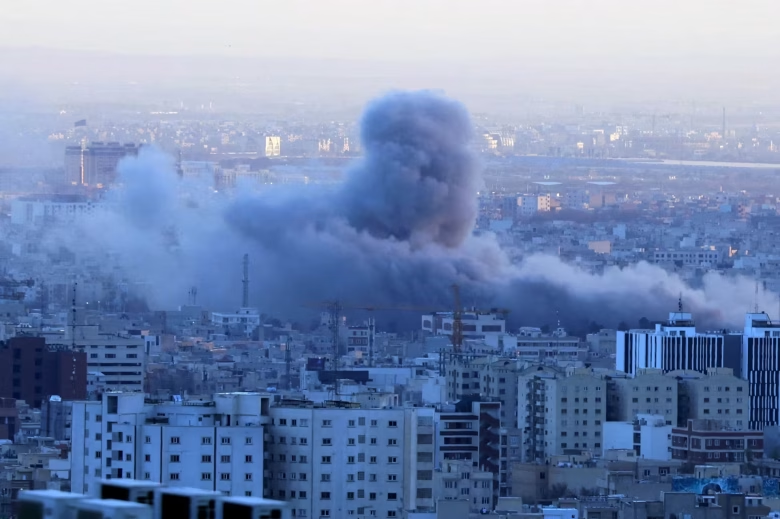
    This military mobilization follows earlier U.S. strikes against Iranian nuclear facilities in June, operations that drew widespread international criticism for allegedly violating established international legal frameworks. The latest deployments substantially expand America’s military capabilities in the region.

    Tensions have intensified following months of civil unrest across Iran, which Tehran claims was instigated by foreign interference. Trump has repeatedly threatened intervention, accusing Iranian authorities of lethal violence against protesters.

    Iran’s Supreme Leader Ayatollah Ali Khamenei has acknowledged that ‘several thousand’ citizens perished during recent nationwide demonstrations. While Trump asserted that nearly 840 executions were canceled following U.S. warnings, Iranian officials reported the confirmed death toll had exceeded 5,000, including hundreds of security personnel.

    The President issued unequivocal warnings regarding Iran’s nuclear ambitions: ‘Should they attempt to reactivate their nuclear program, we will respond with even greater force than previously demonstrated.’

    The protests originated in Tehran’s Grand Bazaar on December 28th as economic demonstrations before evolving into broader antigovernment movements across the nation.

  • Could trilateral talks yield a breakthrough in Ukraine-Russia war?

    Could trilateral talks yield a breakthrough in Ukraine-Russia war?

    In a significant diplomatic development, representatives from Ukraine, Russia, and the United States have convened for unprecedented trilateral discussions, marking the first such meeting since Russia’s full-scale invasion of Ukraine in February 2022. This groundbreaking dialogue represents a potential turning point in the protracted conflict that has reshaped global security architecture.

    The high-level meeting brings together key stakeholders at a critical juncture in the nearly two-year conflict, suggesting possible behind-the-scenes diplomatic maneuvering that may pave the way for more substantive negotiations. While specific agenda items remain confidential, the very occurrence of this tripartite engagement indicates a potential willingness among parties to explore diplomatic channels alongside military operations.

    International observers are closely monitoring these talks for indications of potential compromise areas, including security guarantees, territorial considerations, and humanitarian arrangements. The participation of Washington as both a major military supporter of Ukraine and a global superpower adds considerable weight to the proceedings, potentially creating conditions for confidence-building measures that could de-escalate tensions.

    This diplomatic initiative occurs amid evolving battlefield dynamics and increasing international pressure for conflict resolution. The involvement of all three principal actors simultaneously distinguishes this effort from previous bilateral contacts and suggests a recognition that sustainable peace requires addressing the concerns of all major parties involved in or affected by the conflict.

  • Danish PM visits Greenland for talks after Trump climbdown

    Danish PM visits Greenland for talks after Trump climbdown

    In a significant diplomatic development, Danish Prime Minister Mette Frederiksen concluded crucial talks in Nuuk with Greenlandic leadership following the de-escalation of U.S. territorial ambitions toward the autonomous Arctic territory. The high-level meetings occurred against the backdrop of withdrawn acquisition threats from President Donald Trump, who instead agreed to a nebulous ‘framework’ for future negotiations through NATO mediation.

    The diplomatic confrontation reached its peak when Trump abruptly abandoned his aggressive stance toward Greenland after intensive discussions with NATO Secretary General Mark Rutte. While specific details remain undisclosed, the arrangement purportedly satisfies American strategic interests while respecting Denmark’s territorial sovereignty. According to sources familiar with the negotiations, the framework centers on modernizing the existing 1951 defense pact that already permits U.S. military presence on the island with prior notification.

    Danish Foreign Minister Lars Lokke Rasmussen clarified that no formal agreement had been finalized, characterizing the arrangement merely as ‘a framework for future agreement’ that replaces ‘drastic ideas about needing to own Greenland’ with negotiated solutions. Both Danish and Greenlandic officials have emphatically declared sovereignty protection as their non-negotiable ‘red line’ in forthcoming discussions.

    The geopolitical tension has paradoxically strengthened the relationship between Denmark and Greenland despite historical colonial grievances. Greenlandic Prime Minister Jens-Frederik Nielsen emphasized that no international agreements could be valid without direct involvement from Nuuk authorities, echoing Frederiksen’s consistent position on self-determination matters.

    Analysts observe that Trump’s aggressive posture has temporarily unified Greenland’s political spectrum, causing independence advocates to prioritize solidarity with Denmark amid external pressure. This unexpected diplomatic episode has accelerated security discussions while highlighting the Arctic region’s growing strategic importance in global power dynamics.

  • High stakes but low expectations ahead of Ukraine talks with Russia and US

    High stakes but low expectations ahead of Ukraine talks with Russia and US

    In a significant diplomatic development, representatives from Russia, Ukraine, and the United States are convening in Abu Dhabi for their first tripartite negotiations since Russia’s full-scale invasion of Ukraine in 2022. This meeting marks a new format in peace discussions, though fundamental disagreements between the parties remain largely unchanged.

    Ukrainian President Volodymyr Zelensky has characterized his recent discussions with former US President Donald Trump in Davos as “really positive,” expressing hope for enhanced air defense support against Russia’s ongoing assaults. Despite this optimism, Zelensky maintains cautious realism regarding the Abu Dhabi talks, describing them merely as “a step” toward peace rather than a breakthrough.

    The core obstacle to any potential agreement centers on territorial sovereignty in eastern Ukraine. Russia continues to demand control over substantial portions of the Donbas region—territory it has failed to secure militarily. Ukraine remains steadfast in its refusal to cede these lands, where countless soldiers have perished defending the nation’s integrity.

    Concurrently, Russia has intensified attacks on Ukrainian civilian infrastructure, creating a humanitarian crisis during the harsh winter months. Kyiv’s mayor has advised residents to evacuate if possible, warning that critical infrastructure remains vulnerable to systematic bombardment.

    The reliability of US security guarantees under a potential Trump administration presents another layer of uncertainty. Previous actions, including the temporary suspension of military aid and intelligence sharing, coupled with Trump’s unconventional approach to international alliances, have raised questions about America’s long-term commitment to Ukrainian sovereignty.

    Despite these challenges, Ukraine approaches negotiations with determined pragmatism, recognizing that diplomatic engagement remains essential both for achieving peace and maintaining international support.

  • South Sudan army chief gives soldiers seven days to crush rebellion

    South Sudan army chief gives soldiers seven days to crush rebellion

    The South Sudanese military has dispatched significant reinforcements to the strategic town of Bor in Jonglei State, responding to escalating hostilities from opposition forces that threaten to reignite the nation’s devastating civil conflict. Chief of Defense Forces General Paul Nang Majok issued a stark ultimatum to his troops, granting them precisely seven days to “crush the rebellion” and recapture territories recently seized by the Sudan People’s Liberation Army in Opposition (SPLA-IO).

    This military escalation comes amid growing concerns that the fighting could rapidly escalate toward the capital Juba, located merely two hours from the conflict zone. The SPLA-IO, led by suspended First Vice-President Riek Machar—who currently faces trial for murder, treason, and crimes against humanity—has captured multiple areas in Jonglei State according to local journalists, though these reports await independent verification.

    The current crisis represents the latest deterioration in the fragile 2018 peace agreement that formally ended five years of civil war that claimed approximately 400,000 lives. Despite the peace accord, implementation has remained incomplete amid persistent ethnic tensions, sporadic violence, and deepening political fractures between President Salva Kiir and his former deputy Machar.

    The strategic significance of Bor cannot be overstated—it served as the first major settlement captured by rebel forces during the previous conflict and now functions as a crucial staging post on the approach to Juba. The South Sudanese army receives operational support from Ugandan military forces, with unconfirmed reports suggesting approximately 4,000 Ugandan soldiers have been deployed.

    Analysts interpret the SPLA-IO’s offensive maneuvers as potentially designed to pressure the government into releasing Machar from detention. This theory gained credibility following President Kiir’s recent dismissal of Machar’s wife, Angelina Teny, from her position as interior minister—a move that sparked widespread criticism and fears of further escalation.

    The United Nations peacekeeping mission in South Sudan (UNMISS) has urgently called for immediate cessation of hostilities in Jonglei and other violence-affected regions. Acting UNMISS head Kiki Gbeho emphasized the critical need for leaders to “immediately cease hostilities, de-escalate tensions, and advance reconciliation through inclusive dialogue.”

    Adding to international concerns, the UN Commission on Human Rights in South Sudan expressed alarm over reported airstrikes in Jonglei that have resulted in civilian casualties, destruction of homes and medical facilities, and large-scale displacement. Commission chair Yasmin Sooka highlighted the deteriorating security situation while SPLA-IO acting chief of staff Lieutenant General Peter Thok Chuol Luak issued warnings to Juba residents of imminent military confrontations.

    Despite these threats, Juba Governor Emmanuel Adil Anthony has urged citizens to disregard the opposition’s warnings as government forces prepare to advance into SPLA-IO held territories.

  • Can Donald Trump buy Greenland? Cost and US interest explained

    Can Donald Trump buy Greenland? Cost and US interest explained

    The geopolitical landscape witnessed an unusual proposition as former President Donald Trump reiterated his interest in acquiring Greenland from Denmark, despite Copenhagen’s firm stance that the autonomous territory is not available for purchase. While Trump recently appeared to dismiss military options by claiming a NATO agreement ensured U.S. access to Greenland, specifics of such an arrangement remain undisclosed and unverified.

    Financial analysts project the hypothetical acquisition cost could approach $1 trillion when accounting for territory purchase, citizen compensation, welfare state maintenance, and infrastructure investments. This staggering figure raises eyebrows given the United States’ $38 trillion national deficit. Political opponents have questioned the prioritization, with Democratic Representative Brendan Boyle asking, “How about instead of giving the American people Greenland, we give them healthcare?”

    Constitutional constraints present significant obstacles to any territorial expansion. The acquisition would require Senate ratification by a two-thirds majority (67 senators), necessitating substantial bipartisan support currently absent from Congress. Even some Republican senators, including Lisa Murkowski of Alaska, have emphasized that “respect for the sovereignty of the people of Greenland should be non-negotiable.”

    Greenland’s current status as a self-governing territory within the Kingdom of Denmark complicates any potential transfer. With merely 57,000 inhabitants, statehood appears improbable, while alternative arrangements like a “compact of free association” or territorial status similar to Guam would require complex negotiations.

    The strategic rationale centers on Arctic security competition with Russia and China, plus access to Greenland’s substantial rare-earth mineral deposits. However, the United States already maintains Thule Air Base on the island, and environmental regulations currently prohibit oil and natural gas extraction, while mining projects face bureaucratic and indigenous opposition.

    Republican Senator Mitch McConnell summarized the prevailing skepticism: “I have yet to hear from this administration a single thing we need from Greenland that this sovereign people is not already willing to grant us.” The proposition remains more geopolitical theater than practical policy, highlighting the complex interplay between presidential ambition and constitutional reality.

  • Trump unveils ‘New Gaza’ plan with glittering skyscrapers, seaside resorts

    Trump unveils ‘New Gaza’ plan with glittering skyscrapers, seaside resorts

    In a high-profile presentation at the World Economic Forum in Davos, former President Donald Trump’s administration revealed ambitious plans for a completely reconstructed Gaza Strip. Jared Kushner, Trump’s son-in-law and senior advisor, presented a detailed vision featuring luxury residential towers, data centers, industrial parks, and Mediterranean seaside resorts, dramatically rebranding the war-torn territory as the potential “Riviera of the Middle East.”

    The announcement comes amid persistent violence that continues to undermine the October truce agreement. Just hours before the presentation, Gaza health officials reported five Palestinians killed in Israeli airstrikes, with no immediate comment from Israeli authorities. Since the ceasefire began, health officials report over 480 Palestinian fatalities, while Israel acknowledges three soldier deaths.

    Kushner’s color-coded “master plan” depicted extensive redevelopment beginning in Rafah, currently under complete Israeli military control. However, the proposal notably omitted critical details regarding property rights, compensation mechanisms for Palestinians who lost homes and livelihoods, and temporary housing solutions for the territory’s nearly two million internally displaced persons.

    The financial framework remains equally unclear, with Kushner announcing an upcoming Washington conference to secure private sector contributions while acknowledging the preliminary need to clear approximately 68 million tonnes of rubble and war debris. The presentation slides closely resembled those leaked to the Wall Street Journal in December, which indicated potential U.S. anchoring of 20% of the project.

    Concurrently, Palestinian technocrat leader Ali Shaath, backed by Washington to administer Gaza under Trump’s 20-point plan, announced via video link that the crucial Rafah border crossing with Egypt would reopen next week. Israel immediately countered that reopening remains contingent on Hamas fulfilling its ceasefire obligation to return the remains of the last hostage held in the territory.

    The reconstruction plan forms part of Trump’s broader “Board of Peace” initiative, which he has promoted as a key achievement of his administration’s first year, alongside brokering peace between India and Pakistan. The proposal has drawn significant criticism from Palestinians and observers for addressing architectural transformation while bypassing fundamental political and humanitarian concerns.

  • Trump steals the show in Davos with a mixed bag of rhetoric and results at elite gathering

    Trump steals the show in Davos with a mixed bag of rhetoric and results at elite gathering

    DAVOS, Switzerland — The 2020 World Economic Forum witnessed a striking dichotomy as U.S. President Donald Trump’s geopolitical theater eclipsed substantive discussions on artificial intelligence and climate initiatives that traditionally dominate the annual gathering of global elites. During his whirlwind 24-hour appearance in the Swiss Alps, Trump commanded unprecedented attention through a combination of provocative policy announcements and diplomatic reversals that reshaped the forum’s narrative landscape.

    The presidential presence created what observers termed ‘two parallel conferences’: one focused on technological innovation where business leaders like Elon Musk and Nvidia’s Jensen Huang discussed AI infrastructure and employment impacts, and another dominated entirely by Trump’s geopolitical maneuvers. This division was notably articulated by former Congresswoman Jane Harman, who observed the forum’s unusual bifurcation between technological and political discourses.

    Trump’s agenda included the abrupt announcement of tariffs against eight European nations opposing his Greenland acquisition attempt—a move he dramatically reversed within days following international criticism. Simultaneously, he launched the controversial ‘Board of Peace’ initiative for Middle East conflict resolution, drawing mixed reactions from global leaders. While NATO’s Mark Rutte and Ukraine’s Volodymyr Zelenskyy praised Trump’s engagement with Eastern European security concerns, European allies expressed skepticism about the proposed alternative to UN frameworks.

    Amid the political spectacle, technological discussions advanced with cautious optimism. AI executives emphasized the technology’s potential to create infrastructure jobs rather than eliminate employment, while addressing concerns about energy consumption and U.S.-China trade tensions. The forum concluded with BlackRock’s Larry Fink invoking Elon Musk’s optimistic perspective, underscoring the business community’s preference for hopeful engagement over pessimistic forecasting despite the prevailing political turbulence.

  • Outrage after Trump claims NATO troops avoided Afghan front line

    Outrage after Trump claims NATO troops avoided Afghan front line

    The British government has formally rebuked former U.S. President Donald Trump for what it called “wrong” comments that diminished NATO allies’ contributions during the Afghanistan conflict. The diplomatic row erupted following Trump’s interview with Fox News where he suggested NATO troops “stayed a little back, a little off the front lines” in Afghanistan.

    British officials expressed particular outrage at Trump’s apparent unawareness that 457 British soldiers died during the conflict. Prime Minister Keir Starmer’s official spokesman emphasized that “their sacrifice and that of other NATO forces was made in the service of collective security and in response to an attack on our ally.”

    The controversy deepened as Defense Minister John Healey noted that NATO’s Article 5 collective security clause had only been triggered once in history—precisely to support the United States following the 9/11 attacks. “The UK and NATO allies answered the US call. And more than 450 British personnel lost their lives in Afghanistan,” Healey stated, describing the fallen troops as “heroes who gave their lives in service of our nation.”

    Families of deceased soldiers joined political leaders in expressing outrage. Lucy Aldridge, whose son William died in Afghanistan at age 18, told The Mirror newspaper that Trump’s remarks were “extremely upsetting.” Labour Party politician Emily Thornberry, chair of parliament’s Foreign Affairs Committee, denounced the comments as “so much more than a mistake” and “an absolute insult to 457 families who lost someone in Afghanistan.”

    Official UK figures confirm that 405 of the 457 British casualties in Afghanistan were killed in hostile military action, directly contradicting Trump’s assertion about NATO forces avoiding front-line combat. The United States reportedly lost more than 2,400 soldiers during the conflict.