分类: environment

  • Nation makes strides in climate governance

    Nation makes strides in climate governance

    China has dramatically transformed its role in global environmental governance, evolving from a participating nation to a definitive leader in climate action, according to officials and experts speaking at a recent seminar on Ecological Civilization in Xiamen. The gathering brought together provincial leaders, national ministry officials, researchers, and business representatives to discuss China’s expanding contributions to building a sustainable global future.

    Substantial environmental progress within China provides the foundation for this leadership claim. Public satisfaction with ecological conditions has remained above 90% for four consecutive years, demonstrating successful environmental protection alongside continued economic advancement. Air quality metrics show particularly dramatic improvement: concentrations of fine particulate matter (PM2.5) in major cities have plummeted by 56% compared to a decade ago, while heavily polluted days have decreased by an impressive 92%—representing the world’s most rapid air quality enhancement.

    The green transition has simultaneously fueled economic growth, with China dominating the global new energy vehicle market for ten straight years. The nation’s forest coverage has expanded to over 25%, accounting for a quarter of the planet’s new green growth. These domestic achievements are now complemented by extensive international cooperation through multiple channels.

    China has established 55 climate-focused South-South cooperation agreements with 43 developing nations while providing professional training to participants from over 120 countries. This effort aims to transform developing nations from passive recipients to active participants in global climate rule-making, advocating for equitable responsibility distribution and opposing green trade barriers.

    Juncao technology exemplifies China’s practical contributions to global sustainability. This innovative, adaptable grass hybrid developed by Professor Lin Zhanxi serves multiple purposes—growing edible mushrooms, providing livestock feed, and enabling ecological restoration. Introduced to 109 countries, it has particularly benefited less developed regions through over 400 training sessions for 16,000 international trainees. The technology’s symbolic significance was highlighted when King Tupou VI of Tonga personally planted Juncao during a recent visit to Fujian, with many now calling it ‘friendship grass’ for its role in strengthening international bonds and improving livelihoods.

  • China expands green belt around its largest desert

    China expands green belt around its largest desert

    China’s monumental ecological achievement surrounding the Taklimakan Desert—the nation’s largest desert—has reached a significant milestone after its first year of operation. The 3,046-kilometer green barrier, recognized globally as an engineering marvel, has successfully contained desert expansion while creating new economic opportunities for local communities.

    The ambitious project, which encircles the desert like a protective scarf, was recently honored among the ‘2025 Top 10 Global Engineering Achievements’ by the World Federation of Engineering Organizations. Over the past year, 21 counties and cities along the desert’s edge have expanded the barrier by approximately 593,400 hectares, increasing its width to 7,500 meters while simultaneously improving critical infrastructure including water supply systems, electricity networks, and transportation routes.

    Local residents have emerged as key participants in this ecological transformation. Couples like Tursunbaq Mahmuthet and Sudiumay Tursun from Hotan county have returned to their hometowns to lead restoration initiatives. ‘When we were young, this entire area was nothing but desert,’ they recalled while examining thriving sand date tree saplings. ‘We never imagined we’d be able to cultivate these trees here.’ Their cooperative, comprising 18 households, now cultivates sand dates on 1,000 mu of reclaimed desert land.

    The project employs cutting-edge technologies including photovoltaic systems that harness solar power to extract brackish groundwater for drip irrigation. Innovative techniques such as grass checkerboard stabilization and drought-resistant vegetation have effectively controlled mobile sand dunes. In Yutian county, frequently battered by gales, the ‘terraced desert’ model has reduced land leveling costs by 82 percent while achieving 85 percent vegetation survival rates.

    The Tarim Desert Highway, China’s first desert road, features a 436-kilometer shelterbelt with over 20 million drought-tolerant plants. Smart pipeline systems along this route are undergoing upgrades, offering a pioneering ‘Tarim solution’ for desertification control.

    This ecological effort has catalyzed a remarkable economic transformation. Desertification control has evolved into a sustainable economic model, spawning industries including rose farming, cistanche cultivation, and eco-tourism. In Yutian, expansive rose fields supply high-value ingredients for cosmetics and pharmaceuticals while producing 80 percent of China’s cistanche output, generating employment for over 10,000 residents.

    Enterprises like Xinjiang Silu Guobao Agriculture Co. have invested in desert areas, cultivating roses and pistachios on reclaimed land. Public-private partnerships allow land rentals to benefit villagers, fostering shared wealth. Across the region, sand-based industries now cover 10.8 million mu of desert land, generating approximately $4.1 billion in annual output value and engaging over 360 processing enterprises.

    Tourism has emerged as a key growth sector, with attractions such as the Shaya Poplar Forest and Yuli Lop Nur village attracting over 15 million visitors annually. By 2025, the sand industry’s expansion had increased average annual incomes of 300,000 farmers and herders by 3,000 to 4,500 yuan.

    International experts have praised the project’s comprehensive approach. Peter Gilruth, senior advisor at World Agroforestry, emphasized that ‘this represents a profound long-term commitment, blending financial investment, political will, and multi-stakeholder collaboration.’ Mohamed Elfleet, consultant researcher at King Abdulaziz University, noted the model’s transferability: ‘We need to consider local conditions. Transfer this model, apply it, but adopt it to the local conditions.’

    The project marks a paradigm shift from traditional ‘desert advancing, people retreating’ scenarios to a new era of ‘green advancing, desert retreating,’ offering scalable models for arid regions worldwide while demonstrating how ecological restoration can fuel economic prosperity.

  • Ambitious plan to store CO2 beneath the North Sea set to start operations

    Ambitious plan to store CO2 beneath the North Sea set to start operations

    In a groundbreaking initiative, the Nini oil field in Denmark’s North Sea is being repurposed from fossil fuel extraction to a permanent carbon dioxide storage site. Spearheaded by chemical giant INEOS, the Greensand Future project aims to inject liquefied CO2 into depleted oil reservoirs 1,800 meters beneath the seabed. This innovative approach, which effectively reverses the oil extraction process, is set to commence commercial operations next year, marking the European Union’s first fully operational offshore CO2 storage facility. The project will initially store 400,000 tons of CO2 annually, with plans to scale up to 8 million tons by 2030. Denmark’s geological survey confirms the suitability of the Greensand sandstone rock for this purpose, citing its porous structure and secure seal rock. While proponents hail carbon capture and storage (CCS) as a vital tool in combating climate change, critics argue it should not overshadow the urgent need for emission reductions. Environmental groups like Greenpeace caution against over-reliance on CCS, emphasizing the importance of cutting emissions at their source. Despite these concerns, INEOS is expanding its efforts, including potential development of another North Sea oil field, as part of Europe’s broader energy transition.

  • Explainer: How will China peak coal, oil use in its climate push

    Explainer: How will China peak coal, oil use in its climate push

    As China advances towards its 2030 carbon-peaking goal, the next five years are pivotal in shaping its energy transition. With coal and oil remaining central to its energy system, the country is focusing on reducing their consumption while ensuring energy security. This strategy is embedded in the Communist Party of China Central Committee’s recommendations for the 15th Five-Year Plan (2026-30), unveiled last month. The world’s largest energy consumer aims to balance its climate ambitions with the need for a stable energy supply. Since 2020, China has accelerated its shift toward clean energy, aligning with its pledge to achieve carbon neutrality by 2060. The share of non-fossil fuels in total energy consumption has steadily increased, supported by the rapid expansion of renewable energy systems. Over the next five years, China plans to build a new-type energy system, where non-fossil sources will replace fossil fuels in a secure and orderly manner. Coal consumption will be gradually reduced, with remaining usage made cleaner and more efficient. Simultaneously, China will fast-track the development of major clean energy bases, including wind, solar, hydropower, offshore wind farms, and coastal nuclear projects. New energy sources like biogas, sustainable aviation fuel, and geothermal energy will be advanced based on local conditions. As coal and oil consumption peak, related industries may face challenges. China plans to optimize industrial layouts, expanding advanced capacity while phasing out inefficient coal mining and oil refining. Official projections suggest that by 2030, fossil fuels will account for less than 75 percent of total energy consumption. Coal consumption is expected to peak around 2027, with demand from steel and building materials declining. Oil consumption will likely peak around 2026, as refined oil product usage has already peaked, and petrochemical feedstock demand will grow moderately. Achieving carbon peaking is just the beginning. In September 2025, China unveiled its new Nationally Determined Contributions, setting ambitious goals for 2035, including reducing net greenhouse gas emissions by 7-10 percent from peak levels, increasing the share of non-fossil fuels to over 30 percent, and expanding wind and solar capacity to over six times 2020 levels. Experts believe these commitments mark China’s entry into a more comprehensive phase of low-carbon development, strengthening its role in global climate governance.

  • How lifting the Amazon’s soya bean ban could threaten the rainforest

    How lifting the Amazon’s soya bean ban could threaten the rainforest

    The Amazon rainforest, often referred to as the ‘lungs of the Earth,’ is once again under threat as discussions intensify to lift a decades-old ban on soya bean cultivation in the region. This ban, implemented to curb deforestation and preserve biodiversity, has been a critical safeguard for the rainforest. However, recent pressures from agricultural industries and economic interests have reignited debates about its removal. Environmental experts warn that revoking the ban could lead to a dramatic increase in deforestation, as soya bean farming often requires large-scale land clearing. The Amazon, already grappling with illegal logging and wildfires, could face irreversible damage, further exacerbating global climate change. The potential lifting of the ban raises concerns about the balance between economic development and environmental conservation, highlighting the urgent need for sustainable solutions.

  • China tackles N2O emissions, leading change

    China tackles N2O emissions, leading change

    China has emerged as a global leader in addressing nitrous oxide (N2O) emissions, showcasing a successful blend of pollution control and climate action. Since 2013, the country has managed to stabilize and subsequently reduce the growth rate of anthropogenic N2O emissions, a greenhouse gas significantly more potent than carbon dioxide. This achievement underscores that economic growth does not inevitably lead to increased emissions of heat-trapping gases. Han Yinghui, an associate professor at the University of Chinese Academy of Sciences, emphasized the critical role of N2O in achieving global temperature goals during a recent event at the Chinese pavilion at COP30 in Belem, Brazil. N2O, with a global warming potential nearly 300 times that of CO2, remains in the atmosphere for over a century, making its control essential for mitigating severe climate impacts. While agriculture is the largest source of N2O emissions globally, industrial sources present the greatest potential for reduction. Han highlighted that while developed countries have historically contributed the most to cumulative N2O emissions, recent increases have been driven by emerging economies in Asia, necessitating global cooperation. China’s progress in N2O control is attributed to ‘synergistic governance,’ integrating climate goals into environmental management. The country has widely adopted selective catalytic reduction (SCR) technology in coal-fired power plants, achieving a 70 to 90 percent reduction in N2O emissions. Additionally, China has introduced an action plan targeting industrial N2O emissions and is incorporating N2O data into its national carbon trading system. Proven technologies, such as exhaust gas purification in adipic acid production, are already in use, removing over 95 percent of N2O emissions while recovering the gas as a useful industrial product. China’s validated industrial technologies are scalable and ready for global sharing, helping other nations avoid carbon-intensive development pathways.

  • UAE: Endangered migratory bird on Red List observed in Wasit Reserve

    UAE: Endangered migratory bird on Red List observed in Wasit Reserve

    In a significant ecological discovery, the White-Tailed Lapwing, an endangered migratory bird, has been observed in the Wasit Nature Reserve in the UAE. This medium-sized wader, scientifically known as Vanellus leucurus, is listed on the UAE’s Red List of threatened species, as confirmed by Sharjah’s Environment and Protected Areas Authority. The bird is easily recognizable by its white belly and tail, brown upper plumage, long legs, and pointed bill, which it uses to forage for insects and worms in wetland habitats. The White-Tailed Lapwing breeds in Central Asia and migrates to regions such as India, the Middle East, and North Africa during winter. During breeding season, it exhibits territorial behavior, engaging in aerial and vocal displays to protect its nest. The sighting highlights the importance of wetland conservation efforts in the UAE and underscores the region’s role as a critical habitat for migratory species. This discovery also raises awareness about the need to protect endangered species and their ecosystems, particularly in the face of environmental challenges.

  • Qilihai Wetland records highs in migratory bird species and population

    Qilihai Wetland records highs in migratory bird species and population

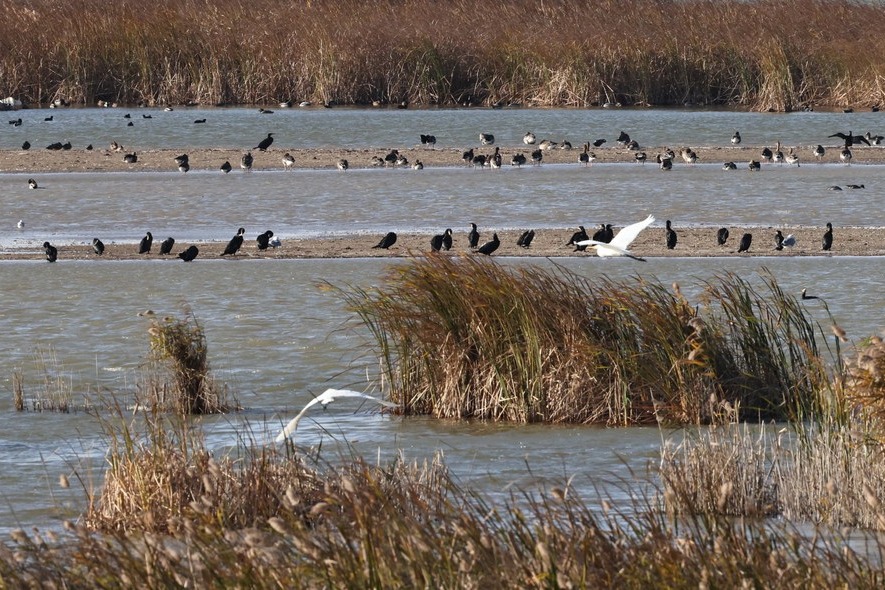
    The Qilihai Wetland in Tianjin’s Ninghe district has witnessed a remarkable increase in both the diversity and population of migratory birds this year, according to local authorities. Monitoring data reveals that 308 bird species have been recorded so far, marking a significant rise of 50 species compared to 2021. Among the notable observations, over 3,000 Eurasian spoonbills were spotted during their autumn migration, doubling the typical count. Additionally, rare species such as the Oriental white stork and black-winged stilt were seen in unusually large numbers. Experts predict that the total number of migratory birds visiting the wetland this year will surpass 600,000. Situated along the East Asian-Australasian Flyway, the Qilihai Wetland is a critical stopover for migratory birds, offering a rich ecosystem of 183 wild plant species and 47 wild fish species that provide ample food resources. This surge in bird activity underscores the wetland’s ecological importance and its role in supporting biodiversity.

  • Brazil’s Amazon rainforest at risk as key protection under threat

    Brazil’s Amazon rainforest at risk as key protection under threat

    The Amazon rainforest, often referred to as the ‘lungs of the Earth,’ is at risk of a renewed wave of deforestation as efforts intensify to overturn a long-standing ban that has protected it. Known as the Amazon Soy Moratorium, this agreement prohibits the sale of soya grown on land cleared after 2008 and has been hailed as a global environmental success story. However, powerful farming interests in Brazil, supported by a faction of politicians, are pushing to lift these restrictions, particularly as the COP30 UN climate conference progresses. Critics argue that the ban unfairly favors a small group of companies, creating a ‘cartel’ in the soya trade. Environmental groups, however, warn that revoking the moratorium would be catastrophic, potentially leading to widespread land grabbing and further deforestation. Scientists have already cautioned that the Amazon is nearing a ‘tipping point,’ where the rainforest could irreversibly transform into a savannah, releasing vast amounts of carbon and disrupting global weather patterns. Brazil, the world’s largest producer of soya beans, plays a pivotal role in this debate. Much of the soya imported into the UK, a key component of animal feed, originates from the Brazilian Amazon. Major UK food companies, including Tesco, Sainsbury’s, and McDonald’s, have joined the UK Soy Manifesto, advocating for the continuation of the moratorium to ensure deforestation-free supply chains. Public opinion in the UK also strongly supports protecting the Amazon, with 70% of respondents in a recent World Wildlife Fund survey backing government action to eliminate illegal deforestation from supply chains. Despite this, Brazilian opponents of the moratorium argue that it stifles economic growth and have called for the Supreme Court to investigate whether the agreement constitutes anti-competitive behavior. The debate has even divided the Brazilian government, with the Justice Ministry questioning the ban while the Ministry of the Environment and the Federal Public Prosecutors Office defend it. The moratorium, initially signed nearly two decades ago by farmers, environmental organizations, and global food companies, has significantly reduced deforestation rates in the past. However, the pressure to lift the ban comes as Brazil prepares to open a major new railway that could further incentivize land clearing. Scientists monitoring the Amazon warn that deforestation is already reshaping the rainforest, with potentially devastating consequences for global climate stability and biodiversity.

  • UAE: 6 illegal fishing boats seized amid crackdown in Fujairah’s Bird Island Reserve

    UAE: 6 illegal fishing boats seized amid crackdown in Fujairah’s Bird Island Reserve

    In a decisive move to protect marine biodiversity, authorities in Fujairah have confiscated six fishing vessels engaged in illegal activities within the Bird Island Reserve. The Fujairah Environment Authority (FEA) conducted the operation during routine field inspections as part of an ongoing monitoring campaign. FEA Director Asila Al Mualla emphasized that fishing within marine reserves constitutes a severe environmental violation and is subject to legal penalties. The monitoring system employs daily oversight, scheduled field visits, and advanced surveillance technologies to detect and address illegal activities promptly. Al Mualla highlighted the importance of protecting Fujairah’s natural reserves, which serve as vital habitats for coral reefs, small fish, and endangered species. Illegal fishing disrupts food chains, depletes fish stocks, and damages coral structures, which are essential for marine life. Additionally, fishing near diving sites poses risks to divers and sea users due to potential entanglement in fishing lines or accidents involving high-speed boats. The FEA stressed that safeguarding these reserves is crucial for environmental sustainability, allowing fish populations to recover and reproduce in safe habitats. These efforts also support the blue economy by promoting eco-tourism and sustainable diving practices. Al Mualla reiterated the FEA’s commitment to enforcing environmental regulations and urged fishers and sea users to comply fully to preserve Fujairah’s natural resources for future generations. This crackdown underscores the emirate’s dedication to balancing human activity with environmental protection.