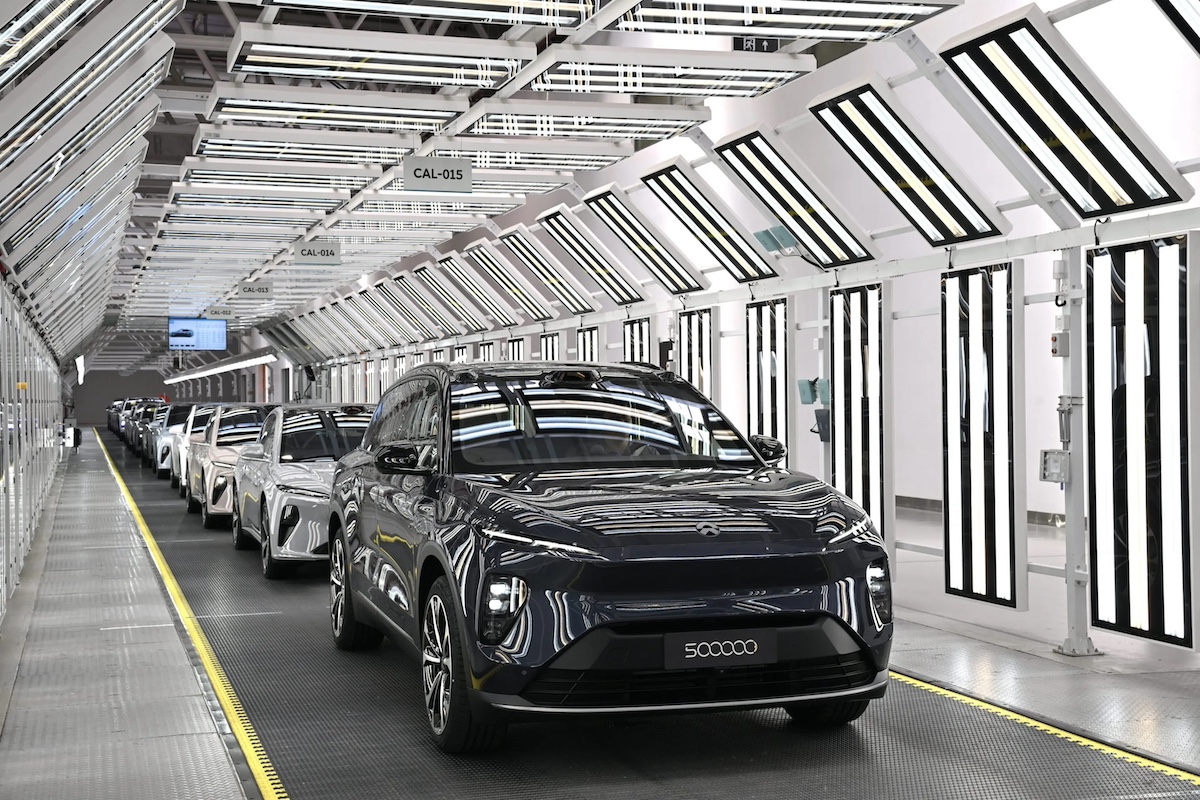
Opening with Queen’s iconic ode to automotive passion, the 2026 Beijing International Automotive Exhibition drives home a stark new reality: cutthroat competition in China’s electric vehicle sector has evolved into a global game-changing conflict that is rewriting the rules of the global auto industry. Building on the momentum of 2024’s Auto China, this year’s event has expanded into an unprecedented industrial showcase, occupying three times the floor space of its predecessor across two adjacent venues.
The 2026 show spans a combined 316,800 square meters, hosting 1,451 vehicles on display — up from roughly 1,000 in 2024 — and marking the global debut of 181 new models, a 55% increase from two years prior. What visitors witness on this expanded stage is a brutal “kill-or-be-killed” battle royale that has only intensified since 2024, as policy shifts and market dynamics push domestic manufacturers to compete harder at home and expand aggressively abroad.
As the Chinese government phases out electric vehicle purchase tax exemptions — cutting the benefit by 50% in 2026 before eliminating it entirely in 2027 — domestic sales fell 20.3% in the first quarter of 2026. But robust export growth of 57% has largely offset the domestic slump, underscoring how Chinese EV makers have pivoted to global markets to sustain expansion. This cutthroat competition is defined by overlapping technology and price wars, where industry leadership can shift overnight: yesterday’s market leaders can quickly be outpaced by newer rivals, while today’s underdogs can stage a full comeback with a single successful model launch.
Take BYD, the long-standing domestic industry leader, for example. The firm has stumbled over the past two years, weighed down by unremarkable product lines and new regulatory reforms aimed at protecting strained suppliers. Regulators forced BYD to revise its unfair payment terms for suppliers, cutting the maximum payment window from 140–180 days to 60 days, which reduced the company’s working capital and slowed its breakneck expansion. In the premium EV segment, BYD’s offerings have been outperformed by new models from NIO, Xiaomi, XPeng, and Huawei-backed brands, while Geely, Chery, Changan, and Leapmotor have gained ground in the mass market through aggressive price competition. Still, industry analysts warn against writing off BYD too soon: the company’s long-term strategic investments in global export infrastructure are already starting to pay off. Years ago, BYD commissioned eight company-owned roll-on-roll-off vehicle transport ships, with seven more currently under construction, and exports are surging. Exports, which deliver six times the profit margins of domestic sales, jumped 145% in 2025 to 1.05 million vehicles, accounting for 23% of the company’s total annual output. BYD is on track to beat its 2026 export target of 1.5 million units, with exports between January and April 2026 already up 60% year-over-year. The company has also unveiled a game-changing technological advance: its second-generation Blade Battery supports 1,500kW flash charging, which can boost a battery from 10% to 70% capacity in just five minutes, and reach 97% in 10 minutes. BYD has committed to building 20,000 flash charging stations across China by the end of 2026, a nationwide rollout that will eliminate range anxiety, one of the last major pain points for EV consumers.
Battery innovation remains the core competitive frontier for the entire Chinese EV industry, as batteries still account for 30–50% of an EV’s total sticker price. CATL’s emerging sodium-ion battery technology could cut battery costs in half, while solid-state batteries — the long-sought “Holy Grail” of battery tech — promise non-flammable construction, doubled driving range, lower weight, and reduced production costs. Chinese researchers produce 66% of the world’s most-cited battery research papers, compared to just 12% from the United States, giving Chinese manufacturers a massive lead in iterative innovation.
The evolution of Chinese EV design and engineering tells a clear story of rapid maturation. In 2024, manufacturers were locked in a “bling war” that packed cars with luxury touches: oversized touchscreens, massaging seats, premium leather, wireless charging, and even built-in refrigerators. Today, that war has shifted to raw horsepower, and the numbers are staggering. The average Chinese EV now boasts more than 270 horsepower, compared to just 150 for the average gasoline-powered car. Perky acceleration of around 200 horsepower is now a baseline expectation for EV buyers; 500 horsepower, once exclusive to high-end European sports cars, is now a common upgrade for mass-market models, and premium EVs are pushing the envelope with 1,000 to 1,500 horsepower. While instant acceleration is a pleasant perk, industry observers note that four-figure horsepower is overkill, much like the excess of six touchscreens and in-car karaoke systems that defined the 2024 design trend.
With the acceleration race reaching its natural limit, Chinese engineers have turned their attention to more meaningful consumer experience upgrades, starting with noise, vibration, and harshness (NVH) reduction. The NVH arms race was launched by Li Auto, whose ultra-quiet interiors and smooth ride cemented its reputation as a premium brand. Unlike traditional manufacturers that rely on heavy insulation to muffle noise, Chinese firms take a holistic approach that targets NVH reduction at every stage of engineering. Motors are redesigned to cut high-pitched whine, electrical systems use pulse width modulation to minimize acoustic noise, chassis are cast as single pieces to eliminate vibration from rivets and welds, multi-layer laminated glass with PVB layers blocks road noise, hydraulic bushings replace rubber to absorb high-frequency road shock, and active noise cancellation systems use in-car speakers and microphones to cancel out residual sound. These engineering advances now deliver a premium low-NVH ride even to mass-market Chinese EV buyers.
Advanced suspension systems are also becoming standard across price ranges, ranging from entry-level continuous damping control (CDC) to mid-tier air suspension to top-tier fully active suspension. CDC, already available on mass-market models from BYD, Geely’s Zeekr, Dongfeng’s Voyah, and Changan’s Deepal, uses electronically controlled shock absorbers that adjust damping in real time to balance ride comfort, handling, and safety. Air suspension, which replaces traditional mechanical springs with electronically controlled air bladders, is offered on most premium models and even some mass-market vehicles from brands including BYD’s Denza, NIO, Li Auto, XPeng, and Huawei’s AITO. The system can adjust ride height based on speed and road conditions, self-level when the car is unevenly loaded, and deliver a far smoother ride than traditional setups. The current gold standard is fully active suspension, featured only on flagship models from NIO, BYD’s YangWang, and Li Auto. Where CDC and air suspensions react to road changes after the fact, fully active systems use hydraulics to cancel vertical wheel movement before it reaches the cabin, almost entirely eliminating bumps and road undulations. The system also eliminates acceleration pitch, braking dive, and cornering roll, and can even perform unexpected party tricks: raising the car to jump over potholes, adjusting the suspension to dance along to music, and even doing “push-ups” by raising and lowering each corner of the car sequentially.
Autonomous driving technology is also widespread across Chinese EVs: roughly 80% of all new EVs sold in China come with some level of self-driving capability. 40–45% offer basic Level 2 self-driving features including adaptive cruise control, lane keeping, and automatic emergency braking; 20–25% offer Level 2+ with highway navigation on autopilot (NOA), automatic lane changing, and on-ramp/off-ramp assistance; 11–19% offer Level 2++ with full urban NOA; and two models — the Arcfox with Huawei ADS and Changan with its proprietary Tianji system — offer legal Level 3 self-driving, which allows drivers to take their eyes off the road on approved expressways, with the manufacturer assuming legal liability for crashes. Level 4 fully driverless robotaxis are already undergoing testing in cities across the country.
This brutal domestic shakeout is already well underway. At the peak of China’s 2018 EV gold rush, there were 487 registered EV manufacturers, most of which were unviable vanity projects that have already exited the market. Today, only around 40 capable manufacturers producing mainstream volume remain, and industry analysts estimate that roughly 30 of these will be eliminated through consolidation in the coming years. As domestic competition pushes weaker players out, most surviving manufacturers are expanding aggressively into global markets. China exported 7.1 million vehicles in 2025, up from just 1 million in 2020, far outpacing Japan’s 4.4 million and Germany’s 3.2 million. Chinese manufacturers also produced 900,000 vehicles in overseas factories in 2025, up from 190,000 in 2020. 2026 Chinese vehicle exports are on track to approach 10 million units, with an additional 1.7 million units produced at local factories overseas.
Chinese EV manufacturers hold three unbeatable advantages over established Western, Japanese, and Korean brands. First, they develop new models two to three times faster than legacy rivals, including Tesla, which has pulled out of Chinese auto shows in recent years due to its outdated and narrow product lineup. Second, China’s deep, integrated domestic supplier ecosystem delivers a 20–30% cost advantage over foreign manufacturers. Third, the final advantage is simple: Chinese EVs are currently better than most competing offerings from the rest of the world, including Tesla. Top executives from Ford, Toyota, and Honda have publicly acknowledged that the competitive threat from Chinese EV makers is existential for their global businesses, and viral online comparisons regularly show that new Chinese EVs outperform far more expensive German models in nearly every measurable category.
At its core, China’s advantage in the global EV race is a story of human capital. China graduates roughly 2.5 times as many new engineers each year as the United States, European Union, and Japan combined, and its total engineering workforce is projected to at least double by 2050, while the workforce in Western developed economies will remain largely stagnant. Engineering roles at leading Chinese EV makers like BYD, Geely, NIO, and Xiaomi are prestigious positions highly coveted by top Chinese university graduates, a talent dynamic that does not exist for legacy Western automakers operating in China. This human capital gap means China’s competitive advantage will only grow in the coming decades.
The article notes that some economies simply do not have the right conditions to build competitive auto industries, pointing to the United States’ decades of protectionist policies to prop up its domestic auto sector, ranging from the 1960s chicken tariff to repeated corporate bailouts, voluntary export restrictions on Japanese automakers, and the current 100% tariff on imported Chinese vehicles. While China’s EV industry also benefited from early government subsidies, the key difference is that Chinese manufacturers have delivered consistently improved, high-quality vehicles at steadily falling prices, while American legacy automakers have continued to sell outdated products at rising prices, prioritizing shareholder buybacks and dividends over product innovation.
Under classical comparative advantage theory, this dynamic is not a problem: the United States retains global leadership in sectors like artificial intelligence, commercial aviation, space launch, and pharmaceuticals, while the EU and Japan lead in machine tools, EUV lithography, industrial robots, and precision components. Open trade would allow each region to specialize in its areas of strength, leaving auto manufacturing to China. But this is not the current global reality, and the article argues that most Western protectionist policies are misdirected. China’s protectionist industrial policy succeeded because it was paired with massive investments in human capital; protectionism without investments in workforce development simply keeps uncompetitive “zombie industries” alive, draining public and private resources that could be used for more productive purposes.
The article concludes with a warning for Western economies: legacy automakers will continue to struggle unless countries address the root human capital gap. Without a major surge in domestic engineering graduates, Ford, GM, and the remaining legacy American brands will continue to operate in a protected, isolated market, selling large, outdated pickup trucks at exorbitant prices, while the U.S. auto affordability crisis deepens, with almost no competitive new offerings priced under $30,000. American consumers looking for affordable, cutting-edge vehicles will only grow more frustrated as they watch viral videos of 500-horsepower, all-wheel-drive Chinese EVs packed with touchscreens, built-in refrigerators, advanced air suspensions, and navigation on autopilot, all priced at around $30,000.