分类: business

  • Ex–China Construction Bank executive gets 18 years for bribery, loan violations

    Ex–China Construction Bank executive gets 18 years for bribery, loan violations

    In a significant ruling against financial corruption, a Chinese court has sentenced Zhang Gengsheng, former vice-president of China Construction Bank (CCB), to 18 years imprisonment for bribery and illegal lending practices. The Zibo Intermediate People’s Court in Shandong province delivered the verdict on Wednesday, additionally imposing a substantial fine of 4.1 million yuan ($589,000).

    The court delineated separate sentences for each offense: 13 years imprisonment with a 4 million yuan fine for accepting bribes, and 10 years with a 100,000 yuan penalty for illicit loan issuance. The combined sentence reflects the severity of the crimes committed by the former banking executive.

    Judicial investigations revealed that between 2006 and September 2019, Zhang systematically exploited his executive positions—progressing from general manager of a client department to vice-president—to provide unlawful advantages to various entities and individuals. His corrupt activities involved manipulating loan credit approvals and facilitating improper job adjustments in exchange for monetary benefits totaling over 40.64 million yuan in property and cash.

    Particularly egregious were Zhang’s actions between late 2016 and April 2017, when he authorized substantial loans to unqualified borrowers despite being fully aware of their non-compliance with lending standards. These transactions resulted in exceptionally significant financial losses for the state-owned banking institution.

    The court acknowledged several mitigating factors that contributed to a relatively lenient punishment considering the magnitude of the crimes. Zhang demonstrated cooperation by providing truthful confessions, voluntarily disclosing previously unknown criminal activities to investigators, and actively returning illegal gains. Authorities have successfully recovered most of the bribes and associated interest, which will be transferred to the state treasury.

    Zhang’s professional trajectory shows a long-standing career with CCB, where he served as vice-president from April 2013 and held concurrent positions as executive director and vice president from 2015 until his retirement in December 2020. Following his banking career, the 65-year-old Anhui native briefly served as an external director for State Grid Corp. of China before being placed under investigation in November 2024.

  • Looking for a job in UAE? Key sectors and in-demand roles in 2025 revealed

    Looking for a job in UAE? Key sectors and in-demand roles in 2025 revealed

    The United Arab Emirates has established itself as the Gulf region’s most balanced labor market in 2025, according to Naukrigulf’s Year End Report. This equilibrium stems from simultaneous hiring for both scale and specialized skills, creating diverse opportunities across multiple sectors.

    Construction and real estate sectors led hiring demand, closely followed by IT, telecommunications, internet services, and the oil, gas, and energy industries. This multi-sector growth has created one of the region’s most evenly distributed job markets.

    The most sought-after positions included engineering, sales, and software/IT roles, with particular demand for project managers, sales executives, and customer service representatives. The report identified HVAC expertise, accounting proficiency, and customer support capabilities as critical skills that provide competitive advantages for job seekers.

    GCC-wide analysis revealed traditional industries continued to dominate regional recruitment, with construction and energy sectors accounting for over 4.6 million candidate searches throughout the year. Employers across the Gulf showed heightened demand for engineering talent (850,000+ searches), sales professionals (800,000+ searches), and project management experts (775,000+ searches), reflecting the region’s execution-focused growth strategy.

    Despite robust hiring activity, employees faced significant negotiation challenges. Approximately 46% of job seekers cited salary expectation mismatches as their primary obstacle, while 32% struggled with articulating their personal value proposition. Additional challenges included handling counteroffers (18%) and negotiating benefits packages (4%).

    UAE professionals demonstrated evolving priorities beyond compensation, with professional development opportunities emerging as the most valued non-monetary benefit. This was followed by vacation time, comprehensive health benefits, and flexible working arrangements, indicating a growing emphasis on long-term career growth and work-life balance.

    The findings are based on insights from more than 9 million hiring interactions on Naukrigulf’s platform throughout 2025, supplemented by jobseeker sentiment data collected through monthly Gulf Pulse surveys across all GCC nations.

  • China needs to invest bigger at home to sustain prosperity

    China needs to invest bigger at home to sustain prosperity

    China’s economy achieved its official growth target of 5% in 2025, according to official GDP figures, but this headline accomplishment conceals significant underlying vulnerabilities. While exports surged to a record-breaking $1.2 trillion trade surplus despite ongoing trade tensions with the United States, the economy faces mounting domestic challenges that threaten sustainable growth.

    The export sector’s remarkable performance, driven by successful diversification to Southeast Asian, South American, European, and African markets, offset concerning weaknesses in domestic consumption. December retail sales grew at a meager 0.9% year-on-year—the slowest pace since late 2022—highlighting persistent consumer reluctance to spend. This consumption weakness appears structural rather than temporary, rooted in high savings rates, property market uncertainties, and concerns about job security.

    Simultaneously, China confronts demographic headwinds as its population declined for the fourth consecutive year in 2025, with birth rates hitting record lows. This accelerating aging population presents long-term economic challenges that require substantial productivity gains to overcome.

    Fiscal constraints further complicate the economic landscape. Local governments face mounting debt burdens, reduced revenues from land sales, and increasing social program obligations, limiting their capacity for stimulus spending. Investment in fixed assets declined by 3.8% in 2025, with property investment plummeting approximately 17%.

    The fundamental challenge lies in redirecting China’s substantial national savings—which reached 43.4% of GDP in 2024—toward productive domestic investment rather than export surpluses that fuel international trade tensions. The transition toward a more capital- and knowledge-intensive growth model, particularly in technology services and high-value manufacturing, appears essential for navigating these structural challenges.

  • Dubai: Gold prices jump over Dh15 per gram to another record high, could touch Dh600 soon

    Dubai: Gold prices jump over Dh15 per gram to another record high, could touch Dh600 soon

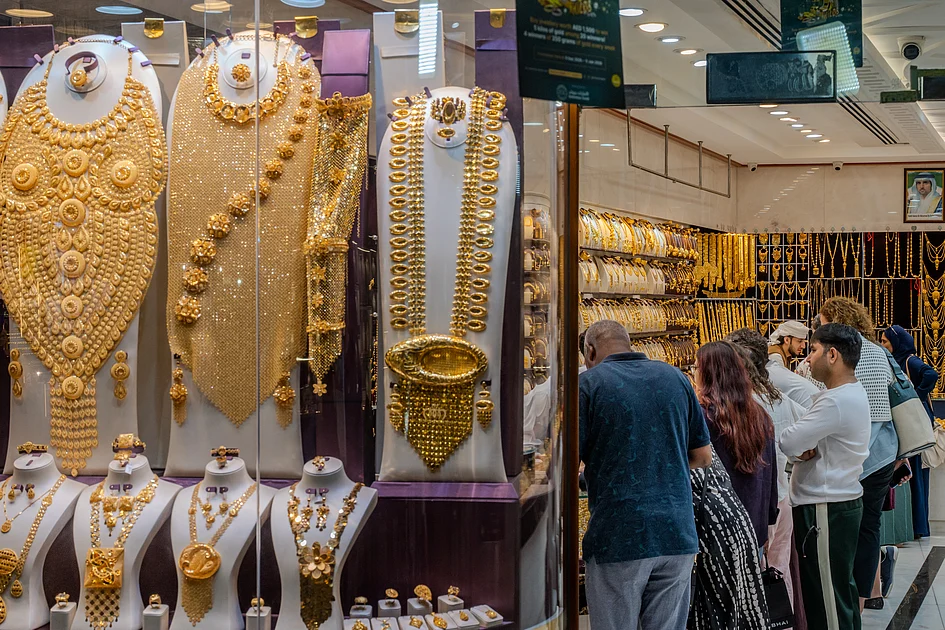
    Dubai’s gold market witnessed unprecedented gains on Wednesday as prices surged dramatically at market opening, setting a third consecutive record high. The precious metal’s remarkable rally saw 24K gold escalate by Dh15.75 to reach Dh586.25 per gram, bringing it within striking distance of the psychological Dh600 barrier.

    The comprehensive price surge affected all variants: 22K gold climbed to Dh542.75 per gram, 21K advanced to Dh520.5, 18K reached Dh446.25, while 14K gold settled at Dh348.0 per gram. This sustained upward trajectory reflects deepening global economic anxieties and geopolitical uncertainties.

    International markets mirrored Dubai’s bullish trend, with gold breaching the $4,800 milestone for the first time in history. At 9:15 AM UAE time, spot gold traded at $4,869.7 per ounce, registering a substantial 2.28 percent increase. This global surge coincides with escalating tensions between the United States and European Union regarding Greenland, adding fresh momentum to gold’s safe-haven appeal.

    Ole Hansen, Head of Commodity Strategy at Saxo Bank, contextualized the rally: ‘The renewed US-Europe standoff over Greenland has acted as a fresh catalyst for gold and silver demand, reinforcing an already powerful hard-asset narrative. Importantly, this rally predates the current dispute and shows no signs of abating. The Greenland episode has effectively poured fresh fuel on a rally that has been building for months, driven by an increasingly uncomfortable macro and geopolitical backdrop.’

    Hansen further noted the concerning performance of traditional safe havens, observing that the dollar, yen, and US Treasuries have all struggled to provide their customary stability as long-end yields rise due to credibility concerns rather than growth optimism.

    Market analysts suggest that if the current momentum persists amid ongoing global uncertainties, Dubai’s gold prices could realistically approach the Dh600 per gram threshold in the near term. Some international forecasts even project gold potentially reaching $5,000 per ounce during the first quarter, underscoring the metal’s strengthened position in contemporary portfolio strategies.

  • Beijing becomes China’s second 5-trillion-yuan economy in 2025

    Beijing becomes China’s second 5-trillion-yuan economy in 2025

    Beijing has officially cemented its status as China’s second 5-trillion-yuan economy, achieving a remarkable GDP of 5.2 trillion yuan ($746.7 billion) in 2025 with a solid 5.4% year-on-year growth rate. This milestone places the capital city alongside Shanghai as the only two Chinese municipalities to surpass this monumental economic threshold.

    The city’s economic expansion was primarily fueled by extraordinary performance in advanced manufacturing sectors. The computer, communications, and electronic equipment manufacturing cluster witnessed a striking 20.2% annual growth, while the automotive industry accelerated with a 17.7% increase. Particularly noteworthy was the explosive growth in green technology and high-tech sectors, where new energy vehicle production skyrocketed by 140%, lithium-ion battery output surged by 120%, and service robot manufacturing advanced by 47.6%.

    Beijing’s export capabilities demonstrated significant strength, with large-scale industrial enterprises achieving a delivery value of 211.3 billion yuan—a 6.4% increase from the previous year. The automotive manufacturing sector led this charge with a substantial 24.6% export growth, followed by specialized equipment manufacturing at 10.8%.

    The service sector equally contributed to Beijing’s economic triumph, with information technology services reaching a combined added value of 1.2 trillion yuan after an 11% growth spurt. Simultaneously, the financial industry strengthened its position with an added value of 866.82 billion yuan, reflecting an 8.7% increase that underscores Beijing’s dual identity as both a technological and financial hub.

    This economic milestone reflects Beijing’s successful transition toward high-value industries and innovation-driven growth, positioning the capital as a model for urban economic development in China’s new era of quality-focused expansion.

  • Hydropower deal boosts grid integration in ASEAN

    Hydropower deal boosts grid integration in ASEAN

    Southeast Asian nations are advancing regional energy integration through a renewed multilateral agreement facilitating hydropower transmission from Laos to Singapore via Thailand and Malaysia. The landmark deal, signed on January 14, represents a strategic step in the Association of Southeast Asian Nations’ (ASEAN) broader initiative to create an interconnected power framework across the region.

    While the initial capacity of 100 megawatts may appear modest, energy experts emphasize the arrangement’s significance lies in establishing a replicable commercial model rather than immediate volume. Christina Ng, Managing Director at the Energy Shift Institute, described the capacity as ‘inconsequential’ but highlighted the framework’s importance: ‘It’s what ASEAN needs right now—a repeatable, bankable commercial framework that markets can scale.’

    The agreement forms part of the ASEAN Power Grid (APG) initiative, first conceptualized through a 2007 memorandum of understanding and implemented in 2009. The Laos-Thailand-Malaysia-Singapore Power Integration Project, operational since 2018, represents the first multilateral cross-border electricity trade project within ASEAN. The current renewal follows successful pilot operations from 2022 to 2024 where Laos transmitted hydropower to Singapore using existing interconnections, with Thailand and Malaysia serving as transmission intermediaries.

    Energy security experts note that cross-border renewable energy trade offers ASEAN nations a strategic tool to diversify energy risks without increasing dependence on volatile fossil fuels. ‘Energy security today is less about ‘owning fuel’,’ Ng explained. ‘It’s more about managing exposure to concentrated risks’—particularly relevant as geopolitical tensions threaten traditional shipping routes and fuel costs.

    According to Dinita Setyawati, Senior Analyst at global energy policy think tank Ember, the collaboration demonstrates ASEAN countries prioritizing economic growth and decarbonization goals over political differences. The region’s energy ministers reinforced this commitment in October 2025 by signing an enhanced memorandum understanding to strengthen electricity connectivity through multilateral power trade and renewable integration.

    Implementation challenges remain, however. David Broadstock, partner at Singapore-based consultancy The Lantau Group, noted that incomplete power grid infrastructure hinders regional connectivity, while Ng highlighted interoperability issues across eleven nations with differing technical standards. For land-constrained Singapore, which lacks sufficient wind resources, hydropower potential, and space for large-scale solar development, such cross-border arrangements represent essential pathways toward renewable energy adoption and energy security.

  • ASX 200 drops for third day as US trade fears rattle market, gold trumps global uncertainty

    ASX 200 drops for third day as US trade fears rattle market, gold trumps global uncertainty

    Australia’s financial markets recorded a third consecutive day of declines as escalating trade disputes between the United States and Europe continued to dampen investor sentiment. The benchmark ASX 200 index fell 0.37 percent to close at 8782.90 points, while the broader All Ordinaries index dropped 0.33 percent to settle at 9108.6.

    The market downturn mirrored substantial losses on Wall Street, triggered by renewed geopolitical tensions surrounding U.S. trade policies toward Greenland. Market analysts attributed the sustained decline to growing concerns about potential disruptions to global trade frameworks and supply chains.

    Amid the market volatility, gold continued its remarkable ascent, climbing 0.02 percent to reach $4,857 per ounce and positioning itself for a potential breakthrough of the $5,000 psychological barrier. The precious metal’s persistent strength reflects its status as a traditional safe-haven asset during periods of economic uncertainty.

    Sector performance revealed a mixed landscape, with eight of eleven industry categories finishing in negative territory. Information technology and consumer discretionary sectors experienced the most significant declines, dropping 2.5 percent and 2.14 percent respectively. Conversely, materials sector stocks continued their strong performance with a 2.5 percent gain, while utilities and energy sectors also closed positively.

    Individual stock movements highlighted the day’s volatility. Emerald Resources NL led gainers with a 13.2 percent surge to $7.96, followed closely by Paladin Energy’s 13.1 percent rise to $13.17. Westgold Resources also posted substantial gains, climbing 9.6 percent to $7.53. Conversely, Droneshield shares plummeted 8.86 percent to $4.32, marking the session’s sharpest decline.

    Australia’s banking sector faced broad pressure, with all four major banks closing lower. ANZ and Commonwealth Bank both fell more than 2 percent, while NAB declined 1.62 percent and Westpac dropped 1.24 percent. Mining giant BHP bucked the trend, advancing 1.46 percent to $48.48.

    The Australian dollar showed resilience amid the equity market turbulence, trading at 67.52 U.S. cents with analysts suggesting potential movement toward 69 cents if current trends persist.

    Market participants now await key developments including former President Trump’s scheduled address at Davos and an emergency EU summit in Brussels, both of which could provide clarity on the direction of international trade relations.

  • Wall Street holds steadier after Trump says he won’t use force to take Greenland

    Wall Street holds steadier after Trump says he won’t use force to take Greenland

    Wall Street exhibited tentative stabilization on Wednesday as investor nerves settled following President Trump’s clarification that he would not employ military force to acquire Greenland. This statement helped the market recoup a fraction of the substantial losses incurred during the previous session’s sell-off, which was triggered by the geopolitical uncertainty surrounding the proposal.

    The S&P 500 index advanced 0.3%, edging closer to its recent all-time peak after a 2.1% plunge on Tuesday. The Dow Jones Industrial Average climbed 200 points (0.4%), while the Nasdaq composite registered a more modest 0.1% gain. The calming of tensions was also reflected in the bond market, where the yield on the 10-year Treasury note retreated slightly to 4.28% from 4.30%.

    Corporate earnings emerged as a primary market driver, providing pockets of strength. Halliburton surged 3.6% after the oilfield services giant delivered quarterly profits that surpassed analyst expectations. United Airlines ascended 3.5% following a similarly robust earnings report and optimistic revenue guidance from CEO Scott Kirby for 2026.

    However, not all corporate news was positive. Netflix shares tumbled 4.8% as investor focus shifted from its profit beat to concerns over decelerating subscriber growth. Kraft Heinz faced even steeper losses, plummeting 6.6% after Berkshire Hathaway signaled a potential divestiture of its massive 325-million-share stake, a move compounded by recent board resignations and a major write-down.

    Underlying anxieties persisted, evidenced by a 1.9% rally in gold, which breached $4,800 per ounce for the first time. Market participants continued to monitor the implications of proposed 10% tariffs on several European nations and evolving fiscal policies in Japan, where Prime Minister Sanae Takaichi’s snap election call sent government bond yields to record levels amid expectations for expansive tax cuts and spending.

  • NRIs in UAE: Can I buy property on behalf of a friend in India?

    NRIs in UAE: Can I buy property on behalf of a friend in India?

    Legal authorities are issuing stern warnings to non-resident Indians in the UAE regarding property transactions involving resident Indian friends. Recent advisory highlights significant legal risks when NRIs make property payments on behalf of residents in India, contrary to foreign exchange regulations.

    The Reserve Bank of India’s Liberalised Remittance Scheme permits resident Indians to remit up to $250,000 annually for specified transactions, including overseas property acquisitions. However, when non-resident Indians or foreign citizens make payments on behalf of resident Indians, this constitutes a violation of Section 3(a) of the Foreign Exchange Management Act (FEMA).

    The Enforcement Directorate has demonstrated increased vigilance in investigating such cases, treating them as serious contraventions of exchange control regulations. Offenses under FEMA are compoundable but involve substantial financial penalties for the resident Indian beneficiary, who becomes subject to comprehensive investigation procedures.

    Concurrently, India has implemented sweeping labor reforms through four consolidated labor codes that replace century-old regulations. The new framework expands wage definitions, enhances social security coverage for unorganized workers, and establishes minimum wage protections across all employment categories. The reforms specifically address gender-based wage discrimination and extend benefits to gig economy workers and contract employees.

    Despite global automotive industry challenges, Indian automobile exports demonstrated remarkable resilience with 858,000 vehicles exported in 2025—a 15% increase from previous years. Manufacturing giants including Maruti Suzuki, Hyundai, and Kia have expanded their global footprint across African, South American, and developed markets, with India emerging as a strategic export hub for new electric vehicle models.

    Legal experts emphasize that cross-border financial assistance for property purchases, while well-intentioned, exposes both parties to significant regulatory consequences and recommend strict adherence to authorized banking channels for all international remittances.

  • Sharjah real estate records highest trading value in its history with Dh65.6 billion in 2025

    Sharjah real estate records highest trading value in its history with Dh65.6 billion in 2025

    Sharjah’s property market has achieved an unprecedented milestone, recording its highest-ever annual trading value of Dh65.6 billion in 2025. This remarkable performance represents a substantial 64.3 percent surge from the Dh40 billion recorded in 2024, signaling exceptional market vitality and growing investor confidence in the emirate’s stable investment landscape.

    The market demonstrated robust activity across multiple metrics, with total real estate transactions climbing to 132,659—a 26.3 percent annual increase. Sales transactions specifically witnessed extraordinary growth, reaching 33,580 transactions with a 38.4 percent expansion rate. This surge was propelled by heightened demand for residential properties for both end-use and investment purposes, supported by attractive rental yields, price stability, and diverse real estate projects offering flexible financing options.

    Mortgage activity similarly experienced significant growth, with total mortgage values reaching Dh15.5 billion through 6,300 transactions—a 45.1 percent increase from the previous year. The market’s international appeal broadened substantially, with investors from 129 nationalities participating in Sharjah’s real estate sector, compared to 120 in 2024. Properties traded by international investors jumped to 60,322 from 45,676, reflecting the market’s expanding global footprint.

    According to Abdulaziz Ahmed Al-Shamsi, Director General of the Sharjah Real Estate Registration Department, this historic achievement stems from strategic leadership vision and long-term planning that has established an integrated real estate ecosystem. ‘These results demonstrate the maturity and efficiency of Sharjah’s real estate system,’ Al-Shamsi noted, ‘reaffirming its capacity to attract high-value, long-term investments within a framework distinguished by transparency, advanced infrastructure, and quality living standards.’

    Transaction analysis revealed Emirati investors accounted for approximately Dh33.8 billion of total value across 41,066 properties. GCC nationals (excluding Emiratis) invested Dh3.4 billion in 2,055 properties, while Arab nationals contributed Dh9.8 billion through 8,663 properties. Other international investors represented Dh18.5 billion across 8,538 properties, highlighting the market’s diverse investment base.

    Documentation processes showed consistent growth across categories: ownership certificate transactions increased 17.6 percent to 47,453, title deed transactions grew 29.7 percent to 46,131, initial sales contracts surged 41.2 percent to 14,472, and valuation transactions expanded 35.8 percent to 3,696. These figures collectively underscore the comprehensive strength and accelerating momentum of Sharjah’s real estate sector throughout 2025.