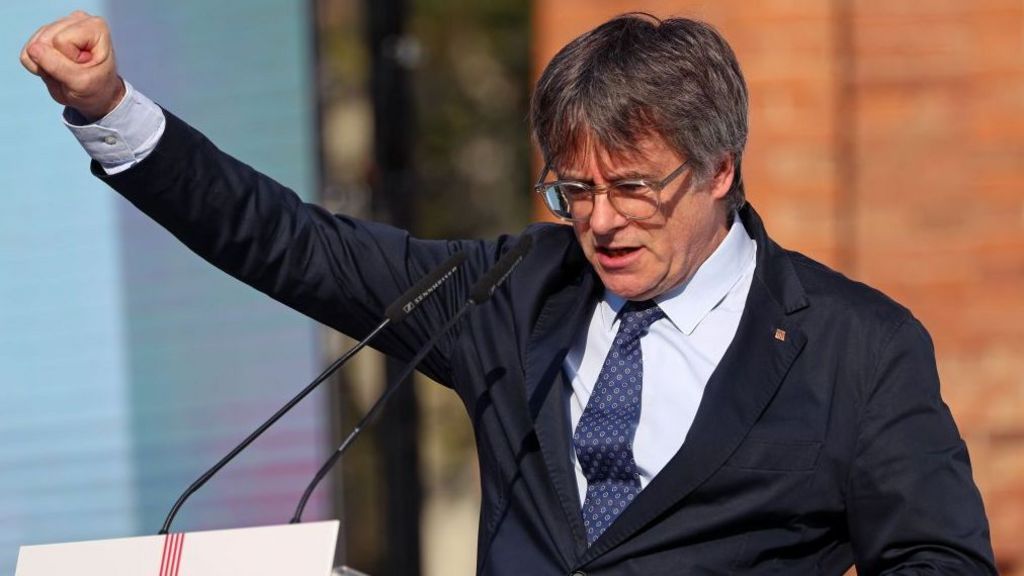
Nearly a decade after he fled Spain following a failed bid for Catalan independence, former Catalonia regional president Carles Puigdemont can now return to the country without risk of arrest, following a landmark ruling from Spain’s Supreme Court. The high court has formally upheld a ruling to withdraw the national arrest warrant issued against Puigdemont over his role in organizing the 2017 unauthorized independence referendum, a vote that defied the central government in Madrid.
After the 2017 referendum, Madrid imposed direct rule on the northeastern region, and Puigdemont fled to Belgium, where he has resided in self-imposed exile ever since. His only confirmed brief return to Spanish territory came earlier in 2024, a surprise appearance in Barcelona that immediately triggered a nationwide police manhunt before he escaped back across the border to France. Today, however, the political landscape Puigdemont would reenter looks drastically different than it did seven years ago: the Catalan independence movement has faded to a marginal issue on Spain’s national political agenda.
Monday’s ruling closes out a years-long, tangled legal battle between the Spanish judiciary and the former separatist leader. The conflict over Puigdemont’s legal status reignited in 2024, when Spain’s ruling socialist government introduced a controversial amnesty law covering dozens of Catalan politicians and activists linked to the secession push. Initially, the Supreme Court ruled that Puigdemont and several of his closest allies should be excluded from the amnesty, arguing that ongoing charges of financial misconduct tied to the 2017 referendum disqualified them from the pardon.
That ruling was overturned by Spain’s Constitutional Court earlier this month. On Monday, the Supreme Court additionally rejected an appeal brought by far-right opposition party Vox against the withdrawal of arrest warrants for Puigdemont and two of his former ministers, Lluís Puig and Toni Comín. The decision now paves the way for all three separatist leaders to return to Spain without legal risk of detention.
Puigdemont, who leads the center-right pro-independence party Together for Catalonia (JxCat), was elected to the European Parliament in 2019, and won a seat in the Catalan regional parliament in 2024. For years, he has campaigned from just across Spain’s northern border in southern France, holding rallies where supporters travel from Catalonia to attend. He has remained an active voice for the independence cause across the continent, regularly criticizing Spanish democratic institutions while working to raise international awareness for the separatist movement.
In the years immediately following the 2017 referendum, nine of Puigdemont’s former colleagues were jailed for their roles in the secession push; all were ultimately pardoned and released by the Spanish government in 2021. Immediately following Monday’s Supreme Court announcement, Puigdemont released a video on social media explaining his decision to remain in exile for seven years. “My role was to stir public opinion, internationalise the conflict and work from the heart of Europe to explain the reality of Spain,” he said.
As of Monday, no official timeline has been announced for Puigdemont’s return to Spain. However, Comín, his former regional health minister and fellow exiled separatist, confirmed plans to travel to Madrid this week to complete administrative procedures tied to his status as an MEP.
The 2017 unauthorized referendum triggered the most severe political crisis Spain has faced since the country transitioned back to democracy following the death of dictator Francisco Franco. The banned vote was met with a harsh police crackdown by national authorities, and after Catalonia’s separatist-led regional parliament declared independence, Madrid dissolved the regional legislature, removed the sitting separatist government, and called an emergency snap regional election.
Today, the issue of Catalan independence no longer holds a central spot in Spanish politics, with voters and parties prioritizing pressing issues like housing affordability and immigration. Even so, Puigdemont’s JxCat party retains critical political sway: its parliamentary support was instrumental in allowing current socialist Prime Minister Pedro Sánchez to form his new left-wing national government after the 2023 general election.
Within Catalonia itself, JxCat has faced growing electoral pressure in recent years, with the more extreme pro-independence party Catalan Alliance siphoning off much of its traditional voter base. The political uncertainty comes as Spain prepares for a new general election next month, with polls indicating that the far right could enter the national governing coalition for the first time in modern Spanish history.