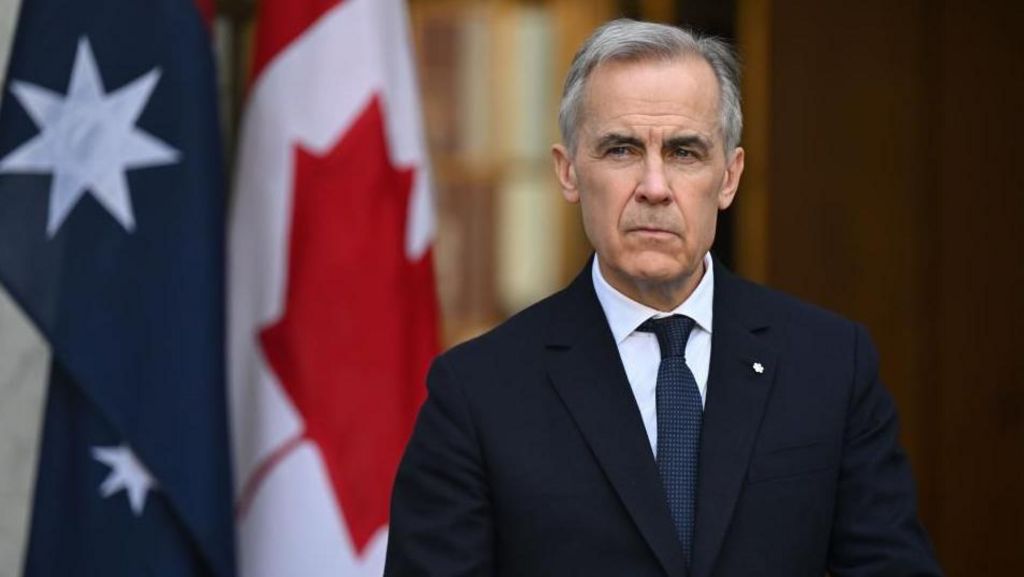
Canadian Prime Minister Mark Carney finds himself navigating intense domestic criticism while attempting to maintain a delicate diplomatic equilibrium regarding U.S.-Israeli military operations in Iran. As Canada urgently works to evacuate its citizens from the escalating conflict zone, the nation confronts the unsettling possibility of being drawn into a broadening regional war.
Carney initially voiced robust support for the strikes when they commenced one week ago, emphasizing the imperative of preventing Iran from acquiring nuclear capabilities and curbing the regime’s capacity to “further threaten international peace and security.” However, within days, the Prime Minister characterized his position as one adopted “with regret,” acknowledging that the military action appeared “inconsistent with international law.”
During meetings with Australian counterpart Anthony Albanese, Carney jointly advocated for “rapid de-escalation” of hostilities. While Canada’s initial response demonstrated greater firmness than European allies including the UK, France and Germany—who collectively condemned Tehran while urging renewed negotiations—Carney now appears to be steering toward a more nuanced diplomatic course.
This recalibration mirrors evolving positions among Western nations. France has augmented its regional military presence following Iranian strikes on its facilities in the United Arab Emirates. The United Kingdom has authorized American utilization of British bases for defensive operations, evidenced by the arrival of a U.S. B-1 Lancer bomber capable of delivering 24 cruise missiles. Germany has positioned its forces for potential defensive measures, though Chancellor Friedrich Merz has cautioned against entanglement in “endless wars.”
Carney has refrained from unequivocally excluding Canadian military involvement, stating the nation “will stand by our allies, when it makes sense.” This ambiguity has provoked substantial dissent within his Liberal Party. Former Foreign Minister Lloyd Axworthy published a scathing critique in the Toronto Star, contrasting current policy with Canada’s refusal to endorse the 2003 Iraq invasion, noting “we are embracing the very doctrine we used to reject.”
Liberal MP Will Greaves denounced endorsing “unilateral and illegal use of military force” while simultaneously defending national sovereignty—an apparent reference to former President Donald Trump’s suggestions regarding Canadian statehood. Opposition Conservatives have dismissed Carney’s approach as “contradictory” and “incoherent.”
University of Ottawa Professor Roland Paris observed that Carney’s stance proved “difficult to decipher,” suggesting the controversy demonstrates the implementation challenges of the pragmatic international vision the Prime Minister outlined in his January Davos address. That speech, which garnered global attention, urged middle powers to unite against great power dominance while advocating UN Charter-aligned principled foreign policy.
Professor Thomas Juneau posited that Carney’s positioning likely reflects necessary management of relations with the Trump administration, given Canada’s substantial economic dependence on U.S. trade and impending high-stakes negotiations. Juneau noted that while Canada gains nothing from endorsing the conflict, it risks significant losses by opposing an “easily irritated Trump.”
Foreign Minister Anita Anand subsequently clarified that Canada has “no intention to participate in Operation Epic Fury,” emphasizing diplomatic efforts prioritizing de-escalation and civilian protection. Defence Staff Gen Jennie Carignan simultaneously indicated that “Gulf partners may require defence and support,” leaving military options theoretically available.
Anand welcomed diverse perspectives within Liberal ranks ahead of caucus discussions on the crisis, acknowledging respectful disagreement while coordinating evacuation efforts for Canadians in the region. Recent polling by Angus Reid indicates a divided populace, with 48% opposing the strikes, 35% supporting, and 17% remaining uncertain.