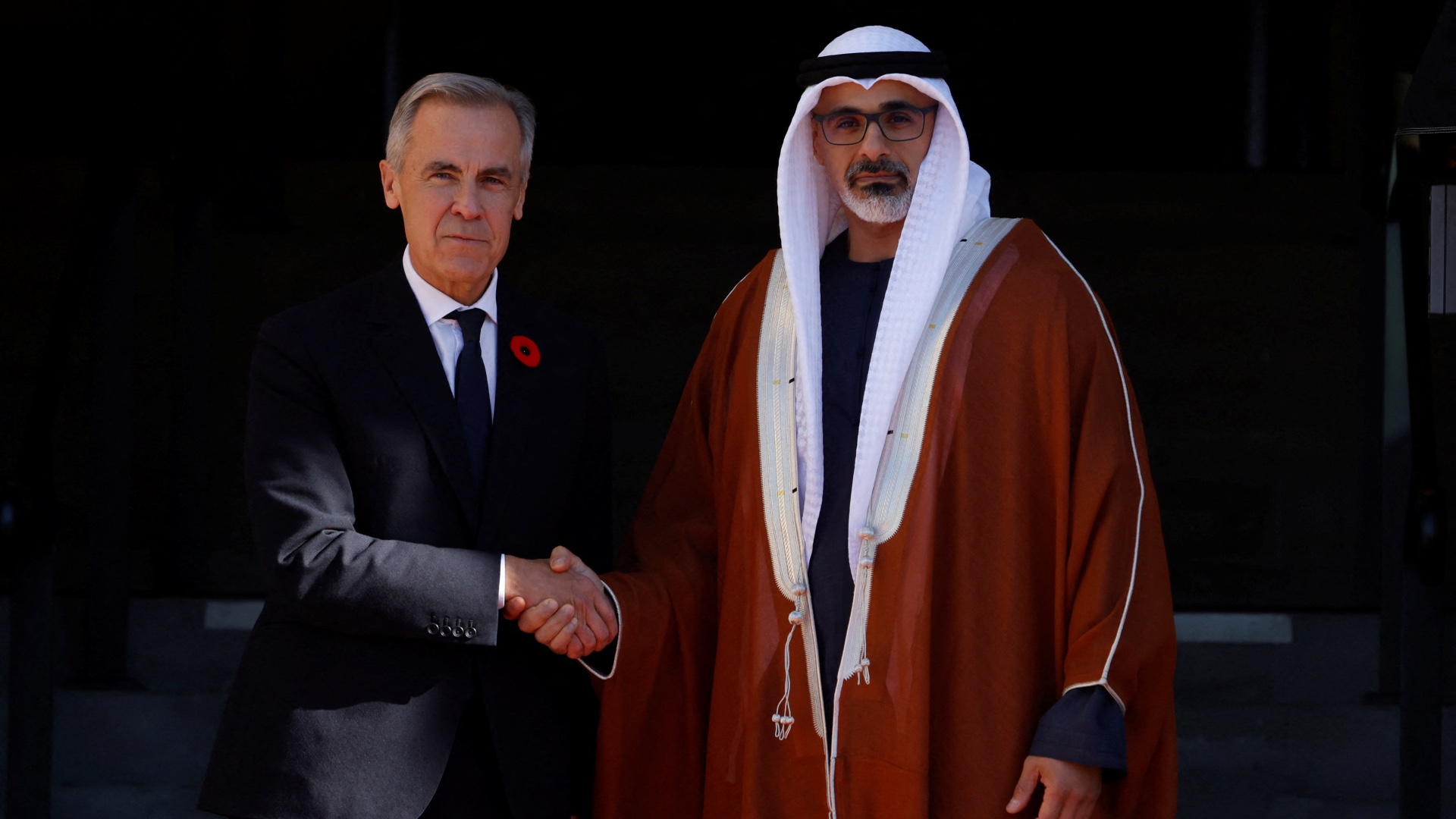
Ottawa formally announced on Tuesday that it had reached a sweeping free trade agreement with the United Arab Emirates, alongside the launch of formal negotiations for a bilateral extradition treaty that would enable Abu Dhabi to request the surrender of individuals accused of criminal offenses on its territory. The landmark diplomatic breakthrough came on the heels of the first ever official visit by Emirati Crown Prince Khaled bin Mohamed bin Zayed Al Nahyan to the Canadian capital, where he held two days of closed-door and public meetings with Canadian Prime Minister Mark Carney. During the high-profile visit, the two leaders also inked a separate Memorandum of Understanding to establish a permanent Canada-UAE Joint Military Committee, a collaborative framework that will cover joint military education and training, coordinated field exercises, cross-border cybersecurity cooperation, and sensitive classified information sharing. Dubbed the Canada-UAE Comprehensive Economic Partnership Agreement (CEPA), the free trade deal was negotiated in a record 47 days for both parties, an unprecedented timeline for a bilateral accord of this scope. Prime Minister Carney confirmed in an official statement that the terms of CEPA will eliminate or slash tariffs on more than 99% of all Canadian exports to the UAE starting in 2027, unlocking new market access for Canadian pulse and canola farmers, industrial machinery and power generation equipment manufacturers, the country’s globally competitive aerospace sector, and a wide range of domestic innovative startups and tech firms. Speaking at a separate press briefing on Wednesday, Canada’s Minister of International Trade Maninder Sidhu projected that CEPA will double the current $2.4 billion two-way trade volume between the two nations to nearly $5 billion over the next 10 years, granting Canadian businesses unprecedented access to the UAE’s $500 billion fast-growing economy. The new agreements build on a pledge the UAE made one year prior, during Prime Minister Carney’s official trip to Abu Dhabi, to direct $50 billion in new investment toward Canadian energy and national development projects, with a particular focus on Arctic infrastructure and resource development. Carney noted that this week’s discussions with Crown Prince Khaled had delivered “significant progress” on unlocking that pledged funding, though he declined to share specific details on finalized investment timelines or project allocations. The high-stakes diplomatic push has drawn sharp criticism from independent policy analysts and human rights advocacy groups. Stuart Trew, director of the Trade and Investment Research Project at the progressive Canadian Centre for Policy Alternatives, argued in an interview with Middle East Eye that the UAE is effectively leveraging its promised $50 billion investment as leverage to secure sweeping concessions from Ottawa. “It looks like Canada is willing to agree to basically anything to try and get that money,” Trew stated, pointing to the proposed extradition treaty and military cooperation accord as deeply problematic choices given well-documented global human rights assessments of the UAE. Trew emphasized that the UAE has been widely characterized by independent monitors as a pervasive surveillance state that harshly suppresses all forms of political dissent, and has been accused by multiple human rights organizations of financially backing the Rapid Support Forces (RSF) paramilitary group in Sudan’s ongoing civil war, a force that has been formally accused of perpetrating mass genocide against civilian populations. The UAE has repeatedly denied all allegations of involvement in Sudan’s internal conflict. The Washington-based advocacy group Democracy for the Arab World Now, founded by slain Saudi journalist and Middle East Eye columnist Jamal Khashoggi, has published formal findings noting that UAE citizens lack any enforceable civil and political rights, and that the state maintains zero tolerance for any public expression of critical political opinion. The flurry of new diplomatic and trade agreements with the UAE is part of a broader, aggressive pivot by the Carney administration to rapidly diversify Canada’s global trade and investment partnerships, after longstanding tensions with its traditional closest ally the United States escalated dramatically in 2025. Shortly after taking office in May 2025, Carney publicly declared that the decades-old “old model” of Canada-US bilateral relations was “over.” The breakdown was triggered by sweeping 25% tariffs on most Canadian goods and 10% tariffs on all Canadian energy imports imposed by US President Donald Trump in March 2025, measures that threatened to upend one of the world’s largest bilateral trade relationships, where more than $2.5 billion in goods and services cross the shared border every single day. Ottawa responded by rolling out retaliatory tariffs covering up to $109 billion worth of US imports, a major escalation that shattered decades of relatively harmonious cross-border trade. Former Canadian Foreign Minister Melanie Joly noted at the time that Canada historically purchased more goods and services from US businesses than the United Kingdom, France, China and Japan combined, making the trade rift an unprecedented economic shock. Compounding Ottawa’s economic pressures, post-pandemic persistent high inflation and surging global fuel prices exacerbated by the US-Israeli military conflict with Iran have pushed the Carney government to urgently pursue new trade and investment partnerships across Europe and the Global South, in a deliberate strategy to demonstrate to Washington that Canada has viable alternative global trade networks to fall back on. Prime Minister Carney’s official Tuesday statement boasted that “Canada is building a trading network that is the envy of the world, with preferential access to 1.5 billion consumers across 16 free trade agreements, 51 countries, and roughly two-thirds of global GDP.” A former central banker who previously served as both Governor of the Bank of Canada and Governor of the Bank of England, Carney has centered his entire governing agenda on expanding economic partnerships, even moving forward with agreements with states flagged by human rights groups for poor records, framing the policy as a necessary step to reduce Canada’s overreliance on the volatile US market. Trew pushed back on the logic of this diversification strategy, arguing that the Carney government has misidentified its core national priorities. “Canada is no different than any other countries in seeking out investment, and capital has been pooling in smaller and smaller places, right? Everybody’s going to the same people for money, so everybody’s going to the UAE for money,” Trew explained. “But it is surprising in that it doesn’t seem to make sense to us… They’ve identified the wrong crisis and have exaggerated the extent to which we need this much foreign funding.” A G7 industrial power, NATO member, and one of the world’s largest contributors to international humanitarian aid, Canada boasts a $2.4 trillion GDP, slightly larger than the UAE’s $2.03 trillion GDP per World Bank data. Earlier in December, Carney committed an additional $1.8 billion in military and humanitarian aid to Ukraine, bringing Canada’s total contribution to the country’s defense against Russian invasion to more than $25 billion. The UAE deal is the latest in a string of unprecedented high-level diplomatic visits Carney has undertaken since taking office, in a historic break from decades of traditional Canadian foreign policy alignment. Earlier this year, he became the first Canadian prime minister in history to visit Doha, where Qatar committed to massive new strategic investments in Canadian national building projects, with collaborative agreements spanning artificial intelligence, quantum computing, aerospace, defense technology, advanced manufacturing and agri-food sectors. That visit followed the first trip by a Canadian prime minister to China in eight years, a four-day diplomatic mission that yielded a trade deal where Beijing agreed to cut tariffs on Canadian canola oil exports to 15% in exchange for Canada accepting 49,000 Chinese-manufactured electric vehicles. In July, Carney became the first Canadian head of government to visit Saudi Arabia in 25 years, securing 13 new commercial accords and memoranda of understanding worth $700 million covering health technology, mining, infrastructure and defense. Just last week, Carney completed the first ever standalone bilateral visit by a Canadian prime minister to NATO ally Turkey, where he and Turkish President Recep Tayyip Erdogan launched an elevated bilateral strategic partnership and formally kicked off negotiations for a full Canada-Turkey free trade agreement. Despite the global flurry of trade diplomacy, Trew warned that no number of new agreements with Middle Eastern, Asian or European partners can ever replace the fundamental economic importance of a stable trade relationship with the geographically proximate United States. “If we don’t sort this out with the United States, then it just undermines the entire point of making, producing automobiles in Canada, for example, which is our second biggest export in goods after energy,” he noted. “We barely export anything anywhere else.”